Q: What does H2 Chemistry Notes: Topic 3 - The Gaseous State cover? A: Review gas laws, kinetic molecular theory, real gas behaviour, and quantitative applications for Core Idea 2 (The Gaseous State) in the 2026 H2 Chemistry syllabus.
Gas behaviour threads through stoichiometry, energetics, and even kinetics questions. This chapter synthesises ideal gas assumptions, deviations, and exam-grade calculations so you handle Paper 2 and Paper 3 prompts efficiently. Additional revision materials live at https://eclatinstitute.sg/blog/h2-chemistry-notes.
Status: SEAB's current H2 Chemistry (9476) syllabus PDF is labelled for 2026, and the current Chemistry Data Booklet is labelled 8873/9476/9813 for use from 2026 in non-practical papers. Core Idea 2 Topic 3 is assessed across Papers 1-3.
The core idea is simple: Gas questions usually reduce to PV equals nRT, provided the units are correct.
Use it as a working check: Convert pressure to Pa, volume to cubic metres, and temperature to K before substituting. Then explain any real-gas deviation using particle size or attraction.
Then go one layer deeper: Example: if a gas is collected at 27 degrees C, use 300 K, not 27. If the pressure is high, expect finite molecular volume to matter more.
Quick revision box
What this topic tests: Gas laws, KMT assumptions, real-gas deviations, and mixed calculations.
Top mistakes to avoid: Wrong unit conversions; forgetting assumptions behind ideal gas law; weak explanation of deviation conditions.
20-minute sprint plan: 5 min formula map; 10 min mixed PV=nRT calculations; 5 min ideal vs real gas explanation.
Route map: choose the gas method first
If the question gives...
Start with...
Then check...
Trap to avoid
Check this topic from memory
Attempt the matching topic bank before reopening the notes. Use each missed idea to decide what to review next.
Do not substitute L, dm³, kPa, or °C into the SI-form equation.
r.t.p. or s.t.p. gas volume
Molar volume shortcut
Whether the stated conditions match the shortcut exactly
Do not use molar volume when the temperature or pressure is different.
A gas mixture
Dalton's law and mole fractions
Whether total pressure or individual partial pressure is needed
Do not treat partial pressures as mole amounts unless the volume and temperature are common.
Gas collected over water
Dry-gas pressure correction
Total pressure minus water vapour pressure
Do not use the wet-gas pressure directly for PV=nRT.
High pressure or low temperature
Real-gas deviation explanation
Finite molecular volume and attractive forces
Do not say "non-ideal" without naming the direction of the pressure or volume effect.
Use this table before substituting numbers. Most wrong gas answers come from choosing the right formula but the wrong conditions, units, or pressure term.
1 Ideal Gas Law Refresher
The combined gas law condenses into the familiar ideal gas equation PV=nRT. Here P is measured in Pa, V in m3, n in mol, T in K, and R=8.31J⋅K−1⋅mol−1 (value from the SEAB Chemistry Data Booklet). Always convert temperature to kelvin and volume to cubic metres before substituting values.
1.1 Gas Law Quick Checks
Law
Statement
Use
Boyle's
P∝V1 at constant n and T.
Predict compression effects.
Charles'
V∝T at constant n and P.
Thermal expansion.
Gay-Lussac's
P∝T at constant n and V.
Pressure-temperature calibrations.
Avogadro's
V∝n at constant P and T.
Relating gas volumes to moles.
Same-sample gas law checkpoint
For before-and-after questions involving the same sealed gas sample, avoid recalculating moles unless the question says gas is added, removed, or produced by reaction. The amount of gas is constant, so compare the two states directly.
Question cue
Quantity held constant
First relationship
Common trap
Same sealed container, temperature changes
n and V
P1/T1=P2/T2
Using degrees C instead of K.
Same gas sample in a movable syringe, temperature constant
n and T
P1V1=P2V2
Same gas sample heated at constant pressure
n and P
V1/T1=V2/T2
Same sample with pressure, volume, and temperature all changing
n only
P1V1/T1=P2V2/T2
Worked check: a sealed 2.00dm3 gas syringe at 300K and 100kPa is compressed to 1.20dm3 while kept at 300K. Since n and T are constant,
P2=V2P1V1=1.20100×2.00=167kPa.
Misconception check: use matching pressure and volume units on both sides of a ratio equation. You only need SI units when substituting into PV=nRT with R=8.31J⋅K−1⋅mol−1.
Gas density checkpoint
For density questions, combine PV=nRT with n=m/M. This gives ρ=RTPM, where M must be in kg⋅mol−1 if pressure is in Pa.
Step
What to do
Common trap
1
Convert pressure to Pa and temperature to K.
Using kPa or degrees C directly.
2
Convert molar mass from g⋅mol−1 to kg⋅mol−1.
Substituting 28.0 instead of 0.0280 for nitrogen.
3
Use ρ=PM/RT.
Treating density as m/V without first finding either m or V.
4
Check the unit.
A gas density should usually be quoted in kg⋅m−3 or g⋅dm−3
Worked check: for NX2 at 298K and 1.01×10⁵Pa, use M=0.0280kg⋅mol−1:
ρ=(8.31)(298)(1.01×10⁵)(0.0280)=1.14kg⋅m−3.
Misconception check: 28.0g⋅mol−1 is the same molar mass as 0.0280kg⋅mol−1, but only the kilogram version matches Pa⋅m3⋅mol−1⋅K−1 units for R.
2 Kinetic Molecular Theory (KMT)
Ideal gas assumptions:
Gas particles have negligible volume compared with container volume.
No intermolecular forces; collisions are perfectly elastic.
The average kinetic energy of the gas particles is proportional to RT per mole, so it rises in direct proportion to absolute temperature.
Exam application: Use Maxwell-Boltzmann distributions to explain how increasing temperature broadens and shifts the distribution to higher speeds. Relate this to collision frequency when bridging to kinetics questions.
3 Real Gas Deviations
At high pressure or low temperature, gases deviate from ideal behaviour.
Subtract nb from V in the van der Waals correction.
The van der Waals equation adjusts the ideal-gas model to (P+V2an2)(V−nb)=nRT.
Candidates are not required to memorise a and b values but must interpret their physical meaning when provided.
When interpreting corrections, state the direction of deviation: attractive forces make measured pressure lower than the ideal prediction, so +V2an2 raises the pressure term; finite molecular size reduces free volume, so replacing V with V−nb increases predicted pressure at high density.
3.1 Deviation Direction Checkpoint
For explanation questions, decide which ideal-gas assumption has failed before writing the correction.
Condition cue
Dominant failure
What happens to the measured behaviour
Sentence frame
Low temperature, particles moving slowly
Attractions are no longer negligible
Molecules pull one another back before hitting the wall, so measured pressure is lower than the ideal prediction.
"Attractions reduce collision force on the container wall, so real pressure is lower than ideal pressure."
High pressure, particles crowded together
Molecular volume is no longer negligible
The free volume available for motion is smaller than the container volume.
State both effects, then say which one the data or question emphasises.
"Both attractions and finite volume matter; compare the stated pressure, temperature, or given correction terms before deciding the direction."
Common trap: do not say "real gases have stronger intermolecular forces" as the full answer. Name how the force changes wall collisions or free volume, then link that to the pressure or volume term in the question.
4 Partial Pressure and Gas Mixtures
Dalton's law states total pressure equals the sum of partial pressures:
Ptotal=i∑Pi
The mole fraction of a component is its amount divided by the total amount of gas present; multiply that fraction by the total pressure to get its partial pressure. Paper 2 often couples this with stoichiometry, for example calculating the volume of oxygen generated during decomposition reactions.
Partial-pressure accounting checkpoint
For gas mixtures, keep three quantities separate: amount of gas, mole fraction, and partial pressure.
amounts of each gas -> total amount -> mole fraction
                              |
                              v
                    partial pressure = mole fraction x total pressure
Question gives
First calculation
Then find
Common trap
Moles of each gas and total pressure
Add moles to get ntotal.
Pi=ntotalniPtotal.
Treating a mole amount as if it were already a pressure.
Partial pressures of each gas
Add partial pressures.
Ptotal=P1+P2+⋯
Total pressure and one partial pressure
Divide to get mole fraction.
χi=PtotalPi
Mixture volume, temperature, and total pressure
Use PV=nRT for total moles.
Use mole fractions or reaction stoichiometry to split the total.
Applying PV=nRT separately to each gas without knowing its partial pressure.
Worked check: a mixture has 0.200molOX2 and 0.800molNX2 at total pressure 120kPa. The mole fraction of oxygen is 0.200/(0.200+0.800)=0.200, so POX2=0.200×120=24.0kPa.
Misconception check: a gas with the larger mole fraction has the larger partial pressure only when all gases share the same container and temperature. Do not compare partial pressures across separate containers without checking conditions.
5 Worked Example
Question: Calcium carbonate decomposes to calcium oxide and carbon dioxide in a sealed 10.0L container at 900K. If 15.0g of CaCOX3 decomposes completely, determine the pressure of COX2 assuming ideal behaviour.
Quote the answer:P=1.12×10⁵Pa (three significant figures).
Markers award method marks for correct conversions and substitution with units.
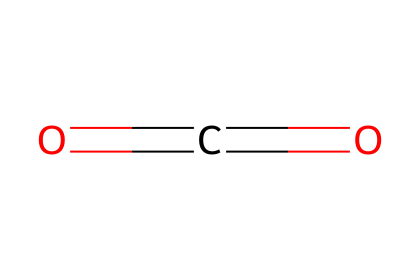
Carbon dioxide: product species in this decomposition pressure calculation.
Use this structure for two exam moves: justify that COX2 is non-polar because dipoles cancel along the linear axis, then return to the scoring step in this question (mole-to-pressure substitution with PV=nRT).
6 Experimental Contexts
Paper 4 planning tasks may include:
Determining molar volume by collecting gas over water; subtract water vapour pressure from the measured total pressure before using the dry gas pressure.
Using gas syringes to study rate of reaction (link to kinetics). Emphasise temperature control and pressure monitoring.
Vapour pressure data is provided in the question when needed (it is not listed in the SEAB Chemistry Data Booklet).
Always mention drying agents or cooling baths when accuracy demands water vapour or temperature corrections.
Dry-gas pressure checkpoint
When a gas is collected over water, the pressure in the container belongs to a mixture of the target gas and water vapour. Correct the pressure before substituting into PV=nRT.
Quantity in the question
What it represents
How to use it
Total pressure in the gas syringe or container
Target gas pressure plus water vapour pressure
Start here, but do not put this directly into PV=nRT.
Water vapour pressure at the stated temperature
Pressure contributed by evaporated water
Subtract it from the total pressure.
Dry-gas pressure
Pressure of the gas produced by the reaction
Use this as P in PV=nRT.
Worked check: if the total pressure is 101kPa and the water vapour pressure is 3.2kPa, then the dry-gas pressure is 101−3.2=97.8kPa. Convert this to 97800Pa before using PV=nRT with R=8.31J⋅K−1⋅mol−1.
Full mole route: if 250cm3 of the wet gas mixture is collected at 298K, first convert the dry pressure and volume:
Pdry=97800Pa,V=250cm3=2.50⋅10−4m3.
Then substitute only the dry-gas pressure into the ideal gas equation:
Misconception check: subtract water vapour pressure from pressure, not from volume. The collected volume still belongs to the gas mixture occupying the container.
7 Common Errors
Mixing units (for example, using dm3 instead of converting to m3).
Forgetting temperature in Kelvin.
Misreading “collect over water” and failing to subtract vapour pressure.
Assuming ideal behaviour at high pressures without commenting on possible deviations.
8 Quick Practice Drill
Calculate the density of nitrogen at 298K and 1.01×10⁵Pa using ρ=RTPM.
Two gases, OX2 and NX2
Given van der Waals constants, compare the pressures predicted for COX2 by the ideal-gas equation and by the corrected equation at 6.0 mol, 273 K, and 5.00 L. State whether the correction increases or decreases the predicted pressure.
Common exam mistakes
Using Celsius instead of Kelvin: Substituting temperature in °C into PV=nRT is one of the most common numerical errors; always convert T(K)=T(∘C)+273 before substituting.
Using dm³ instead of m³ for volume: The gas constant R=8.31J⋅K−1⋅mol−1 requires volume in m³; if the question gives volume in dm³ or L, divide by 1000 before calculating pressure in Pa.
Forgetting to subtract water vapour pressure: When gas is collected over water, the measured total pressure includes water vapour, so the dry gas pressure is total pressure minus water vapour pressure.
Assuming ideal behaviour at high pressure or low temperature: Stating that a real gas at high pressure behaves ideally, or failing to mention deviation direction, will lose explanation marks.
Mixing up the two van der Waals corrections: The a correction accounts for attractive forces (adds to pressure term); the b correction accounts for finite molecular volume (subtracts from volume term) - confusing the two gives wrong physical interpretation.
Inconsistent significant figures: Carrying only 2 s.f. through a multi-step calculation when the data has 3 s.f. loses the final answer mark even if the method is correct.
Frequently asked questions
What value of molar volume should I use at RTP and at STP? The SEAB Chemistry Data Booklet lists 24.0dm3⋅mol−1 at r.t.p. (25 °C, 1 bar) and 22.7dm3⋅mol−1 at s.t.p. (0 °C, 1 bar). Use whichever value matches the conditions stated in the question, or revert to PV=nRT if conditions differ.
When should I use the ideal gas equation versus the molar volume shortcut? Use n=V/Vm only when the question explicitly states r.t.p. or s.t.p. conditions. For any other temperature or pressure, use PV=nRT with the appropriate unit conversions.
How do I explain why a real gas deviates from ideal behaviour at high pressure? At high pressure, gas molecules are forced close together and their finite volume becomes significant (ideal gas assumes negligible particle volume). Additionally, intermolecular attractive forces are non-negligible at small separations, lowering the actual pressure below the ideal prediction. A complete answer names both effects.
Is kinetic molecular theory required for Paper 2? Yes. KMT assumptions underpin ideal gas behaviour. Questions may ask you to justify why an ideal gas has zero enthalpy of expansion (no intermolecular forces) or to explain Maxwell-Boltzmann distribution shifts with temperature changes in the context of reaction kinetics.
Struggling with The Gaseous State? Our H2 Chemistry tuition programme covers this topic with structured practice, Paper 4 practical drills, and worked exam solutions.