Q: What does H2 Chemistry Notes: Topic 5 - The Periodic Table cover? A: Topic 5 teaches how to use the Periodic Table to explain trends, Period 3 oxides and chlorides, Group 2 chemistry, and Group 17 chemistry. If you need the official A-Level Periodic Table PDF, use the SEAB Data Booklet guide; if you need revision notes, stay on this page.
TL;DR Periodic Table questions are comparison questions. State the trend, then explain it with nuclear charge, shielding, radius, bonding, structure, or electrode potential data from the Data Booklet when the question gives values.
Trends need reasons: Name the property and direction.
Most explanations use charge, distance, and shielding: Pick the controlling factor before writing.
Period 3, Group 2, and Group 17 questions need equations and comparisons: Link structure or bonding to the observation.
Concrete example: First ionisation energy generally increases across a period because nuclear charge increases while shielding stays similar. The electron is held more strongly.
Start here: choose the right periodic-table page
Searches for "A-Level periodic table" can mean two different tasks. Use this split before you revise.
Search intent
Use this page for
Use another page for
A-Level periodic table notes
Explaining trends across Period 3 and down Groups 2 and 17.
Not needed unless you only want the official PDF.
SEAB periodic table or 9476 Data Booklet
Seeing how periodic data supports trend explanations.
Periodic Table questions look like memorisation questions, but the marks usually come from matching the observation to the right explanation route. Use this map before writing.
Question cue
Start with
Explain using
Trap to avoid
Across-period or down-group trend
Direction of the property change
Nuclear charge, shielding, distance from nucleus, and subshell energy if relevant
Giving the trend direction without the controlling factor
Period 3 oxide behaviour
Structure and bonding of the oxide
Ionic, covalent, giant covalent, basic, acidic, or amphoteric behaviour
Calling aluminium oxide simply basic or insoluble without mentioning amphoterism
Period 3 chloride hydrolysis
Whether the chloride is ionic or covalent
Charge density, polarisation, water attack, and acidic products
Listing products without linking hydrolysis to bonding
Group 2 thermal stability or solubility
Cation size down the group
Polarising power, lattice energy, and hydration enthalpy
Saying "more reactive" when the question asks about decomposition or solubility
Group 17 oxidising or reducing strength
Electron gain or electron loss direction
Electronegativity, atomic radius, and standard electrode potential
Mixing up halogen oxidising strength with halide reducing strength
Periodic trends inform everything from bonding predictions to qualitative analysis.
This guide explains electron configuration roots of the trends, highlights compulsory case studies (Period 3 oxides and chlorides, Groups 2 and 17), and provides exam-ready examples.
Status: SEAB's current H2 Chemistry (9476) syllabus PDF is labelled for 2026, and the current Chemistry Data Booklet is labelled 8873/9476/9813 for use from 2026 in non-practical papers. Core Idea 2 Topic 5 is assessed across Papers 1-3.
Quick revision box
What this topic tests: Periodic trends, Period 3 chemistry, Group 2/17 reactivity patterns.
Top mistakes to avoid: Trend statements without shielding/radius logic; memorised facts without comparisons; weak oxide/chloride interpretation.
20-minute sprint plan: 5 min trend table recall; 10 min explain-and-compare questions; 5 min Group 2/17 reaction patterns.
1 General Periodic Trends
Property
Across a period (left → right)
Down a group
Key reasoning
Atomic radius
Decreases
Increases
Effective nuclear charge vs shell number.
Ionisation energy
Increases (with small dips)
Decreases
Stronger nuclear attraction vs increased shielding.
Electronegativity
Increases
Decreases
Attraction for bonding electrons.
Metallic character
Decreases
Increases
Ease of electron loss to form cations.
Explain anomalies: e.g. the drop in IE1 from Be to B arises from 2p vs 2s subshell energy.
Quote numerical data (atomic radii, first ionisation energies, standard electrode potentials) from the SEAB Chemistry Data Booklet or IUPAC tables when calculations or ranking require specific values.
2 Period 3 Oxides
Oxide
Structure/Bonding
Acid-base behaviour
Reaction with water
NaX2O
Giant ionic
Basic
NaX2O+HX2O2NaOH
MgO
Giant ionic
Basic (weaker due to lattice energy)
Slowly forms Mg(OH)X2
AlX2OX3
SiOX2
Giant covalent
Acidic (weak)
Insoluble; reacts with strong bases on heating.
PX4OX10
Molecular covalent
SOX2, SOX3
Exam pointer: Always link structure/bonding to acid-base behaviour. Mention amphoteric nature of Al2O3 explicitly and provide balanced equations when asked.
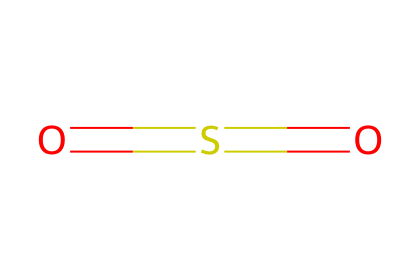
SO2: molecular Period 3 oxide with acidic behaviour.
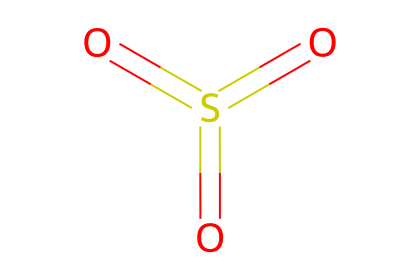
SO3: molecular Period 3 oxide and acid anhydride.
3 Period 3 Chlorides
Chloride
Hydrolysis in water
Resulting solution
NaCl, MgClX2
Dissociate without hydrolysis.
Neutral for NaCl; slightly acidic for MgClX2 due to hydrolysis of MgX2+
AlClX3
Hydrolyses strongly.
Acidic, releases HCl.
SiClX4
Violent hydrolysis.
Produces HCl and solid SiOX2
PClX3, PClX5
SX2ClX2
Relate hydrolysis extent to the nature of bonding (ionic vs covalent) and the high charge density/electrophilicity of covalent chlorides that makes them susceptible to water attack.
Chloride hydrolysis answer checkpoint
For Period 3 chloride questions, classify the chloride before writing products. The classification tells you whether to explain simple dissociation, cation hydrolysis, or nucleophilic attack by water.
Chloride type
First classification
What to explain
Common trap
NaCl
Ionic chloride of a low charge-density cation
Dissociation only; no significant hydrolysis of the ions.
Saying every chloride produces acidic solution because it contains chloride ions.
MgClX2
Ionic chloride with a higher charge-density cation
Hydrated MgX2+ can polarise water, giving slight acidity.
Treating it like a fully covalent chloride.
AlClX3
Chloride with high cation charge density and covalent character
Strong hydrolysis gives acidic solution and releases HCl.
Calling it neutral because aluminium is a metal.
SiClX4, PClX3
Misconception check: acidity in these chloride questions is not caused by free ClX− alone. It comes from hydrolysis that generates HX+ or HCl in water.
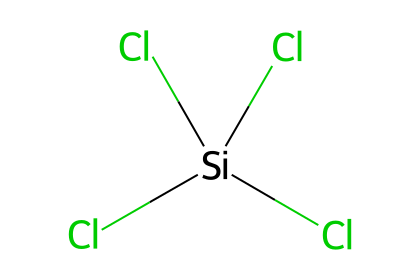
SiCl4: covalent chloride with vigorous hydrolysis.
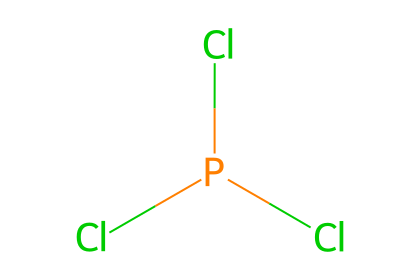
PCl3: covalent chloride hydrolysing to phosphorus acids.
4 Group 2 (Alkaline Earth Metals)
4.1 Physical and Chemical Trends
Atomic/ionic radius: Increases down the group; screening added shells.
Ionisation energy: Decreases; easier to form +2 ions.
Melting point: Generally decreases due to weaker metallic bonding as cation size increases (magnesium is an exception due to crystal structure).
Reactivity with water: Increases; from slow reaction of magnesium with cold water to vigorous reaction of barium.
4.2 Thermal Stability of Carbonates/Nitrates
Thermal stability increases down the group. Smaller cations (MgX2+) polarise the anion more strongly, facilitating decomposition. Provide balanced equations, e.g. MgCOX3MgO+COX2.
4.3 Uses in Papers
Explaining why CaO acts as a base in steel-making (ionic lattice).
Comparing solubility of hydroxides/carbonates using lattice energy vs hydration enthalpy.
Group 2 enthalpy comparison checkpoint
When Group 2 solubility or thermal stability appears, write the energy competition before deciding the trend. The question is usually asking whether the lattice becomes easier to break, whether hydration still compensates enough, or whether the anion is being polarised.
Question cue
First comparison to make
Direction to state
Common trap
Hydroxide solubility down Group 2
Lattice energy falls as the cation gets larger; hydration enthalpy also becomes less exothermic.
Hydroxides become more soluble when the fall in lattice energy matters more.
Saying bigger ions are always less soluble without comparing both terms.
Sulfate solubility down Group 2
The large SOX4X2− ion means lattice energy changes less sharply; hydration becomes less exothermic.
Sulfates become less soluble down the group.
Using the hydroxide trend for sulfates.
Carbonate or nitrate thermal stability
Smaller cations polarise the anion more strongly.
Stability increases down the group because larger cations polarise less.
Explaining decomposition with solubility language instead of polarisation.
Worked check: Mg(OH)X2 is less soluble than Ba(OH)X2 because MgX2+ gives a stronger lattice that is harder to overcome. For MgSOX4 versus BaSOX4, the decreasing hydration enthalpy down the group dominates more strongly, so BaSOX4 is less soluble.
Misconception check: do not memorise one Group 2 solubility direction and reuse it everywhere. Hydroxides and sulfates move in opposite directions because the lattice-energy and hydration-enthalpy balance is different.
5 Group 17 (Halogens)
5.1 Reactivity and Oxidising Strength
Fluorine strongest oxidising agent due to high electronegativity and small atomic radius (reflected in the highest standard electrode potential in the SEAB Chemistry Data Booklet).
Down the group, oxidising power decreases (standard electrode potentials fall); conversely, halide ions' reducing ability increases.
5.2 Disproportionation
Know key reactions:
ClX2+2OHX−ClX−+ClOX−+HX2O
In hot concentrated NaOH:
3ClX2+6OHX−5ClX−+ClOX3X−+3HX2O
Explain by citing chlorine's intermediate oxidation states (0,+1,−1, or +5).
5.3 Halide Reaction with H2SO4
Halide
Observation
Reason
ClX−
Produces HCl only.
Weak reducing agent.
BrX−
Produces SOX2, BrX2
Moderate reducing strength.
IX−
Produces SOX2
6 Worked Example
Question:
Describe and explain the change in the pH of solutions formed when NaX2O, AlX2OX3, and SiOX2 are added separately to water.
Solution:
NaX2O: Ionic oxide reacts with water to form NaOH; solution becomes alkaline (pH>7, potentially strongly alkaline depending on concentration). Explanation: OX2− ions attract protons to produce OHX−.
AlX2OX3: Insoluble; amphoteric but does not change pH
SiOX2: Giant covalent oxide; insoluble; no appreciable pH change. Provide reasoning about the covalent network resisting hydrolysis.
If the question switches medium, show amphoterism explicitly: AlX2OX3+6HX+2AlX3++3HX2O in acid and AlX2OX3+2OHX−+3HX2O2[Al(OH)X4]X− in alkali.
Organise answer by oxide type, then state pH outcome and justification referencing bonding and acid-base nature.
7 Practical Angles
Paper 4: Qualitative analysis questions often rely on Group 2 and Group 17 trends (e.g. flame tests, precipitation with silver nitrate). When planning experiments, specify reagents and expected observations (colour, precipitate, gas).
Investigations: Expect to justify using chlorine water vs bromine water as oxidising agents in halide tests, referencing standard electrode potentials from the SEAB Chemistry Data Booklet.
8 Common Misconceptions
Confusing amphoteric oxides (AlX2OX3, ZnO) with simple metal oxides.
Claiming MgO is soluble; stress sparing solubility due to high lattice energy.
Forgetting to mention oxidation states in disproportionation explanations.
Describing reactivity trends without referencing atomic/ionic radius and shielding.
9 Practice Drill
Write balanced equations and describe observations when chlorine reacts with cold and hot NaOH.
Compare the solubility of Mg(OH)X2 and Ba(OH)X2 using lattice and hydration enthalpy arguments.
Predict products when Mg reacts with steam and with cold water; include temperature conditions and discuss relative rates.
Common exam mistakes
Explaining trends without mentioning shielding: Saying "nuclear charge increases across the period" alone is insufficient; examiners expect you to also address shielding and effective nuclear charge for full explanation marks.
Treating MgO as readily soluble: Students often assume all Group 2 oxides dissolve freely in water; MgO has limited solubility because its high lattice energy resists hydration - state this explicitly.
Forgetting oxidation states in disproportionation answers: Disproportionation questions require you to identify both the oxidation and reduction half-reactions; omitting oxidation state changes from the explanation loses marks.
Confusing Period 3 chloride hydrolysis products: PClX3 hydrolyses to HX3POX3 while PClX5 gives HX3POX4; using the wrong acid product is a common factual error.
Misidentifying amphoteric oxides: Only AlX2OX3 (and ZnO
Giving trend direction without reference to group or period: Always specify whether the trend is across a period or down a group; ambiguous answers cannot be credited.
Omitting balanced equations for Group 2 or Group 17 reactions: Observations alone are insufficient when the question says "describe and explain"; balanced equations, including state symbols, are usually required.
Frequently asked questions
Why does ionisation energy not increase smoothly across Period 3? There are two notable dips: from Na to Mg to Al (IE₁ drops at Al because its outer electron is in the higher-energy 3p subshell vs the 3s of Mg), and from P to S (IE₁ drops at S because pairing an electron in the 3p subshell introduces extra repulsion, making it easier to remove). These anomalies are a standard Paper 2 explanation target.
What is the difference between a basic oxide and an acidic oxide? Basic oxides (typically formed by metals) react with acids to form a salt and water and may dissolve in water to give alkaline solutions. Acidic oxides (typically from non-metals) react with bases and dissolve in water to give acidic solutions. Amphoteric oxides such as AlX2OX3 react with both acids and bases.
How do I explain why fluorine is the strongest oxidising agent in Group 17? Fluorine has the highest electronegativity and smallest atomic radius, so it attracts electrons most strongly. Its standard electrode potential is the most positive in the halogen series (Data Booklet). Combining these points - high electronegativity, small size, strong attraction for electrons - constitutes a complete explanation.
Are Group 2 solubility trends tested directly? Yes. The increasing solubility of Group 2 hydroxides down the group (and decreasing solubility of sulfates) is regularly tested. Explain both trends using a competition between lattice energy and hydration enthalpy; when hydration enthalpy decreases less steeply than lattice energy, solubility falls (sulfates), and vice versa (hydroxides).
Struggling with The Periodic Table? Our H2 Chemistry tuition programme covers this topic with structured practice, Paper 4 practical drills, and worked exam solutions.