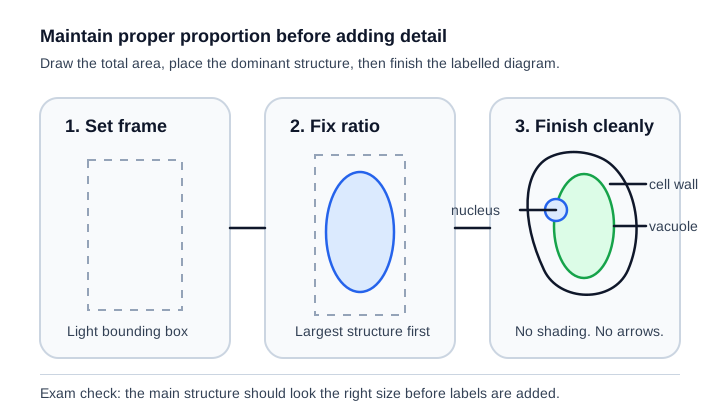
TL;DR To maintain proper proportion in a biological diagram, sketch the total drawing area first, estimate the main size ratios, then place the largest structure before adding smaller details. Biological diagrams are technical records, not art -- examiners award marks for accurate proportion, clean outlines, and correct labelling, not for shading or colour. There are five criteria that distinguish a full-mark diagram: single continuous lines, no shading, correct proportion, ruler-drawn label lines touching the structure, and no arrowheads. The most common mark losses are drawing the nucleus too large, omitting the cell wall in plant cells, shading to show organelles, and placing labels inside the boundary of the structure.
Eclat keeps centre-held attendance records and may issue an internal attendance or completion document based on participation and internal assessment.
For SEAB private-candidate declarations, the centre record is the key evidence. Any Eclat completion document is not an MOE or SEAB qualification or accreditation.
Concrete example: For a palisade cell, draw the large vacuole first because it controls the proportion of everything else. The best next step is to practise one diagram using a faint bounding box before drawing the final outline.
Use this as a visual checklist before you start the final drawing. If the biggest structure is the wrong size at Step 2, the finished diagram will still lose proportion marks even if the labels are neat.
1 | Why biological diagrams are marked differently from art
When you draw a diagram in an art class, shading, texture, and personal interpretation are rewarded. In O-Level Biology Paper 3, the opposite is true. A biological drawing is a scientific record. Its job is to communicate the size relationship between structures and to identify each part by name so that another biologist could reproduce what you observed.
The SEAB 6093 mark scheme credits diagrams on three grounds: whether the proportions between structures are correct, whether the outlines are clean enough to be unambiguous, and whether the labels identify the correct structures using accepted biological terminology. Artistic merit is irrelevant. A pencil drawing with no shading and accurate proportion will outscore a visually impressive coloured sketch every time.
This has a practical consequence: the skills that earn marks in biology diagrams are learnable and consistent. Unlike free-response questions where the exact wording varies, diagram marks follow the same five criteria across every specimen and every year.
2 | The five examiner-mark criteria
Every biological drawing in Paper 3 is assessed against five criteria. Learn them once and they apply to every diagram you ever draw.
Criterion
What it means
Common mistake
Clean single continuous lines
Each boundary is drawn with one smooth, unbroken stroke. No feathering, no sketchy repeated marks, no jagged edges.
Drawing the cell membrane as a series of short dashes, or going over the same line multiple times to "thicken" it.
No shading or sketching
Structures are defined by outline only. No cross-hatching, no pencil tone, no colour.
Shading the nucleus to make it stand out, or colouring the cytoplasm differently from the vacuole.
Correct proportion
The relative sizes of structures match what is seen in the specimen. To maintain proper proportion in a biological diagram, the dominant structure must occupy the correct fraction of the total cell area.
Drawing the nucleus as large as the whole cell, or making the vacuole the same size as the nucleus in a plant cell.
Ruler-drawn label lines touching the structure
Each label line is drawn with a ruler, runs to the boundary of the structure, and ends at the structure (not floating above it).
Freehand curved lines, lines that point vaguely into the middle of the cell rather than touching the structure boundary.
No arrowheads on label lines
Label lines end at the structure with no arrowhead. Arrowheads imply direction of movement and are reserved for process diagrams.
Adding small triangular tips to every label line because it "looks more scientific".
3 | How to maintain proper proportion
Short answer: maintain proper proportion by fixing the biggest spatial relationship before drawing detail. Decide how much of the total cell is occupied by the dominant structure, such as the vacuole in a plant cell or the nucleus in an animal cell, then draw the outline and labels around that ratio.
3.1 | Why proportion is the most-penalised criterion
Of the five criteria, proportion attracts the most marking deductions. An examiner looking at your diagram asks one question first: does the nucleus look roughly the right size relative to the cytoplasm? If the nucleus fills three-quarters of the cell when it should fill roughly one-quarter, that is a proportion error regardless of how neatly the lines are drawn.
The key to maintaining proper proportion in a biological diagram is to fix the spatial relationships before you draw any detail. Most students do the opposite: they draw the outline, then fit organelles into whatever space is left. That approach makes proportion errors almost inevitable.
3.2 | A four-step proportion method
Step 1: Estimate the ratio from the specimen.
Before you touch paper, look at the specimen or diagram and estimate one ratio: what fraction of the total cell area does the largest single structure occupy? For a typical animal cell under the microscope, the nucleus occupies roughly one-quarter to one-third of the total cell area. For a palisade mesophyll cell, the large central vacuole occupies the majority of the interior, pushing the chloroplasts and nucleus to the periphery.
Step 2: Draw a lightly pencilled bounding box.
Draw a faint rectangle that represents the maximum area your finished diagram will occupy. All subsequent proportions will be measured relative to this box. This step forces you to commit to a total size before any structure is drawn.
Step 3: Block in major subdivisions before details.
Divide the bounding box using the ratio from Step 1. If the nucleus occupies one-third of the cell area, lightly pencil in a nucleus circle that covers one-third of the cell interior before you draw the cell membrane in its final form. If the vacuole dominates, sketch its boundary first. Then fit the remaining structures around these anchor positions.
Step 4: Check the dominant structure fraction before inking your final lines.
Before committing to your final pencil lines, stand back and compare the dominant structure to the overall cell. If you are drawing an animal cell, the nucleus should look noticeably smaller than the cytoplasm. If you are drawing a plant cell, the vacuole should dominate the interior. Only proceed once the proportions match your Step 1 estimate.
3.3 | Worked example: palisade mesophyll cell
A palisade mesophyll cell is elongated -- roughly two to three times taller than it is wide. The large central vacuole occupies most of the interior. Chloroplasts are small, roughly oval, and distributed near the periphery of the cytoplasm. The nucleus is roughly the same size as a chloroplast or slightly larger, and sits just inside the cell membrane.
When you apply the four-step method:
Ratio: vacuole = roughly 60-70% of the interior; nucleus = roughly the same area as one chloroplast.
Draw a tall, narrow bounding box with roughly 2.5:1 height-to-width ratio.
Sketch the vacuole boundary first -- it should fill most of the box interior, leaving only a thin layer of cytoplasm between the vacuole boundary and the cell wall.
Add chloroplasts (small ovals) in the cytoplasm layer, then the nucleus (slightly larger oval) adjacent to the vacuole boundary.
The completed drawing should show a cell where the vacuole clearly dominates and the chloroplasts read as small peripheral structures. If the chloroplasts look as large as the vacuole, the proportion is wrong.
4 | Labelling rules
Labels communicate identity. A diagram with correct proportion but no labels earns zero marks for that section of the mark scheme. Follow these rules for every diagram.
Use a ruler for every label line. Freehand lines are penalised. The ruler ensures the line runs straight from the label word to the structure boundary.
Touch the boundary of the structure, not the interior. The label line should terminate exactly at the outer edge of the structure you are identifying. A line that ends inside the nucleus and another that floats above the cell wall both indicate ambiguity about which structure is being labelled.
No arrowheads. A plain line ending at the structure is correct. An arrowhead implies direction and belongs on process diagrams (e.g. diffusion arrows, blood flow diagrams), not on structural labels.
Keep labels horizontal and on one side where possible. Where space allows, place all labels on the right side of the diagram with their label lines running horizontally. This produces a clean, readable result. In complex diagrams with many structures, two sides are acceptable, but consistency within each side is expected.
Label outside the diagram boundary. Never write a label word inside the structure it identifies. The word should be outside the cell outline, with the ruler line connecting it to the structure.
Lines must not cross. If two label lines cross each other, it creates ambiguity about which line connects to which label word. Reorder your labels or adjust their positions to eliminate crossing lines.
Use the correct biological term. The mark scheme credits specific biological vocabulary. "Cytoplasm" is correct; "jelly" is not. "Cell sap" or "vacuole with cell sap" is correct; "water" is not. "Cell wall" is correct; "outer layer" is not. When in doubt, use the term from the SEAB 6093 syllabus glossary.
Diagram tuition checkpoint
Use this after one timed drawing. It tells you whether the problem is observation, proportion, line discipline, or biological vocabulary.
What the teacher marks down
What it means
Next drill
The main structure is too large or too small
Proportion was not fixed before details
Draw the bounding box and dominant structure first.
Lines are sketchy or shaded
The drawing is being treated like art
Redraw with one clean outline per boundary and no tone.
Label lines float or use arrowheads
Labelling convention is weak
Use ruler lines that touch the structure and stop without arrowheads.
Correct drawing, wrong label term
Biology vocabulary is not secure
Replace informal terms with syllabus terms before redrawing.
For Sec 3-4 students who need regular feedback on diagrams, Paper 2 phrasing, and Paper 3 practical routines, use O-Level Biology tuition as the primary class-support route.
5 | Specialised cells: the six diagrams you must be able to draw
The 6093 syllabus tests a recurring set of specialised cells under Paper 3 drawing conditions. For each cell, know the defining proportion and the key structure that makes it recognisable.
Cell
Key structures to show
Defining proportion
Palisade mesophyll cell
Cell wall, cell membrane, large central vacuole, chloroplasts (peripheral), nucleus
Tall and narrow (2.5:1 ratio); vacuole dominates; chloroplasts small and peripheral
Root hair cell
Cell wall, cell membrane, large vacuole, nucleus, root hair extension
Cell hair extension is at least as long as the cell body; no chloroplasts
Red blood cell
Biconcave disc outline (two curved edges meeting at a thin centre region); no nucleus
No nucleus; edge is thicker than the centre region; circular plan view
Sperm cell
Head (containing nucleus + acrosome), midpiece (mitochondria), long tail (flagellum)
Tail is several times longer than the head; head is small and streamlined
Nerve cell (motor neurone)
Cell body with nucleus, dendrites, long axon, myelin sheath, axon terminals
Axon is many times longer than the cell body; cell body is small relative to total length
Ciliated epithelial cell
Cell membrane, nucleus (near base), cilia (fine projections from the apical surface)
Cilia are short relative to cell height; nucleus sits in the lower third of the cell
These specialised cells exemplify how function determines form. The root hair cell's extension maximises surface area for water absorption; the sperm cell's long tail provides motility. When you draw any specialised cell, the proportion of the adaptation structure (hair extension, tail, axon, cilia) relative to the cell body communicates that function to the examiner.
6 | Plant cell vs animal cell: the proportion difference
Questions about drawing a plant cell vs animal cell diagram test whether you know which features are exclusive to each cell type and how those features alter the proportional layout.
Feature
Plant cell
Animal cell
Cell wall
Present -- outermost boundary; draw as a thick double line outside the membrane
Absent -- cell membrane is the outermost boundary; draw as a single thin line
Large central vacuole
Present -- dominates interior, pushes cytoplasm to a thin peripheral layer
Absent -- small vacuoles may be present but are not drawn as a dominant structure
Chloroplasts
Present (in photosynthetic cells) -- small ovals in the peripheral cytoplasm
Absent
Nucleus position
Often peripheral, displaced by the vacuole
Approximately central, or slightly off-centre
Proportion of cytoplasm visible
Thin layer between vacuole boundary and cell wall
Cytoplasm fills the majority of the cell interior
Centrioles
Absent
Present (usually not shown unless specifically asked)
The vacuole is the structural key. In a plant cell, the vacuole occupies most of the interior, so the cytoplasm is a thin layer and the nucleus appears pushed against the cell wall. In an animal cell, the cytoplasm fills the majority of the drawing and the nucleus appears as a large, roughly central oval. If you draw an animal cell with a dominant vacuole or a plant cell where the cytoplasm fills the interior, you have made a proportion-category error.
7 | Common mistakes that lose marks
The following mistakes account for the majority of diagram mark deductions in O-Level Biology Paper 3. Each one has a straightforward fix.
Shading to show a structure. You shade the nucleus because you want it to stand out. Fix: define every structure by outline only. If the outline is clear, shading adds nothing and costs marks.
Drawing the nucleus too large in an animal cell. The nucleus fills half the cell or more. Fix: the nucleus should occupy roughly one-quarter to one-third of the cell interior. Block it in at the start using the bounding-box method.
Omitting the cell wall in a plant cell. The outermost boundary looks like a single thin line identical to the cell membrane. Fix: the cell wall is drawn as a thicker or double line outside the cell membrane. Both the cell wall and the cell membrane must be visible as distinct boundaries.
Arrowheads on label lines. Every label line ends in a small triangle. Fix: remove all arrowheads. The line simply terminates at the structure.
Labels placed inside the diagram. The label word sits inside the structure, with no line. Fix: every label word is outside the cell boundary, connected to the structure by a ruler-drawn line.
Label lines not touching the structure. The line ends a few millimetres short of the boundary. Fix: extend each label line until it makes contact with the outer edge of the structure. Floating lines are ambiguous.
Label lines crossing. Two lines intersect. Fix: reorder labels so that lines to adjacent structures do not cross. If necessary, add labels on both sides of the diagram.
No title or magnification. The diagram is drawn but not annotated with a title (e.g. "Palisade mesophyll cell as seen under high power of a light microscope") and no magnification or scale bar. Fix: add a title below the diagram. If magnification is required by the question, calculate it from the observed size and the actual size, and write it as a ratio (e.g. x400).
Using "water" instead of "vacuole with cell sap". The structure is labelled "water" or "liquid centre". Fix: the correct term is "vacuole" or "vacuole containing cell sap". The word "water" on a label line will not receive a mark.
Sketchy repeated pencil marks. The outline is drawn by going over the same boundary line multiple times to get a smooth edge. Fix: practise drawing a single confident stroke. If the first line is wrong, erase it completely and redraw. Multiple overlapping strokes are penalised as "sketching".
8 | Practice exam prompts
Use these prompts for timed practice. For each one, allow 5--8 minutes, then check your diagram against the five criteria in Section 2.
Draw and label a palisade mesophyll cell as seen under the high power of a light microscope. Show at least four structures. Include the magnification.
Draw and label an animal cell (such as a cheek epithelial cell) as seen under the high power of a light microscope. Show the cell membrane, nucleus, and cytoplasm. Your diagram must be drawn to correct proportion.
Draw and label a root hair cell. Show how its structure is adapted for the absorption of water by osmosis.
Draw a motor neurone and label the following structures: cell body, nucleus, axon, myelin sheath, axon terminals. Your diagram must show correct proportion between the axon length and the cell body.
For each practice attempt, check: (a) are all lines single and continuous? (b) is there any shading? (c) does the dominant structure occupy the correct fraction of the frame? (d) are all label lines drawn with a ruler and touching their structure? (e) are there any arrowheads?
For structured support with biological diagrams, cell biology, and the full range of Paper 3 practical skills, visit our O-Level Biology Experiments hub for topic-specific walkthrough posts, or speak to a teacher directly through our O-Level Biology tuition page.