P
Planning
Hypothesis, controls, data plan for enzyme or transport investigations.
Name the dependent and at least two independent variables you'll vary.
Loading page…


Loading blog content…
Practise H2 Biology lab routines, microscopy, and data work with guidance, then use the archive and timed sessions to prepare for Paper 4.
Last updated: 2026-08-06
Source: 2026 SEAB 9477 syllabus (PDF)
Hypothesis, controls, data plan for enzyme or transport investigations.
Name the dependent and at least two independent variables you'll vary.
Microscope calibration, biological drawing, transport and enzyme technique.
Calibrate the eyepiece graticule before any measurement - log the scale.
Drawings with scale, tables with units, processed rate calculations.
Always include the magnification formula on biological drawings.
Statistical reasoning, biological interpretation, defendable refinements.
Tie each conclusion to a biological mechanism, not just the trend in your graph.
Paper 4 is weighted 20% of the A-Level grade.
The H2 Biology practical programme is staged to build microscopy discipline first, then data-heavy biology investigations, and finally full-paper judgement.
Microscopy and biological drawings · Basic nutrient and food tests · Observation recording with the correct biological language
Students can handle microscope-based questions and produce cleaner practical records before the paper becomes more data-heavy.
Serial dilution routines · Enzyme investigations · Substrate-concentration and protein tests
Students can set up rate-based biology practicals more confidently and explain how the variables are being controlled.
Respiration investigations · Osmosis and yeast-cell work · Antibiotic and bacteria-style analysis
Henderson Road
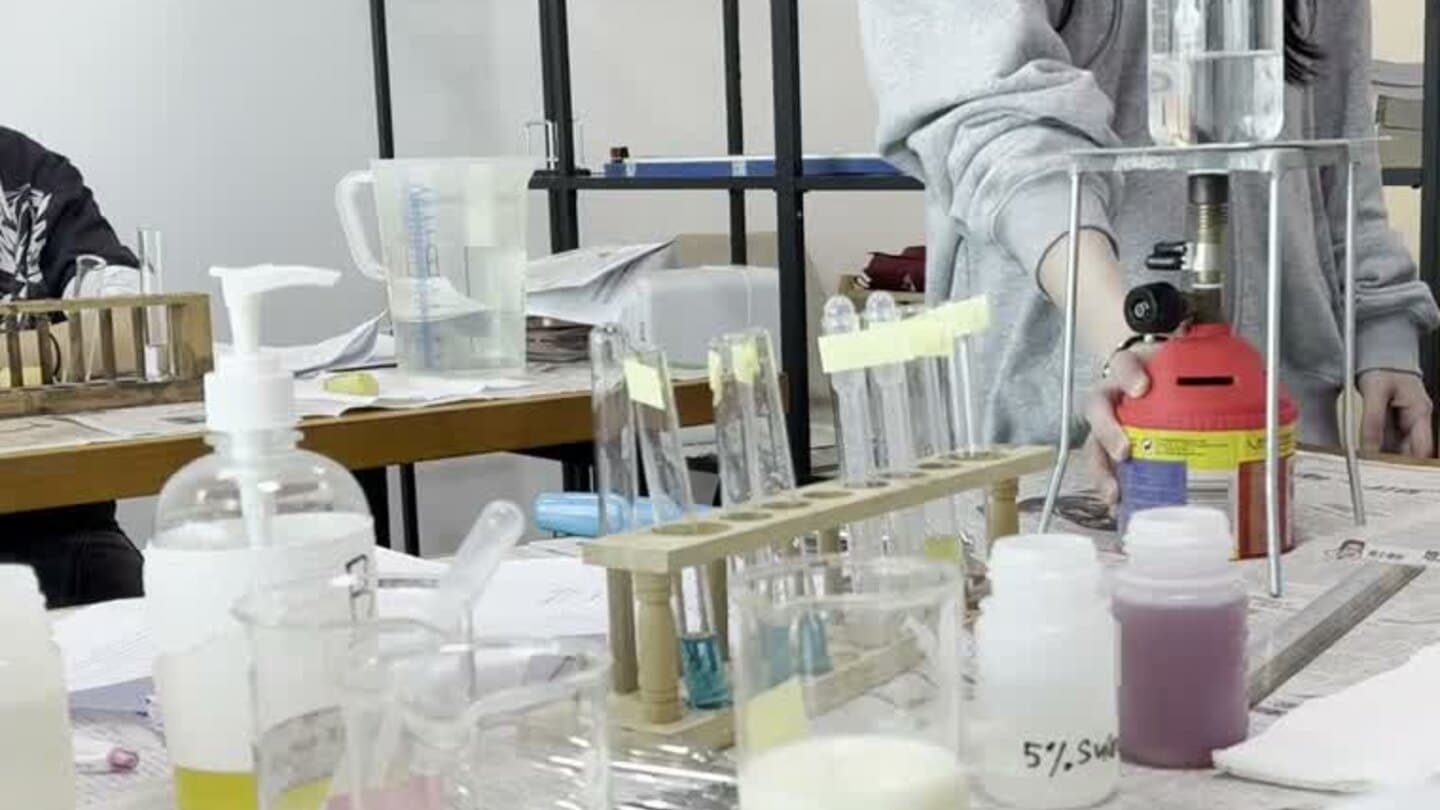
Our Henderson Practical Lab is a full laboratory for Chemistry, Physics, and Biology practical work, not an ordinary classroom.
General timings only, not a list of available classes. Dates, topics, venue and places must be confirmed before booking.
Open only the route that matches your next decision.
SEAB states that private candidates for science subjects with laboratory-based components must either have sat the same subject before, or attend a course of instruction in science practical and complete it before the practical paper.
Eclat’s practical sessions provide supervised lab training plus centre-held attendance records. Where relevant, we may also issue an internal attendance or completion document, but the SEAB-facing requirement is the declaration supported by the centre’s records.
Paper 4 lasts 2 h 30 min, carries 50 marks, and contributes 20% of the H2 grade. It weaves together apparatus-based work and data interpretation across the P, MMO, PDO, and ACE skill strands.
Planning carries 4% of the marks under the 9477 syllabus. The remaining 16% assesses MMO, PDO, and ACE.
Yes. The 9477 syllabus emphasises microscope calibration, drawing conventions, enzyme kinetics, transport studies, photosynthesis or respiration rate work, and ecological sampling.
For practical, lab, and experiment courses, Eclat Institute keeps centre-held attendance records and may also issue an internal attendance or completion document based on participation and internal assessment.
Official references: MOE private-school certificate guidance · SEAB practical requirement for private candidates · SEAB registration declaration note.
Students can interpret the result in a new biological setting and choose sensible next steps when the question changes context.
Enzyme and dilution planning questions · Microscopy plus data-analysis combinations · Timed H2 Biology practical runs
Students can move through H2 Biology practical questions with clearer structure, stronger evaluation language, and better time control.
Justify procedure choices and quantify risks before any apparatus is touched.
Zero-error checks, repeat readings, and timing discipline under Paper 4 pacing.
Live graphing with gradient units, intercepts, and uncertainty bands.
Reconcile anomalies, argue limitations, and recommend defendable improvements.
Timings last updated: 17 July 2026. Confirm the venue and exact session before travelling.
A-Level: SGD $210 - $290 per lesson
Contact us to learn more about our tailored packages and available pricing options.
Tell us the student's school, JC level, next assessment, and whether microscopy, Planning, PDO, or ACE is the main concern. We will check whether a scheduled lab group or a focused practical intensive fits better.
WhatsApp opens a private enquiry with our team; it does not mean the lesson itself is one-to-one.
“Browse student discussions”
r/SGExams: H2 Biology practical search
Each guide includes template tables and graph prompts for processing raw readings, plotting calibration curves, calculating rates, and presenting results clearly before the exam window.
Yes. Biological drawings remain part of Paper 4, with marks awarded for proportion, sharpness, labels without crossing arrows, and the magnification formula.
Use the archive when you want a specific microscopy, biological drawing, enzyme, photosynthesis, planning, or ACE guide.