

Lab safety starts before the experiment
A lab can feel strange when you are new to practical work. There is apparatus to set up, steps to follow and something to watch or measure, sometimes while you are still working out what the experiment is meant to show.
Safe practical work starts with understanding the setup, the steps and the aim before you begin. Teachers also have a duty to explain the risks and to supervise the work. ACS school safety guidance and NUS guidance on supervised practical teaching both put preparation and adult responsibility at the centre of practical lessons.
At Eclat, our trainers do not assume that students will remember an earlier explanation. Students may be new to practical work, lose focus or forget an instruction. At the start of every practical, trainers explain the setup, the steps and the aim, going through each step in detail. During the experiment, they watch closely, and when a student does not follow a safety step, by mistake or not, they bring them back on track, gently but firmly.
What to understand before you start
Before you start, ask yourself:
- What is this experiment trying to find out?
- What does each piece of apparatus do?
- Which steps need extra care?
- What should I do if the setup or result is not what I expected?
You do not need to pretend you understand. If you cannot explain an important step, pause and ask the trainer to go through it with you. Serangoon Garden Secondary School's published laboratory rules tell students not to carry on when instructions are unclear.
Knowing the aim also helps you follow the steps with a purpose. You know which reading or observation matters, instead of rushing through steps without knowing why they are there.
Your trainer keeps watching while you work
A safety briefing is only the start. During the experiment, a trainer needs to watch how students use the apparatus, notice when someone stops following the steps and step in when needed. NUS's teaching guidance describes supervising and correcting students as responsibilities of teaching a practical.
When a trainer corrects you, the next step should be clear. If you are told to pause or to handle something differently, stop and listen. Ask again if the instruction is not clear.
A quiz or a signed safety sheet can introduce the rules. It cannot show everything a student will do at the bench, and it does not replace supervision while the experiment runs.
Safety starts before you arrive and ends after cleanup
Much of the work happens before students arrive. Materials have to be identified and prepared, equipment checked, and the lesson planned so that it can be supervised properly. The technician and the trainer need to tell each other about changes, faults and what will be left over afterwards. MOM's risk-management guidance supports assessing risks beyond the usual routine task.
The practical is not finished when you have your result. Follow the trainer's cleanup and disposal instructions, report damaged equipment and ask before you handle anything unfamiliar. Where waste goes depends on what is in it and on the arrangements the lab has approval for. Singapore's PUB trade-effluent requirements are one reason there cannot be a simple rule that lab liquids may go down the sink.
Report a mistake or anything unexpected straight away. The adults need to know so they can decide what happens next. Do not hide a broken item, make your own fix or change a result to make the experiment look successful.
Six questions to keep in mind
Ask yourself these six questions before, during and after the experiment:
- Know: Do I understand the setup, the steps and the aim?
- Minimise: Am I using only the amounts and conditions I was given?
- Separate: Am I keeping materials and work areas apart, as I was told or shown?
- Contain: Am I using the equipment and safeguards approved for this task?
- Monitor: Have I noticed anything that means I should pause and ask?
- Be ready: Do I know how to get the trainer's attention, and what the trainer has said to do if something goes wrong?
Some questions belong to more than one stage. For example, you need to be ready for an emergency before the experiment starts. The prompts are for learning, not a certificate or permission to change the method yourself. The adults stay responsible for assessing the activity and choosing the right safeguards.
An example: comparing how two containers cool
Imagine a supervised lesson comparing how two containers of warm water cool. The aim is to compare the two setups under the same conditions, not to prove that one insulating material is always best. IOP's cooling activity uses insulation and temperature probes; its equipment and preparation are specific to that activity. The trainer chooses the containers, materials, water conditions and preparation for your lesson.
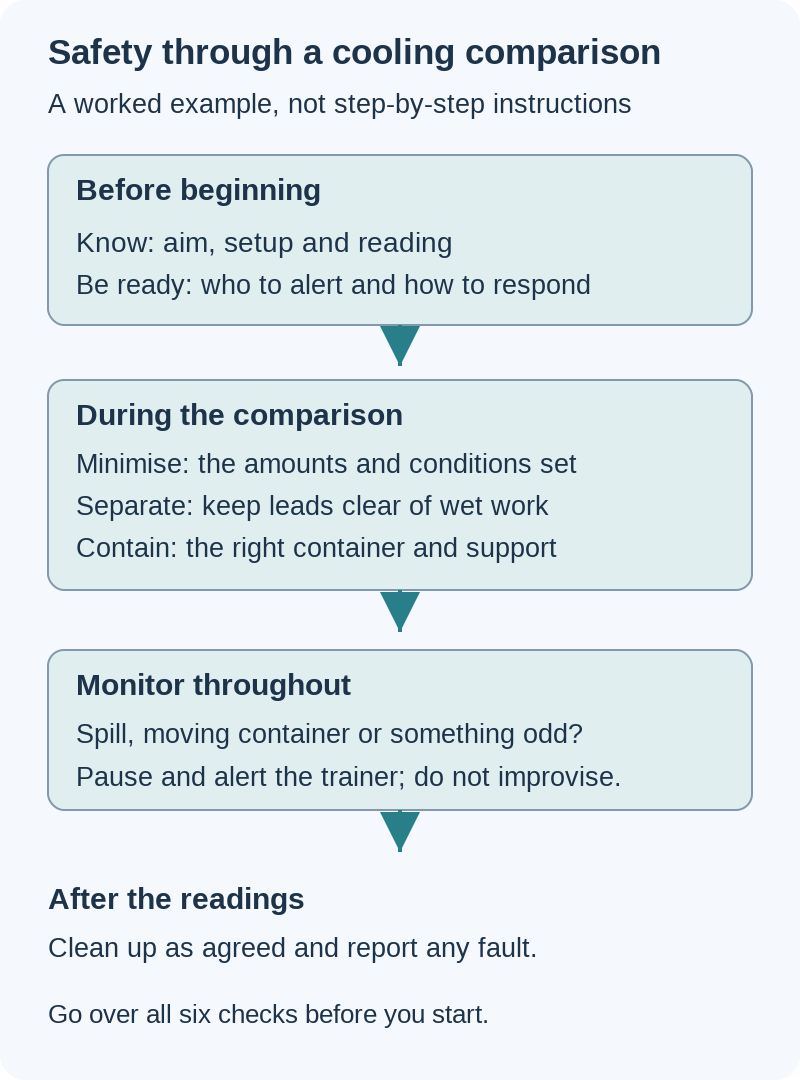
The diagram shows when each question matters: being ready comes before the first reading, and monitoring carries on into cleanup. It gives no temperature, amount of water, protective-equipment choice or first-aid steps; those belong to the lesson's own risk assessment and briefing.
Before you start, say what you will record, when you will record it and which conditions must stay the same (know). Check who to tell, how to get their attention and what you have been told to do if something goes wrong (be ready).
During the comparison, use the amount of water and starting conditions you are given. Using hotter water to speed up the lesson would change both the task and its risks: hotter water can scald. That is why minimise means sticking to the conditions you were given, not choosing your own smaller or larger amounts. Keep leads and dry equipment away from the wet work, as you were told or shown (separate), because water should be kept away from leads, sockets and other electrical parts. Use the container and the stand or support you are given (contain). A container that gives a temperature reading can still be the wrong one, or unsteady.
Keep watching the setup, not just the numbers. A spill, a container that moves or a probe that shifts is a reason to pause and tell the trainer (monitor). Do not reach out to catch a falling container or move unfamiliar hot equipment to save the result; grabbing at a falling container or hot equipment can easily cause cuts and burns. A probe that has moved may also be measuring a different part of the water. The trainer decides whether and how the activity can carry on; write down the interruption instead of treating the run as if nothing changed.
After the readings, follow the cooling, packing-away and cleanup steps you are given. Report a spill or a damaged part even if the comparison still gave a useful result. The technician and the trainer need to know before the equipment is used again.
For more on the measurements, see the insulation guide and the temperature-probe guide. The same six questions can help plan other briefings, but the answers and safeguards have to be worked out for each experiment. A chemical reaction or an investigation with living things needs its own risk assessment and method.
What a certificate tells you
A certificate covers only what it says it covers. An SCDF Fire Safety Certificate covers completed fire-safety works. It does not assess every experiment, how well a student has prepared or how a trainer supervises.
The Henderson laboratory page shows the venue's Fire Safety Certificate and explains what it covers. Students and parents can ask what each document covers, and how the adults prepare, supervise and finish a practical.
To explore practical lessons, see our IP science practical programme, or ask us about the subject and practical work you need help with.
Sources
- https://spark.iop.org/slower-cooling
- https://www.acs.org/education/policies/middle-and-high-school-chemistry/safety.html
- https://chemistry.nus.edu.sg/health-safety/more-safety-information/personnel-responsibilities/supervised-practical-teaching/
- https://www.sgs.moe.edu.sg/students/safety-guidelines/science-laboratories-safety-rules/
- https://www.mom.gov.sg/workplace-safety-and-health/safety-and-health-management-systems/risk-management
- https://www.pub.gov.sg/Professionals/Requirements/Used-Water/Trade-Effluent/Written-Approval
- https://www.scdf.gov.sg/fire-safety-services-listing/plans-submission-process/fire-safety-certificate-temporary-fire-permit