Optics
Converging lenses, focal length, ray alignment, prisms, refraction, and recording repeatable image or angle measurements.
Loading page…


Loading blog content…
Practise measurements, circuits and graphs in Years 3 to 4, with guided experiments and timed mocks matched to your school’s topics.
Henderson · Jurong East · Orchard for Physics
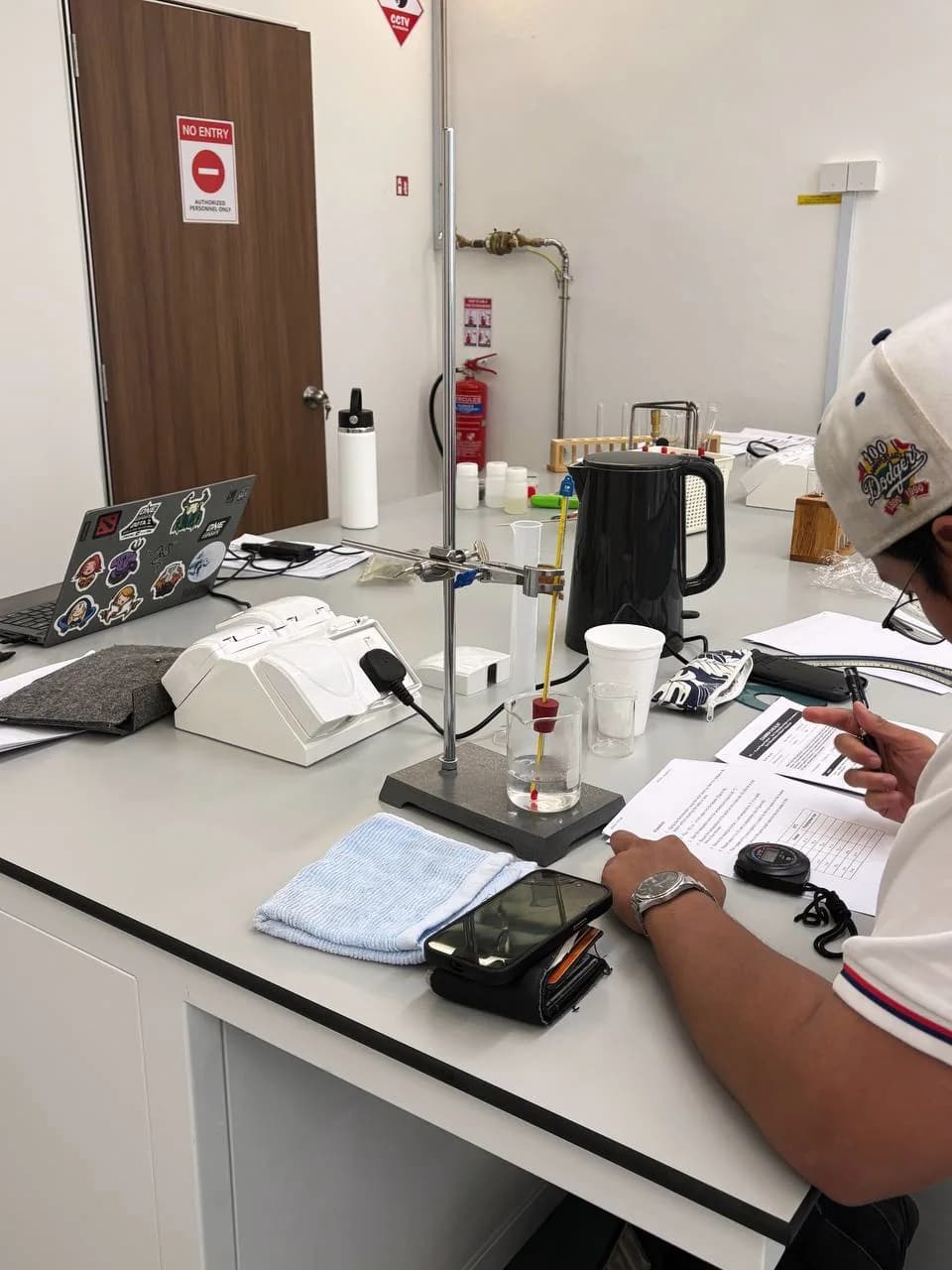
Practise using apparatus, taking readings, making tables and graphs, and explaining measurement uncertainty. For regular theory lessons following school topics, see IP Physics tuition.
Send us the student's school, year, current topic, and instructions for the next practical weighted assessment (WA). We will check which experiments and equipment fit the task. Schools teach topics in different orders, so the examples below are not a fixed Year 1 to Year 4 syllabus.
The chosen experiment should match the student's current school topic or the practical notice issued for the next WA.
Converging lenses, focal length, ray alignment, prisms, refraction, and recording repeatable image or angle measurements.
Build circuits safely, use variable resistance, rheostats or sensors, measure potential difference and current, and interpret relationships.
Use Hooke's law, pendulum timing, repeated readings, gradients, and decisions about the useful range of data.
Work with heating, cooling, boiling water or ice, and energy measurements while controlling heat loss and timing consistently.
Guided lab - 1.5 hours
The tutor can pause to help with the set-up, observations, table, graph, or explanation. The student can then try that step again with guidance.
Practical mock - 1 hour
The planned format uses 50 minutes for the practical and 10 minutes for questions, marking, and immediate feedback. This fits a student who already knows the method but needs timed WA practice.
A practical WA can test how the student carries out an experiment and explains the results. Practise taking a fair measurement, recording it clearly, showing the pattern, and explaining what the results do and do not show.
Choose and handle apparatus safely, then control the important variables.
Record what you see or measure separately from what you think it means. Put readings in tables with units and suitable precision.
Choose graph axes and scales that reveal the relationship without distorting the data.
Use the result to answer theory questions, evaluate the method, and suggest a workable improvement.
Send us the student's school, year, subject, next assessment date, and any instructions from the school. We will check which session, time, and venue can meet those needs.
Guided labs and timed mocks usually run in groups. We will confirm the group size before you book.
General timings only, not a list of available classes. Dates, topics, venue and places must be confirmed before booking.
These are general two-hour windows. A one-hour mock or 1.5-hour guided lab uses part of that time. We will confirm the exact start and end time before you book.
Timings last updated: 17 July 2026.
The place depends on the subject, equipment, and available group.
A practical lab for Chemistry, Physics, and Biology.
IP guided labs and practical mocks are shorter than our two-hour O-Level and H2 practical clinics. We will confirm the current IP price before you book.
We will also put the topic, equipment, tutor, place, duration, group size, and price in writing. We do not promise a particular grade.
Attendance is recorded. An internal completion document may be issued.
Page updated: 3 October 2026
Usually not. Handling equipment takes practice. Start with the next assessment topic or a skill the student finds difficult, such as circuit set-up, lens alignment, graphing, or explaining problems with a method.
The student should be able to record consistent readings, include units and sensible precision, plot a useful graph, interpret the relationship, and discuss limitations using the actual set-up.
No. Each IP school can teach topics and run assessments in a different order. These pages give examples of practical work. Send the school's instructions so we can check what the student needs.
Send the student's school, year, subject, next assessment date, and any instructions or worksheet from the school. We can then check which session fits.
For practical, lab, and experiment courses, Eclat Institute keeps centre-held attendance records and may also issue an internal attendance or completion document based on participation and internal assessment.
Official references: MOE private-school certificate guidance · SEAB practical requirement for private candidates · SEAB registration declaration note.
Schools and centres can arrange lab access for learners.