

Germinating seeds in practicals: respiration, controls and handling
Germinating seeds are living material used to study respiration. You can see them growing, which helps you describe them, but a photo of a root does not measure how much oxygen the seeds take up or how much carbon dioxide they give out.
Your teacher chooses the seed type, batch, condition, amount and method. Use the seeds you are given, not seeds from somewhere else, because a different batch may be at a different stage or have been treated differently.
Seeing growth and measuring respiration
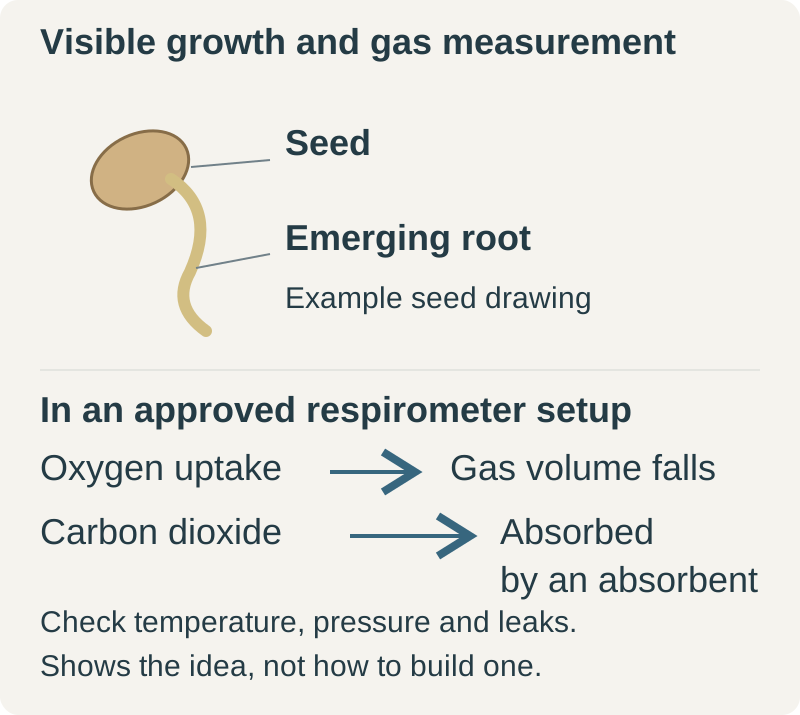
A growing root shows development. A respirometer measures a change in the gas around the seeds. These answer different questions. The lower half of the drawing explains how the measurement works; it is not an apparatus to build.
Respiring seeds take up oxygen and give out carbon dioxide. In the Practical Biology respirometer example, an absorbent removes the carbon dioxide. With that gas gone, a fall in gas volume can be read as oxygen taken up, as long as other causes are controlled.
Parts of a germinating seed
Record the seed's name and any treatment it had, if you are told. Seeds at different stages may not respire at the same rate, even when you use equal masses.
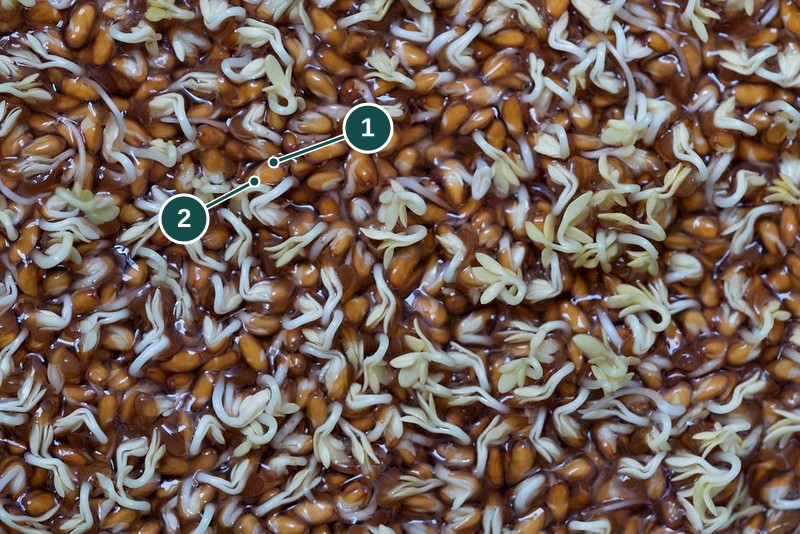
- Seed. The root grows out of it. Use the seed type given for your lesson.
- Emerging root. Shows that the seed has started to grow. The photo does not measure respiration.
Illustrative photo: Fez Brook on Pexels.
Whether a batch is alive, how it was treated and whether it suits the task are in the seed record. A photo cannot tell you those things.
Why the marker can move for other reasons
The respirometer measures any change in the gas around the seeds, not only oxygen uptake. Practical Biology explains that small changes in temperature or air pressure make the air inside expand or contract, which moves the marker too. A leak lets air in or out. So reading the change as oxygen uptake needs temperature, pressure and leaks controlled, and the carbon dioxide from respiration removed.
The absorbent is a separate chemical hazard, even if the seeds look harmless. Practical Biology warns users to take care with potassium hydroxide and other carbon dioxide absorbers, notes that soda lime is corrosive, and says the seeds must not touch the absorbent. Your trainer decides which absorbent to use, how strong it is, how it is held and what keeps it away from the seeds. This guide gives no recipe for preparing or assembling it.
Use the respiration guide for the wider ideas, then follow your lesson's method.
Suppose the marker moves before you expect a steady reading. Respiration is one explanation, but a temperature change or a leak can also do it. If it moves unexpectedly, ask your trainer to check the setup. Do not push it back or write down the value you expected. A growing root does not prove that the marker moved because of respiration.
What each control checks
Controls do different jobs, so say which cause each one addresses before you use its result.
- A comparison tube without living seeds responds to temperature and pressure changes in the same way. Practical Biology calls this a thermobarometer. It shows how much of the movement is physical, not biological.
- A boiled-seed control, prepared by your teacher, has much less biological activity, because heat denatures the enzymes the seeds need to respire. Boiling also changes the seeds in other ways, so it is not a perfect match for every physical difference. Do not boil seeds yourself, and do not assume its reading must be exactly zero.
- Neither one shows the apparatus is airtight. Your trainer checks for leaks separately.
Equal mass does not mean equal stage, seed size or water content. Record what you are keeping the same, and treat every batch the same way you were told.
If two trials use equal masses but the seeds are at visibly different stages, you are comparing different groups. Record the difference and ask whether the comparison still answers the question. Repeating the measurement on the same mismatched groups does not fix it.
If both the seed tube and its comparison change unexpectedly, report both. Only subtract one reading from the other if your method's measurement model says to. A correction needs a reason, not just a better-looking result.
Keeping a useful seed record
Record the batch, the visible stage and the amount, measured the way your method compares them. Also record any treatment or preparation difference you are told about. "Germinating seeds" covers a wide range of stages, so one sample is not the same as another.
SAPS's germination activity uses visible roots and shoots to follow development. That is a different question from measuring gas. A longer root is not a measure of oxygen taken up, and a photo cannot show how your batch was prepared.
Before students begin, your trainer checks the seeds, the chemicals, how they are contained, how the seeds are kept away from the absorbent, and the apparatus. You need to know the order of observations, the signal to stop and where waste goes. Follow your trainer for leak checks, absorbent handling and replacing a doubtful batch.
Handling seeds and their waste
Follow your trainer's hygiene and containment rules. Do not taste laboratory seeds or take them home to eat. Do not open seeds with visible mould to look inside: breathing in mould spores can trigger allergies and asthma. Report unexpected growth, damage or an unclear label. Your trainer has to consider the actual species, any treatments and allergies.
Keep seeds separate from absorbent, indicator and other chemical waste, because where they go depends on what they touched. Report spills and any contact with your skin or eyes, or any other exposure, and wash your hands afterwards. Read lab safety before the investigation.
Sources
- https://practicalbiology.org/energy/gas-balance-in-respiration-and-photosynthesis/measuring-the-rate-of-metabolism.html
- https://www.saps.org.uk/teaching-resources/resources/6151/germinating-seeds-in-small-pots/
- https://en.wikipedia.org/wiki/Denaturation_(biochemistry)
- https://en.wikipedia.org/wiki/Mold_health_issues