Loading page…


Loading blog content…
Loading page…
Loading blog content…
Prefer a quick answer?Ask AI:
Small-group lessons for clearer concepts, accurate working, and regular Paper 4 practice.
For JC1 and JC2 students who need clearer concepts, stronger calculations, or better answers under time pressure.
Students bring recent school work, revisit the ideas behind each question, and correct the steps that went wrong. Timed practice builds on that understanding. Paper 4 graphing, uncertainty, planning, and evaluation stay part of the weekly routine.
A timing example adapted from our Physics planning notes.
First attempt: “Use a stopwatch to measure the period.” This names the instrument, but leaves the start point and counting method unclear.
Make it precise: Time ten complete oscillations, starting and stopping as the bob crosses the centre in the same direction. Divide the total time by ten. Repeat the measurement and find the mean period.
Before the first JC1 weighted assessment is a useful time to start. It gives students time to connect concepts across topics and practise Paper 4 skills before JC2.
We cap each group at 8 students so the tutor can check each student's working, correct misunderstandings early, and give useful comments during class.
In-person theory lessons run at Jurong East Centre (Vision Exchange) (2 Venture Dr, #16-07 Vision Exchange). Our one-north office is for talks and presentations only, not regular lessons. See the Centre section above for the full address and map link.
Share the school, level, and latest grade. We will recommend a suitable class and explain what happens next.
Choose the question closest to the decision you are making.
The definitive 2025/26 handbook to scoring an A in H2 Physics: syllabus changes, Paper-4 spreadsheet skills, SUVAT-to-Fields transfer drills.

A practical roadmap for H2 Physics students from JC1 to JC2: topic sequencing, problem-solving routines, practical milestones, and exam-window execution checkpoints.
Explain why: If ten oscillations take 20.0 seconds, the period is 2.00 seconds. Suppose the total timing uncertainty is 0.2 seconds: that is 1% of 20.0 seconds, compared with 10% when timing one 2.0-second oscillation. Timing more cycles reduces the percentage uncertainty, provided the motion stays steady and the cycles are counted correctly.
SEAB H2 9478, 2026 examination syllabus. Topic groups describe content; JC1 and JC2 lesson order is adjusted to the student's school.
Connect calculations to measurements, graphs, uncertainty and Paper 4 planning. Practical training can include circuits and oscillations.
The lesson outline is a teaching plan, not an official year-by-year sequence. We adjust it to the student's school and examination year.
Managing Director
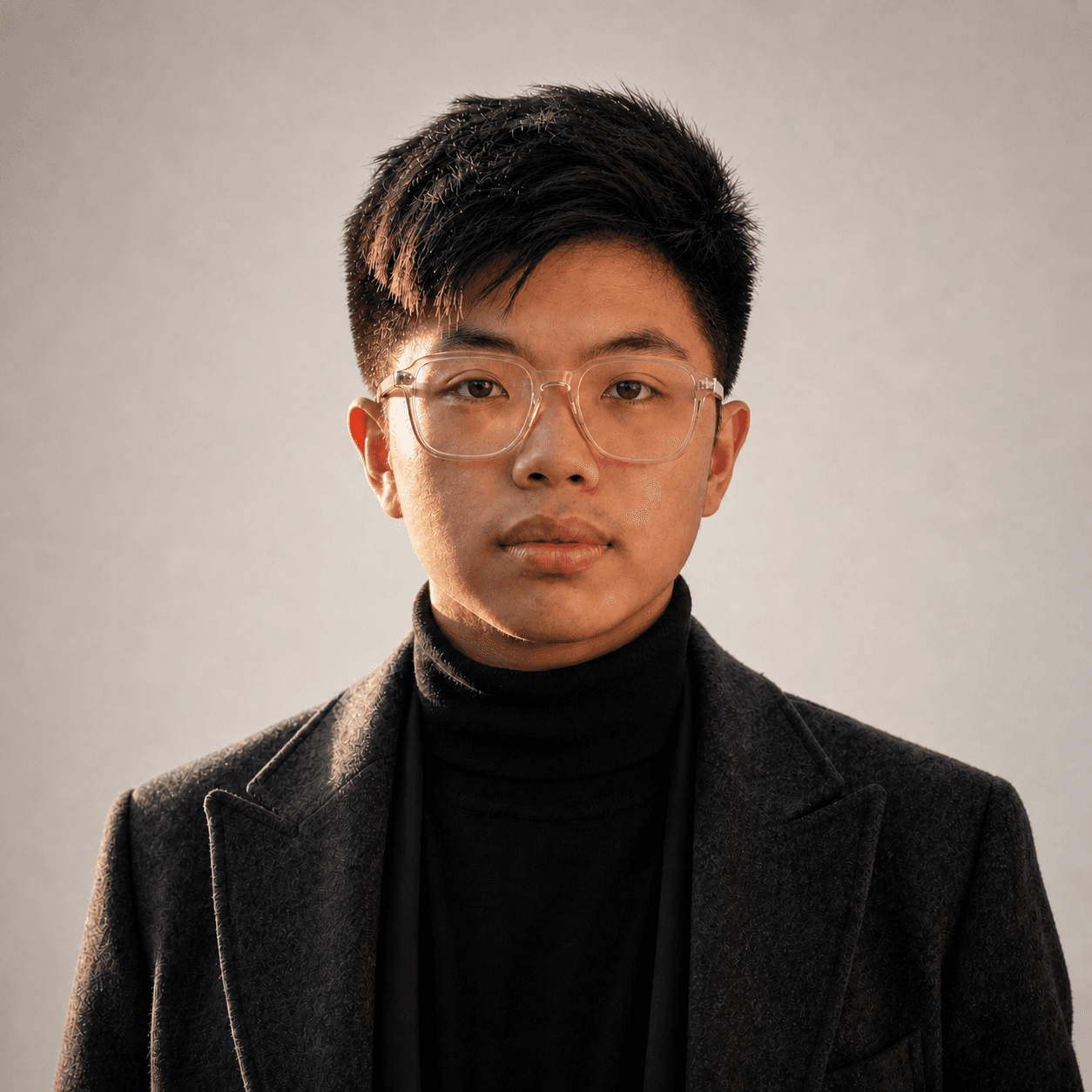
Principal tutor at Eclat Institute. He oversees A-Level classes, helps students plan their study, and trains teachers in A-Level theory and laboratory work.
Marcus Pang graduated from River Valley High School (RVHS IP) and has a Bachelor of Engineering (Electrical) from the National University of Singapore, as well as a master of education in curriculum and teaching by the national institute of teaching (NIE). Teaching since 2014, he serves as the current principal tutor in Eclat Institute and is an adjunct lecturer and teacher trainer for PEIs on O-Level, A-Level, IGCSE, and CIE theory classes as well as lab work.
View full profile

Academic Advisor (Physics)
Academic Advisor (Physics) and Director of Technology at Eclat Institute. Focuses on strong fundamentals and clear problem-solving structure.
Chee Wei Jie has graduated with a first class honours from Imperial College London and a Master of Advanced Study (MASt) in Mathematics from the University of Cambridge. He is an NUS High School alumni and a DSTA scholar. He worked in the AI research lab at DSO National Laboratories. Now he works on his own tech venture, Instavar. He also took IGCSE as a private candidate in 2006, which he gained experience in setting up his own lab for practice. Connect on LinkedIn.
View full profile
Public reviews from students taught at our Jurong East centre.
I was Marcus's physics student from upper secondary till jc. I found Marcus way of teaching to be very useful as he emphasise on understanding the topics and how to be exam smart. He explains physics in ways which are easy to comprehend and makes physics a more manageable and enjoyable subject.
joined the class when i was weak in physics. mr pang has single handedly saved my grades. 10/10 wld recommend
These are selected public reviews, not a full-cohort success rate. Read the full set on our Google reviews.
4 lessons each month, 1.5 hours each.
SGD 360-400
per subject, per month
Continue into the next year and the Early Intake rate applies again.
Paper 4 intensives and holiday classes are quoted separately when they are needed.
Open the sections below for fees, class formats, syllabus details, and checklists.
Parents often search for the best H2 Physics tuition after a weak weighted assessment, promo, or JC2 block test. No class is best for every student. Check whether the teaching style, class size, Paper 4 training, and level of Mathematics address the student's main problem before booking a trial lesson.
| Main problem | What it looks like | Tuition format that helps |
|---|---|---|
| Concept gap | The student can substitute values but cannot explain why a model applies | Clear reteaching followed by questions that check understanding |
| Maths breaks down in Physics | Calculus, vectors, gradients, or sign conventions break under time pressure | Guided problem sets that link mathematics to physical meaning |
| Answer phrasing gap | The student understands the idea but loses command-word or explanation marks | Rewriting answers, model wording, and marked corrections |
| Paper 4 gap | Spreadsheet, uncertainty, graph, or ACE answers are inconsistent | Practical work throughout the year |
| Runs out of time | The student knows isolated topics but runs out of time in Papers 2 and 3 | Timed mixed-topic questions followed by corrections |
Ask specific questions. Who teaches the class? How many students are in it? How are weak answers corrected? What happens when the same vector, unit, or sign error returns? Check whether Paper 4 is taught throughout the year and whether JC1 and JC2 students receive different work. Claims about being “top” or “proven” are not enough.
Score each area from 1 to 5 during a trial lesson or consultation call.
The tutor explains command words clearly (define, explain, calculate, sketch, suggest) and shows how to convert conceptual understanding into the precise wording examiners expect. Common mistakes such as sign errors, unit conversions, and free-body diagram errors are addressed explicitly.
Each lesson has a clear order: check understanding, practise under time pressure, review, then rewrite. Practice follows the school timeline, and correction points are tied to Physics command words, not generic comments.
Students practise planning questions regularly. Data processing and analysis are rehearsed with spreadsheet-based methods, graphs, trendlines, and uncertainty propagation, and ACE write-ups are practised repeatedly rather than only near the exam.
Students can ask specific questions between lessons. There is a clear way to catch up after an absence, with more practice before major assessments.
Shortlist classes that explain concepts clearly, correct written work, and suit the student's schedule. Compare fees after those checks.
Fees differ because classes vary in size, frequency, marked work, and Paper 4 training. Some centres include spreadsheets, graph linearisation, uncertainty, and planning in the weekly class. Others charge separately for those lessons. Compare the full monthly cost, not only the advertised weekly fee.
Before comparing monthly fees, check what practical training is included. Some classes cover theory only. Others add planning questions, spreadsheets, graph linearisation, uncertainty analysis, and corrected ACE answers. For a student who struggles with Paper 4, these differences may matter more than the headline fee.
Eclat's own H2 Physics tuition fees fall in the S$360 to S$400 per month range shown above, covering four weekly 1.5-hour lessons with Paper 4 practical training included in weekly lessons rather than sold as a separate block.
| Paper | Weight | Key skills |
|---|---|---|
| Paper 1 MCQ | 15 percent | Fast recall and avoiding common traps |
| Paper 2 Structured | 30 percent | Questions that combine topics and complete working for method marks |
| Paper 3 Long Questions | 35 percent | Data handling and explanation structure |
| Paper 4 Practical | 20 percent | Spreadsheet data processing, graph linearisation, and ACE evaluation |
JC programmes have replaced mid-year exams with weighted assessments and block tests. Check your college calendar early and plan tuition around WA1, WA2, and promos. A primer lives in Weighted Assessments vs Mid-Year Examination.
Worried about promotional exam results? What to do if your child fails JC promos explains what to do next and when to seek more help.
Strengthen the upper secondary ideas used again in JC mechanics and fields.
Fees are charged monthly for each subject. The Early Intake from October to February is SGD 360 per month. The Regular Intake from March to June is SGD 380 per month. The Catch-up Intake from July to September is SGD 400 per month. Students who continue into the next year return to the Early Intake rate of SGD 360 per month. The monthly fee covers 4 weekly 1.5-hour lessons. Holiday intensives and practical clinics are scheduled separately. Use the WhatsApp button to ask about current class times.
Look for small groups, marked corrections, clear links between mechanics and fields, and regular Paper 4 data analysis. Ask how the class uses timed papers, spreadsheets, uncertainty calculations, and the student's school assessment dates.
Paper 4 is worth 20 percent of the H2 Physics grade under SEAB 9478. Spreadsheet-based data processing, graph linearisation, uncertainty reporting, planning, and ACE evaluation should be trained throughout the year, not only in the weeks before the exam.
Tuition may help when block-test marks remain weak despite completed tutorials, the same vector, unit, or sign error keeps returning, or Paper 4 write-ups are repeatedly avoided. Address the pattern before the next full paper.