

Cambridge International AS and A Level Biology 2: Biological molecules
Cambridge International AS and A Level Biology 9700 notes on biological tests, carbohydrates, lipids, proteins and water.
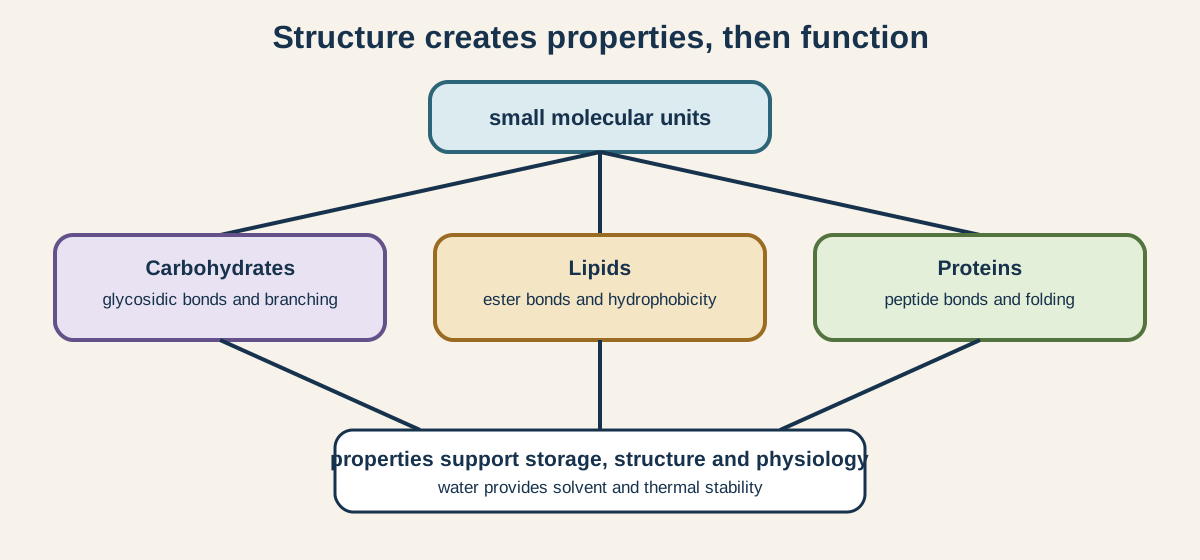
Biological Molecules is Cambridge International Biology 9700 Topic 2. It links chemical structure to function across carbohydrates, lipids, proteins and water. Detailed reagent handling, standardisation, heating and safety belong to the separate practical hub; this theory note owns test principles, molecular interpretation and structure-function explanations.
1. Tests for biological molecules
Benedict's test detects reducing sugars through a heated reaction that can progress from blue toward green, yellow, orange or brick-red precipitate as reducing-sugar concentration increases. A semi-quantitative comparison requires equal reagent volumes, equal sample volumes, controlled temperature and time, and either standard colour references or a defined time to first colour change.
Iodine solution changes from yellow-brown to blue-black with starch. The emulsion test for lipids produces a cloudy white emulsion after lipid dissolved in ethanol is mixed with water. The biuret test changes from blue to lilac or purple when peptide bonds are present.
Sucrose is non-reducing. First show no reducing-sugar result, then hydrolyse glycosidic bonds with acid, neutralise and repeat Benedict's test. A positive result after hydrolysis supports the presence of non-reducing sugar. The practical hub owns procedural detail and risk control.
2. Monomers, polymers and condensation
A monomer is a small molecular unit that can join others. A polymer is a long molecule of repeated or related monomers. A macromolecule is a very large molecule and need not always be a repeating polymer. Monosaccharides are single sugars, disaccharides contain two monosaccharide units and polysaccharides contain many.
Alpha-glucose and beta-glucose differ in the orientation of the hydroxyl group on carbon 1. Condensation joins smaller molecules through a covalent bond while releasing water; hydrolysis uses water to break the bond.
Glycosidic bonds join monosaccharides. Glucose, fructose and maltose are reducing sugars, while sucrose is non-reducing. Sucrose forms from glucose and fructose.
3. Storage and structural polysaccharides
Starch contains amylose and amylopectin. Amylose uses alpha-1,4 bonds and coils; amylopectin also has alpha-1,6 branch points. Glycogen is similarly based on alpha-glucose but is more highly branched. Compactness supports storage, insolubility limits osmotic effect and branching supplies many ends for rapid enzyme action.
Cellulose contains beta-glucose joined by beta-1,4 bonds. Alternate monomers rotate, producing straight chains. Hydrogen bonds form between parallel chains, which assemble into microfibrils with high tensile strength. This arrangement supports plant cell walls and resists turgor pressure.
Check this topic from memory
Attempt the matching topic bank before reopening the notes. Use each missed idea to decide what to review next.
Start the topic quiz