

Pearson International A Level Further Mathematics: D1 Decision Mathematics 1
Pearson International A Level Further Mathematics notes on algorithms, graph algorithms, critical path analysis and linear programming.
D1 is an externally assessed modular unit used within Pearson Edexcel International A Level Further Mathematics. The current Mathematics, Further Mathematics and Pure Mathematics specification is Issue 3. This note follows the official D1 order and keeps qualification cash-in choices separate from the mathematical content: your centre must still confirm that the unit combination is eligible for the award you intend to claim.
This page explains D1 in a Further Mathematics pathway. If your registered award is Pearson IAL Mathematics, use the Mathematics D1 route note, where D1 can be paired with M1 or S1.
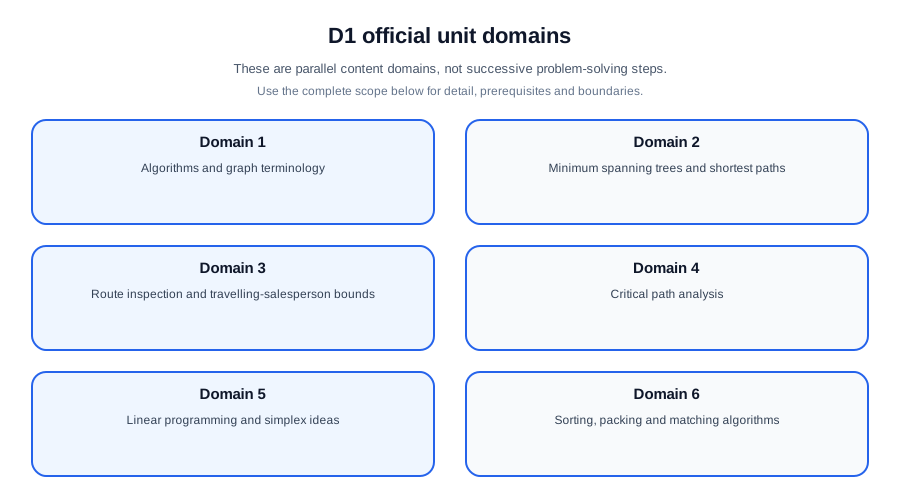
Official unit scope
- Algorithms and graph terminology.
- Minimum spanning trees and shortest paths.
- Route inspection and travelling-salesperson bounds.
- Critical path analysis.
- Linear programming and simplex ideas.
- Sorting, packing and matching algorithms.
The specification assumes prerequisite knowledge stated for the unit, so later-unit questions may combine earlier methods without re-teaching them. Treat the list above as an integrated toolkit. A question can begin in one topic and finish in another, such as using algebra to form a model, calculus to optimise it and a graph to interpret the result.
Core reasoning and methods
- Follow an algorithm's tie-breaking and labelling rules visibly so the final answer can be audited.
- Distinguish a minimum spanning tree, which connects all vertices cheaply, from a shortest path between two named vertices.
- In critical path analysis, use forward and backward passes to identify zero-float activities and project duration.
Write mathematical arguments so another reader can reproduce every transition. Define symbols that are introduced, preserve exact values until a decimal is requested, and place restrictions beside the step that creates them. Calculator use can support arithmetic, graph exploration and checking, but it does not replace a proof, derivation or required chain of working.
Check this topic from memory
Attempt the matching topic bank before reopening the notes. Use each missed idea to decide what to review next.
Start the topic quiz