

Cambridge International AS and A Level Biology 3: Enzymes
Cambridge International AS and A Level Biology 9700 notes on enzyme action, rate factors, inhibition, Km and immobilised enzymes.
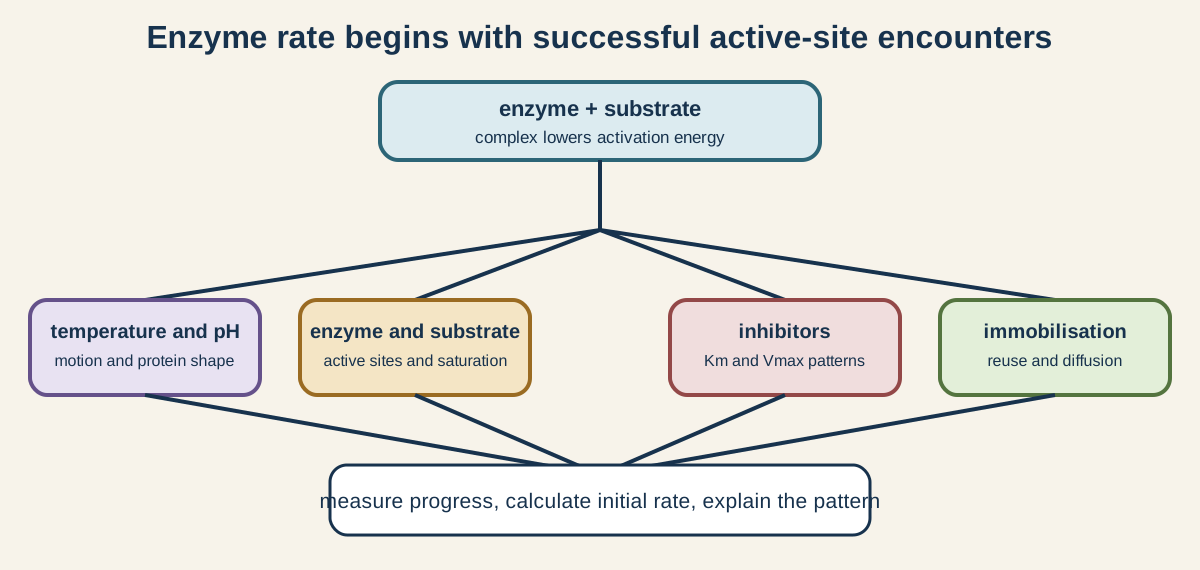
Enzymes is Cambridge International Biology 9700 Topic 3. It covers catalytic action, reaction progress, rate factors, Michaelis-Menten interpretation, reversible inhibition and immobilised enzymes. Detailed catalase, amylase, colorimetry and alginate-bead procedures belong to the separate Biology practical hub; this theory note owns mechanisms, predicted patterns and interpretation.
1. Enzymes as biological catalysts
Enzymes are globular proteins that increase reaction rate and remain chemically unchanged at the end. Intracellular enzymes catalyse reactions inside cells. Extracellular enzymes are secreted and work outside cells, such as digestive enzymes acting in a gut lumen.
A catalyst provides an alternative reaction pathway with lower activation energy. It does not change the overall energy difference between reactants and products, move an equilibrium position or make an impossible reaction energetically favourable.
2. Active sites and specificity
The active site is a three-dimensional region formed by the enzyme's tertiary structure. Its shape and chemical environment are complementary to a substrate. Binding forms a temporary enzyme-substrate complex, positions reacting groups and lowers activation energy.
The lock-and-key hypothesis treats the active site as already complementary. The induced-fit hypothesis explains that substrate binding changes active-site conformation, improving the catalytic fit. Specificity follows from molecular shape and interactions, not from the enzyme recognising a name.
After reaction, products no longer fit or interact in the same way and leave. The enzyme can catalyse another cycle.
3. Measuring reaction progress
Rate is change in product or substrate quantity divided by time. Catalase activity can be followed through oxygen product formation. Amylase activity can be followed through starch disappearance. A colorimeter can track reactions involving colour by measuring absorbance or transmission at a suitable wavelength.
Initial rate is preferable because substrate depletion, product accumulation and reverse reactions have had less effect. On a progress curve, initial rate is the gradient of a tangent near time zero. Practical notes own apparatus, sampling intervals and safety; theory owns which quantity tracks reaction and how the graph supports a rate conclusion.
4. Temperature and pH
Raising temperature initially increases molecular kinetic energy, collision frequency and the proportion of encounters exceeding activation energy. Rate rises toward an optimum. Above it, bonds stabilising tertiary structure are disrupted, the active site changes and fewer enzyme-substrate complexes form. Denaturation is a structural explanation, not simply the enzyme dying.
Check this topic from memory
Attempt the matching topic bank before reopening the notes. Use each missed idea to decide what to review next.
Start the topic quiz