

Cambridge International AS and A Level Biology 4: Cell membranes and transport
Cambridge International Biology 9700 notes on fluid mosaic membranes, signalling, diffusion, osmosis, active transport and bulk transport.
Cell Membranes and Transport is Cambridge International Biology 9700 Topic 4. It covers fluid mosaic structure, signalling, membrane transport, surface area to volume ratio and water potential. Diffusion, osmosis, dialysis tubing, agar-block and plant-tissue procedures remain in the dedicated practical hub; theory owns mechanisms, calculations and interpretation.
1. The fluid mosaic model
Phospholipids are amphipathic. Hydrophilic heads interact with water on both membrane surfaces, while hydrophobic tails turn inward away from water, forming a bilayer. Lipids and many proteins can move laterally, making the membrane fluid. The mixture of phospholipids, proteins, cholesterol, glycolipids and glycoproteins creates the mosaic.
The hydrophobic core limits passage of ions and most polar molecules. Small non-polar molecules can cross the bilayer more readily. Selective permeability therefore arises from both lipid properties and specific transport proteins.
2. Membrane components and functions
Phospholipids form the basic barrier and permit membrane flexibility. Cholesterol sits among phospholipid tails, stabilising the membrane, reducing excessive fluidity at high temperature and preventing tight packing at low temperature. It also reduces permeability to some small water-soluble substances.
Channel proteins provide hydrophilic pathways, often selective by size or charge. Carrier proteins bind particular solutes and change conformation. Some carriers mediate facilitated diffusion, while pumps use energy for active transport.
Glycoproteins and glycolipids project carbohydrate chains from the outer surface. They participate in cell recognition, antigens, adhesion and signalling. Receptor proteins bind specific ligands.
3. Cell signalling
One cell secretes a ligand. The ligand travels to target cells and binds only to cells with a complementary receptor. Binding initiates intracellular events that produce a specific response.
Specificity depends on receptor structure and expression. A ligand can pass many cells without affecting them if they lack the receptor. The ligand need not enter the cell when a surface receptor transduces the signal.
4. Simple and facilitated diffusion
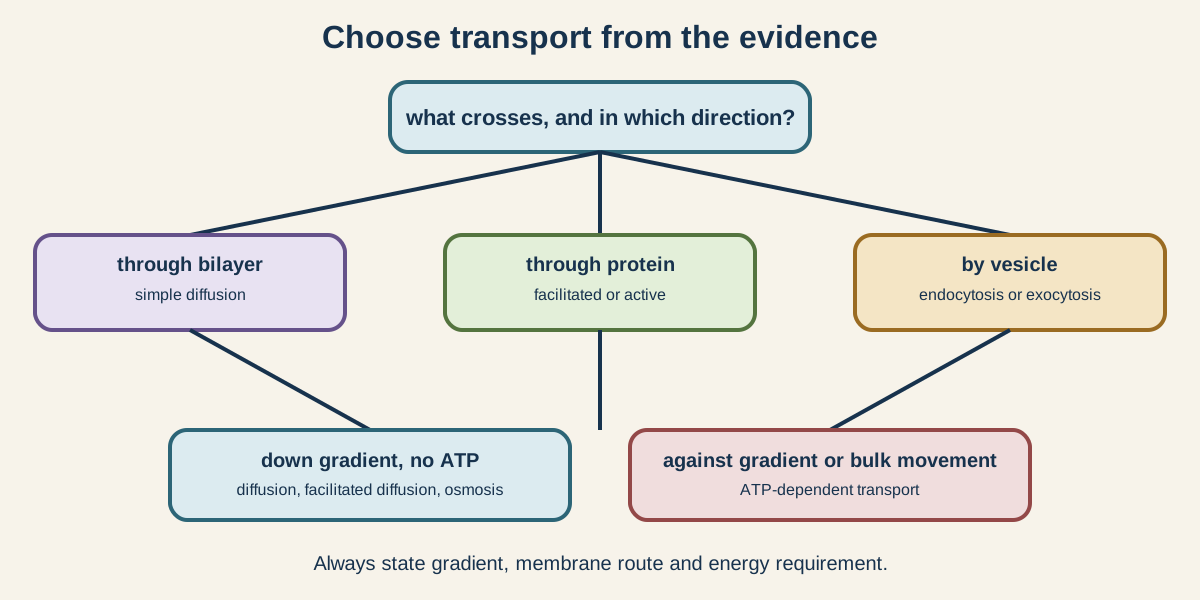
Diffusion is net movement from higher to lower concentration due to random molecular motion. Simple diffusion crosses the bilayer directly and requires no ATP. Rate increases with surface area, concentration difference and temperature, and decreases with diffusion distance.
Facilitated diffusion also moves down an electrochemical or concentration gradient without direct ATP use, but it requires selective channel or carrier proteins. Because protein number is finite, carrier-mediated transport can show saturation.
Check this topic from memory
Attempt the matching topic bank before reopening the notes. Use each missed idea to decide what to review next.
Start the topic quiz