

Cambridge International AS and A Level Biology 6: Nucleic acids and protein synthesis
Cambridge International Biology 9700 notes on nucleotides, DNA replication, RNA, transcription, translation and gene mutation.
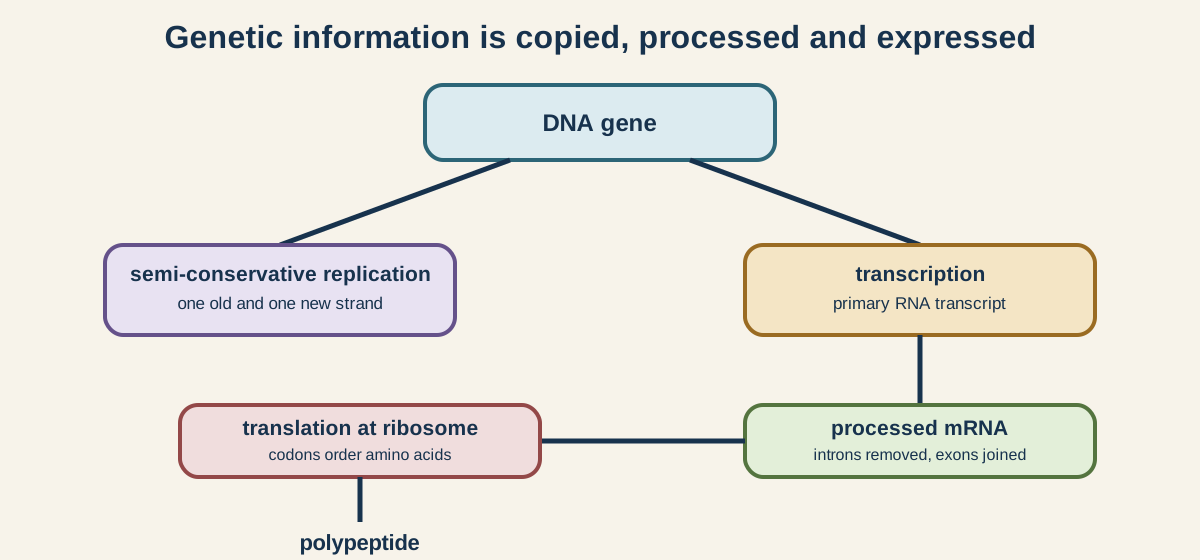
Nucleic Acids and Protein Synthesis is Cambridge International Biology 9700 Topic 6. It connects nucleotide structure to DNA replication, RNA, the genetic code, transcription, RNA processing, translation and gene mutation. The official boundary does not require structural formulas for bases or extra cellular replication enzymes beyond DNA polymerase and DNA ligase.
1. Nucleotides and ATP
A nucleotide contains a pentose sugar, phosphate group and nitrogenous base. DNA nucleotides contain deoxyribose and use adenine, thymine, cytosine or guanine. RNA nucleotides contain ribose and use uracil instead of thymine.
Adenine and guanine are double-ring purines. Cytosine, thymine and uracil are single-ring pyrimidines. Structural formulas for these bases are not expected.
ATP is a phosphorylated nucleotide with adenine, ribose and three phosphate groups. Hydrolysis of its terminal phosphate transfers usable energy for cellular processes. ATP is not a long-term energy store and is regenerated continually.
2. DNA structure
DNA contains two antiparallel polynucleotide strands. One runs 5-prime to 3-prime while the other runs 3-prime to 5-prime. Within each strand, phosphodiester bonds link the sugar of one nucleotide to the phosphate of the next, producing a sugar-phosphate backbone.
The strands form a double helix and are held together by complementary base pairing. Adenine pairs with thymine through two hydrogen bonds. Cytosine pairs with guanine through three. Complementarity permits accurate copying and information retrieval.
Hydrogen bonds are individually weak enough for strand separation, but their large number stabilises the molecule. Phosphodiester bonds are covalent and hold each backbone together.
3. Semi-conservative replication
During S phase, the two DNA strands separate and each acts as a template. Complementary free nucleotides align. DNA polymerase catalyses phosphodiester-bond formation and adds nucleotides only in the 5-prime to 3-prime direction.
Because the templates are antiparallel, one new strand can be made continuously toward the replication region, while the other is made discontinuously in fragments. DNA ligase joins the fragments of the lagging strand. Each daughter DNA molecule contains one original strand and one newly synthesised strand, making replication semi-conservative.
Cambridge does not expect other cellular replication enzymes or different DNA polymerase types in this outcome. Do not turn a precise syllabus explanation into an unnecessary catalogue.
4. RNA and genes
RNA is usually single-stranded, contains ribose and uses uracil. Messenger RNA is a polynucleotide whose base sequence carries information from DNA for polypeptide synthesis.
Check this topic from memory
Attempt the matching topic bank before reopening the notes. Use each missed idea to decide what to review next.
Start the topic quiz