

Cambridge International AS and A Level Biology 7: Transport in plants
Cambridge International Biology 9700 notes on xylem, phloem, transpiration, cohesion-tension and assimilate translocation.
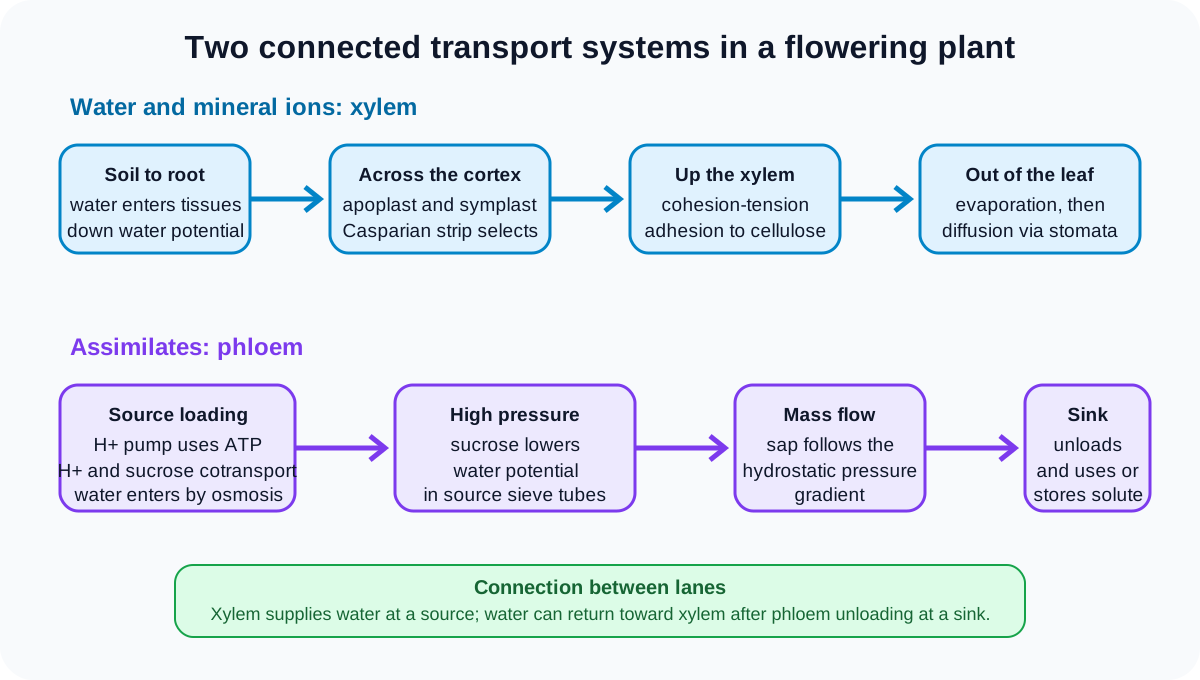
Transport in Plants is Cambridge International Biology 9700 Topic 7. It links the distribution and structure of xylem and phloem to water movement, transpiration, xerophytic leaves and assimilate translocation. Theory owns tissue recognition, structure-function reasoning and transport mechanisms; microscope handling, slide work, biological drawing execution and plant transport investigations remain in the dedicated practical hub.
1. Distribution of xylem and phloem
In a transverse section of a herbaceous dicotyledonous stem, vascular bundles form a ring. Xylem lies toward the centre of each bundle and phloem lies toward the outside. This arrangement supports the upright stem and connects roots with leaves and growing regions.
In a root, xylem commonly forms a central star or cross, with phloem between its arms. In a leaf, xylem lies toward the upper surface of a vascular bundle and phloem toward the lower surface. The precise outline changes with the plane and position of the section, so identify tissues from several features rather than memorising one perfect diagram.
A plan diagram shows the distribution and relative proportions of tissues without individual cells. A cellular drawing shows selected cells and their visible boundaries. These are different representations and should not be mixed.
2. Xylem vessel elements
Mature xylem vessel elements are dead and joined end to end. Their end walls are partly or completely lost, forming a continuous, low-resistance lumen for water and dissolved mineral ions. They contain no cytoplasm that would obstruct flow.
Lignin is deposited in the walls. It strengthens the vessel, resists collapse under the tension generated by transpiration and waterproofs wall regions. Uneven lignification can allow some flexibility during organ growth. Pits are unlignified wall regions that permit lateral water movement between vessels and surrounding tissues.
The vessel is not a living pump. Its structure supports passive bulk movement driven by a pressure difference established elsewhere in the plant.
3. Sieve tube elements and companion cells
Phloem transports assimilates such as sucrose and amino acids. Sieve tube elements are living cells joined end to end. Their end walls form sieve plates with pores through which phloem sap moves. Mature sieve tube elements have little cytoplasm and no nucleus, reducing resistance but limiting their independent metabolic control.
Companion cells lie beside sieve tube elements and are connected to them by plasmodesmata. They contain a nucleus, many mitochondria and membrane transport proteins. Their metabolism supports active loading and unloading of assimilates. A sieve tube element and its companion cell therefore act as a functional partnership.
Check this topic from memory
Attempt the matching topic bank before reopening the notes. Use each missed idea to decide what to review next.
Start the topic quiz