

Cambridge International AS and A Level Biology 8: Transport in mammals
Cambridge International Biology 9700 notes on circulation, vessels, tissue fluid, gas transport, haemoglobin and the cardiac cycle.
Transport in Mammals is Cambridge International Biology 9700 Topic 8. It connects closed double circulation and vessel structure to tissue fluid, blood-cell recognition, oxygen and carbon dioxide transport, haemoglobin behaviour, heart structure and the cardiac cycle. Theory owns structure-function reasoning and trace interpretation; microscope handling, biological drawing execution and physiological investigations remain in the dedicated practical hub.
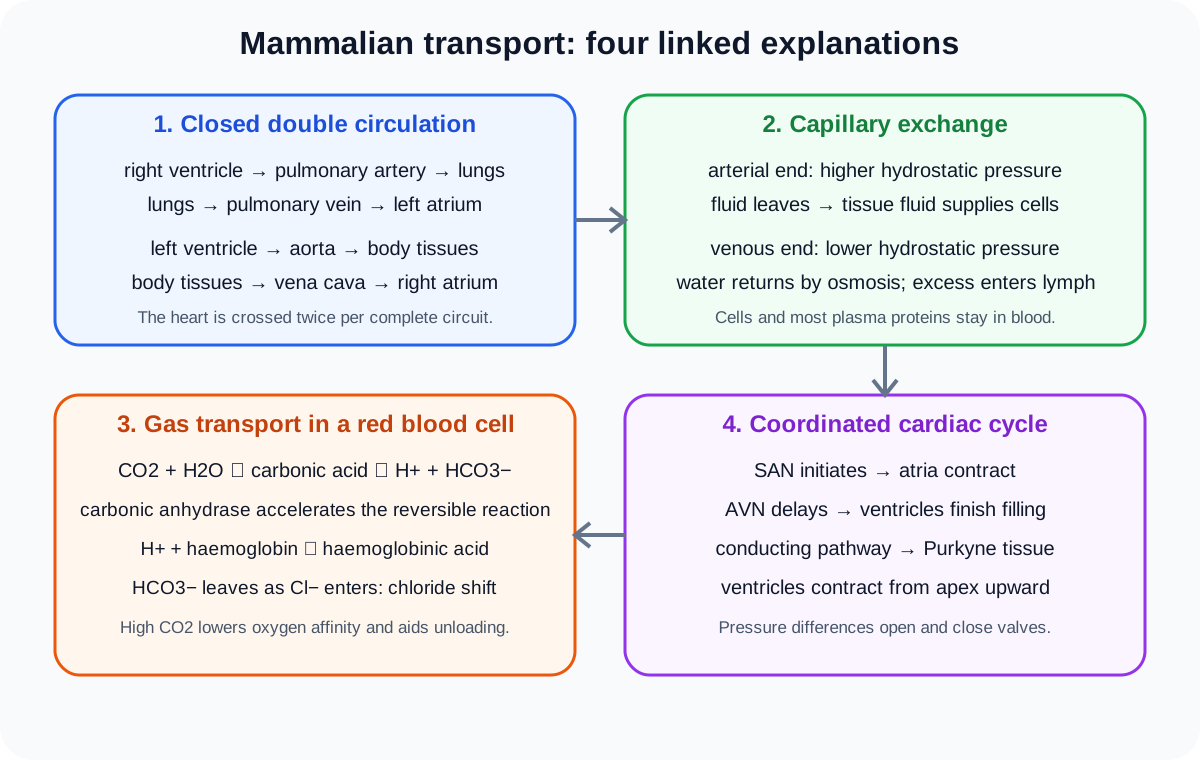
1. Closed double circulation
Mammals have a closed circulation because blood remains within vessels. It is double because blood passes through the heart twice in one complete circuit. The pulmonary circulation carries blood from the heart to the lungs and back. The systemic circulation carries blood from the heart to body tissues and back.
The pulmonary artery carries deoxygenated blood from the right ventricle to the lungs, and the pulmonary vein returns oxygenated blood to the left atrium. The aorta carries oxygenated blood from the left ventricle to the body, while the vena cava returns deoxygenated blood to the right atrium. Artery and vein describe direction relative to the heart, not oxygen content.
2. Vessel structure and function
Elastic arteries receive blood at high, fluctuating pressure near the heart. Their thick walls contain abundant elastic tissue, which stretches during ventricular systole and recoils during diastole. Recoil smooths pressure fluctuations and maintains forward flow.
Muscular arteries distribute blood to organs. Their walls contain a relatively large smooth-muscle component, allowing lumen diameter and blood distribution to change. Arterioles provide strong control of local flow because smooth muscle can alter their narrow lumen.
Veins return blood at lower pressure. They have a wider lumen and thinner walls with less muscle and elastic tissue than comparable arteries. Valves prevent backflow where pressure is insufficient to guarantee one-way movement.
Capillaries have a lumen only wide enough for red blood cells to pass close to the wall. Their endothelium is one cell thick, giving a short diffusion distance. Extensive networks provide a large exchange area, while gaps and permeability permit fluid exchange.
3. Recognising vessels and blood cells
In transverse section, an artery usually has a thick wall relative to its lumen and tends to retain a rounded outline. A vein usually has a thinner wall, wider lumen and more irregular collapsed shape. A capillary has only an endothelial wall and a very small lumen. Orientation, preparation and scale can alter appearance, so use several features.
Red blood cells are biconcave discs without nuclei. Neutrophils have a multilobed nucleus and granular cytoplasm. Lymphocytes usually show a large round nucleus with a narrow cytoplasmic rim. Monocytes are larger, often with a kidney-shaped nucleus and more cytoplasm. Recognition belongs in theory, while slide setup and assessed drawing technique remain practical skills.
Check this topic from memory
Attempt the matching topic bank before reopening the notes. Use each missed idea to decide what to review next.
Start the topic quiz