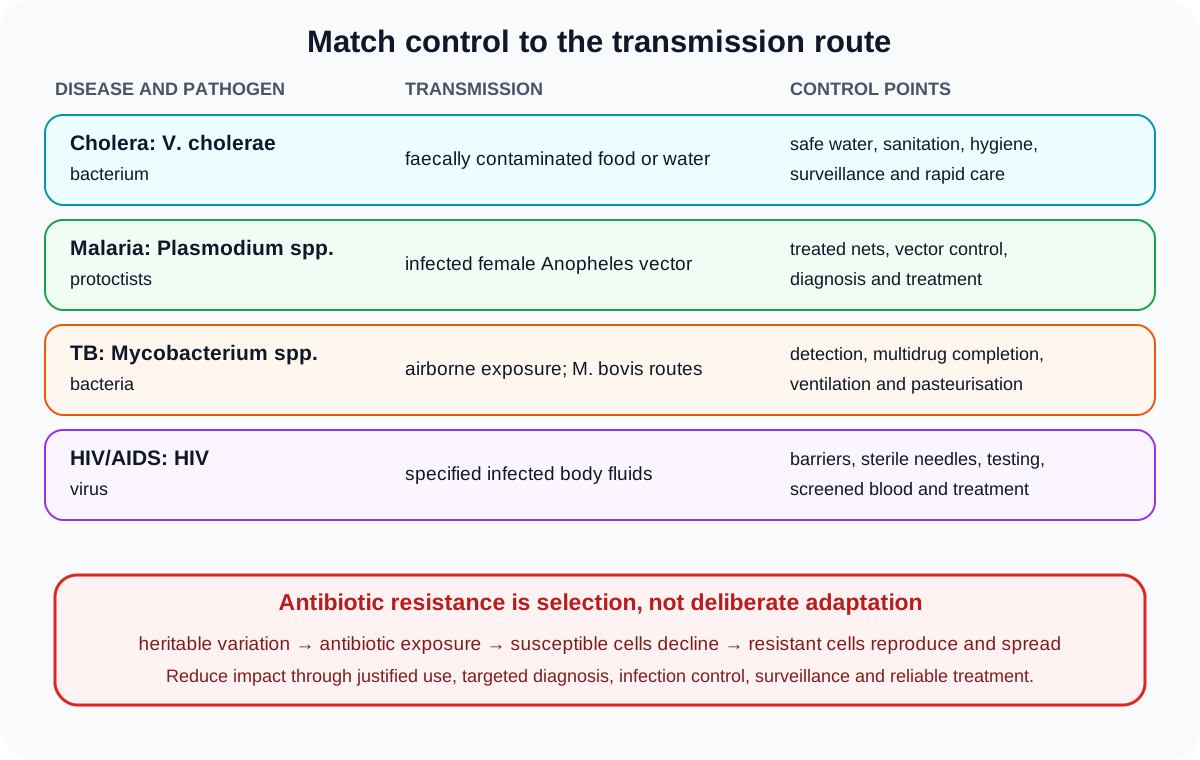
Infectious Diseases is Cambridge International Biology 9700 Topic 10. It covers the named pathogens and transmission of cholera, malaria, tuberculosis and HIV/AIDS, the biological, social and economic dimensions of prevention and control, penicillin action and antibiotic resistance. Detailed stages of the malarial parasite life cycle are explicitly outside the official boundary.
1. Pathogens and infectious disease
A pathogen is an organism or infectious agent that causes disease. An infectious disease is caused by a pathogen and can be transmitted between hosts, directly or indirectly. The transmission route determines which control measures can interrupt spread.
The four required diseases involve different pathogen types. Cholera is caused by the bacterium Vibrio cholerae. For malaria, the Cambridge syllabus names the protoctists Plasmodium falciparum, P. malariae, P. ovale and P. vivax; this syllabus list is not an exhaustive list of every Plasmodium species that can infect humans. Tuberculosis is caused by the bacteria Mycobacterium tuberculosis and M. bovis. HIV/AIDS is caused by human immunodeficiency virus, HIV.
Naming only the disease group is insufficient where Cambridge asks for the exact pathogen and type.
2. Cholera transmission and control
Cholera is transmitted through ingestion of water or food contaminated with faeces containing V. cholerae. Transmission becomes more likely where sewage contaminates drinking-water supplies, sanitation is limited or hygienic food handling is difficult.
Control should match this faecal-oral route. Safe water treatment, protected water sources, sewage treatment, latrines, handwashing and hygienic food preparation reduce the chance that bacteria move from faeces to a new host. Rapid diagnosis and treatment reduce harm, while surveillance can identify outbreaks and target resources.
Biological feasibility is not enough. Infrastructure costs, rapid urban growth, conflict, public trust, access to care and the ability to maintain water systems affect whether a measure succeeds.
3. Malaria transmission and control
Malaria is transmitted by a vector. An infected female Anopheles mosquito can transmit Plasmodium when feeding on human blood. The syllabus requires the transmission principle and named species, not a detailed parasite life cycle.
Insecticide-treated bed nets reduce contact between mosquitoes and sleeping people. Indoor residual spraying can kill mosquitoes resting on treated surfaces. Removing or managing standing water can reduce breeding sites where locally feasible. Screening, prompt diagnosis, antimalarial treatment and preventative medicines can reduce illness and the reservoir of transmissible infection.
Check this topic from memory
Attempt the matching topic bank before reopening the notes. Use each missed idea to decide what to review next.
Control is challenged by insecticide resistance, drug resistance, mosquito behaviour, climate, migration, housing quality, healthcare access and sustained cost. A useful discussion weighs effectiveness, feasibility and unintended effects rather than presenting one universal solution.
4. Tuberculosis transmission and control
Mycobacterium tuberculosis spreads mainly in airborne droplets or aerosols released by an infected person, especially during prolonged close contact in poorly ventilated spaces. M. bovis can also infect humans, historically through unpasteurised milk from infected cattle.
Control can include early case detection, contact tracing, appropriate multidrug treatment, good ventilation, reduction of crowded exposure, vaccination where programmes use it, cattle testing and milk pasteurisation. Completing the prescribed multidrug course is important because incomplete or ineffective treatment can leave resistant bacteria to survive and spread.
Long treatment, drug side effects, stigma, insecure work, housing and travel costs can reduce adherence. Public-health programmes therefore need practical support as well as correct medication.
5. HIV transmission and control
HIV can be transmitted through infected body fluids during sexual contact, sharing contaminated needles, transfusion of unscreened blood, and from parent to child during pregnancy, birth or breastfeeding. It is not spread through ordinary social contact, shared utensils or insect bites.
Control includes barrier protection, testing, screened blood, sterile needles and equipment, prevention of parent-to-child transmission and antiretroviral treatment. Effective treatment reduces viral replication and improves health, while also reducing transmission risk.
Biology interacts with privacy, stigma, consent, cultural expectations, healthcare access and medication cost. Fear of discrimination can discourage testing, so a programme that is technically available can still have limited reach.
6. Comparing control strategies
A biological factor concerns the pathogen, host or vector: transmission route, incubation, reservoirs, resistance, immunity or vector ecology. A social factor concerns behaviour, trust, education, stigma, housing, migration or cultural practice. An economic factor concerns affordability, infrastructure, staffing, supply chains and the opportunity cost of sustained programmes.
These dimensions interact. A chlorination system requires finance and maintenance; bed nets require correct use and replacement; TB therapy requires months of access and adherence; HIV testing requires confidentiality and trust. Control succeeds when the intervention interrupts the biological route and can be adopted consistently in the actual community.
7. Penicillin action
Penicillin is an antibiotic that acts on susceptible bacteria by interfering with formation of peptidoglycan cross-links in the cell wall. A growing bacterium with a weakened wall is less able to resist osmotic pressure and may lyse.
Penicillin is most effective when susceptible bacteria are actively making wall material. It does not treat every bacterial species because permeability, target differences and resistance mechanisms vary.
Viruses lack peptidoglycan cell walls and do not carry out independent cell-wall synthesis. They reproduce using host-cell machinery, so the bacterial target of penicillin is absent. Antibiotics therefore do not cure viral infections.
8. How antibiotic resistance spreads
Resistance is a heritable ability to survive an antibiotic concentration that would inhibit susceptible bacteria. Variation can arise through mutation or acquisition of resistance genes. Antibiotic exposure then creates selection pressure: susceptible bacteria die or reproduce less, while resistant bacteria survive, multiply and pass resistance onward.
Antibiotics do not make an individual bacterium resistant because it needs to adapt. They select variants already carrying or acquiring resistance. Genes can spread vertically to daughter cells and horizontally between bacteria.
Resistance makes infections harder and more expensive to treat, increases illness and mortality, extends hospital stays and can make routine procedures riskier. Resistant strains can spread between people, institutions, animals and environments.
9. Reducing the impact of resistance
Use antibiotics only when bacterial infection justifies them, choose an appropriate drug, dose and duration, and follow current clinical guidance. Laboratory susceptibility testing can support targeted treatment. Infection prevention, vaccination, hygiene, screening and isolation reduce transmission and therefore reduce antibiotic demand.
Healthcare systems can monitor resistance, restrict inappropriate prescribing and maintain reliable drug quality. Agriculture can reduce non-essential antibiotic use and strengthen animal-health measures. Research can develop new drugs and diagnostics, but stewardship is still necessary because selection can affect new antibiotics too.
Patients should follow professional instructions and should not share leftover medicines. The syllabus asks for steps that reduce impact, so connect each step to lower selection pressure, less transmission or better targeting.
Worked application: choosing route-specific control
A district reports cholera after flooding and a simultaneous rise in malaria. Distributing antibiotics to everyone would not address both transmission routes and could increase bacterial selection pressure. Cholera control should prioritise safe drinking water, sanitation, hygiene and rapid case management because infection follows faecal contamination of food or water. Malaria control should reduce contact with infected female Anopheles mosquitoes through treated nets, locally suitable vector control, diagnosis and treatment. Limited funding should be allocated using surveillance, local mosquito ecology and water-system damage. This response integrates biological route, social uptake and economic feasibility instead of naming one intervention for every infectious disease.
Common misconceptions and corrections
Calling every microorganism a pathogen. A pathogen causes disease.
Calling infectious and inherited diseases synonyms. Infectious disease involves a transmissible pathogen.
Calling cholera viral.V. cholerae is a bacterium.
Saying cholera spreads mainly through mosquito bites. It follows faecally contaminated food or water.
Calling Plasmodium a bacterium. It is a protoctist.
Naming only P. falciparum. Four Plasmodium species are listed.
Giving a full malaria life cycle as required content. Detailed life-cycle stages are excluded.
Calling the mosquito the malaria pathogen. It is the vector.
Calling TB viral.M. tuberculosis and M. bovis are bacteria.
Reducing TB control to medication alone. Detection, adherence and transmission conditions matter.
Saying HIV spreads through casual contact. Transmission requires specified infected body fluids.
Equating HIV infection with every transmission event. Route and exposure conditions matter.
Listing control measures without matching the route. Explain which link each measure breaks.
Treating cost as the only economic factor. Staffing, infrastructure and continuity also matter.
Saying penicillin dissolves every bacterium immediately. It disrupts wall formation in susceptible growing bacteria.
Saying antibiotics kill viruses. Viruses lack the bacterial targets.
Saying bacteria become resistant because they try to adapt. Selection acts on heritable variation.
Calling resistance a human-body property. The resistant population is bacterial.
Assuming a new antibiotic permanently solves resistance. Selection pressure can recur.
Saying stewardship means never using antibiotics. It means justified, targeted and effective use.
Assessment guidance
Start each disease answer with the exact pathogen type and named transmission route, then select controls that interrupt that route. In discussion questions, separate biological, social and economic factors before showing how they interact; a long list without evaluation rarely answers the command. Respect the explicit exclusion of detailed malaria life-cycle stages. For penicillin, name peptidoglycan wall synthesis, growing susceptible bacteria and osmotic lysis, then contrast the absent target in viruses. Resistance answers should follow variation, selection, survival, reproduction and spread. Finish each proposed response by stating whether it reduces selection pressure, transmission or diagnostic uncertainty.
Retrieval practice
Build a four-row table giving each disease, exact pathogen, pathogen type, transmission route and matched controls. For one intervention per disease, add a biological limitation, social limitation and economic limitation. Explain penicillin action from molecular target to bacterial outcome, then explain why a virus is unaffected. Model resistance as a selection sequence and classify six stewardship measures by whether they reduce antibiotic exposure, prevent transmission or improve targeting.