Energy and Respiration is Cambridge International Biology 9700 Topic 12 and begins the A Level-only content. It covers ATP, respiratory substrates and respiratory quotient, the four stages of aerobic respiration, mitochondrial structure, fermentation, rice adaptations and the principles behind named respiration investigations. Theory owns mechanisms, calculations and data interpretation; apparatus execution, risk control and evaluation remain in the dedicated practical hub.
1. Why organisms need energy
Living cells transfer energy to drive active transport, movement and anabolic reactions. Active transport moves substances against electrochemical gradients. Movement includes muscle contraction, ciliary action and intracellular transport. Anabolic processes build larger molecules, as in DNA replication and protein synthesis.
Energy is not created by respiration. Chemical energy in substrates is transferred through enzyme-controlled reactions and captured in ATP or released as heat. ATP then couples energy-releasing reactions to energy-requiring processes.
2. ATP as an energy currency
ATP consists of adenine, ribose and three phosphate groups. Hydrolysis removes the terminal phosphate, forming ADP and inorganic phosphate. This transfers a small, manageable quantity of energy rather than releasing the substrate's energy all at once.
ATP is soluble, moves within cells, releases energy rapidly in one reaction and can transfer phosphate to another molecule, making that molecule more reactive. It is regenerated rapidly from ADP and phosphate, so it serves as a short-term transferable currency rather than a long-term energy store.
ATP can be synthesised directly when a phosphate is transferred from a phosphorylated intermediate to ADP. This is substrate-level phosphorylation. It can also be synthesised through chemiosmosis across mitochondrial or chloroplast membranes.
3. Respiratory substrates and respiratory quotient
Carbohydrates, lipids and proteins can act as respiratory substrates. Lipids release more energy per unit mass because their molecules contain many carbon-hydrogen bonds and are more reduced. Oxidising them transfers more hydrogen to respiratory coenzymes. Carbohydrates yield less energy per unit mass, and proteins vary with amino-acid composition and require removal of nitrogen-containing groups before their carbon skeletons enter respiration.
Respiratory quotient compares carbon dioxide production with oxygen uptake:
RQ=molecules of oxygen taken inmolecules of carbon dioxide produced
Check this topic from memory
Attempt the matching topic bank before reopening the notes. Use each missed idea to decide what to review next.
Complete aerobic respiration of carbohydrate gives an RQ of 1 because equal molecular amounts of carbon dioxide and oxygen occur in the balanced equation. Lipid commonly gives a value near 0.7 and protein near 0.8. A mixed substrate can give an intermediate value.
4. Respirometer principles and ownership
A simple respirometer places living material in a sealed chamber connected to a calibrated capillary. If carbon dioxide is absorbed, a fall in gas volume represents oxygen uptake. Movement per unit time can be converted to a rate, with chamber volume, organism mass and temperature controlled or standardised.
To determine RQ, oxygen uptake and carbon dioxide production must both be inferred, commonly by comparing suitable setups with and without carbon dioxide absorption. A control accounts for pressure or temperature changes unrelated to respiration.
The theory note owns why gas volume changes and how RQ is calculated. Assembly, equilibration, safe absorbent handling, leak testing, repeat design and uncertainty belong in the practical hub.
5. Glycolysis in the cytoplasm
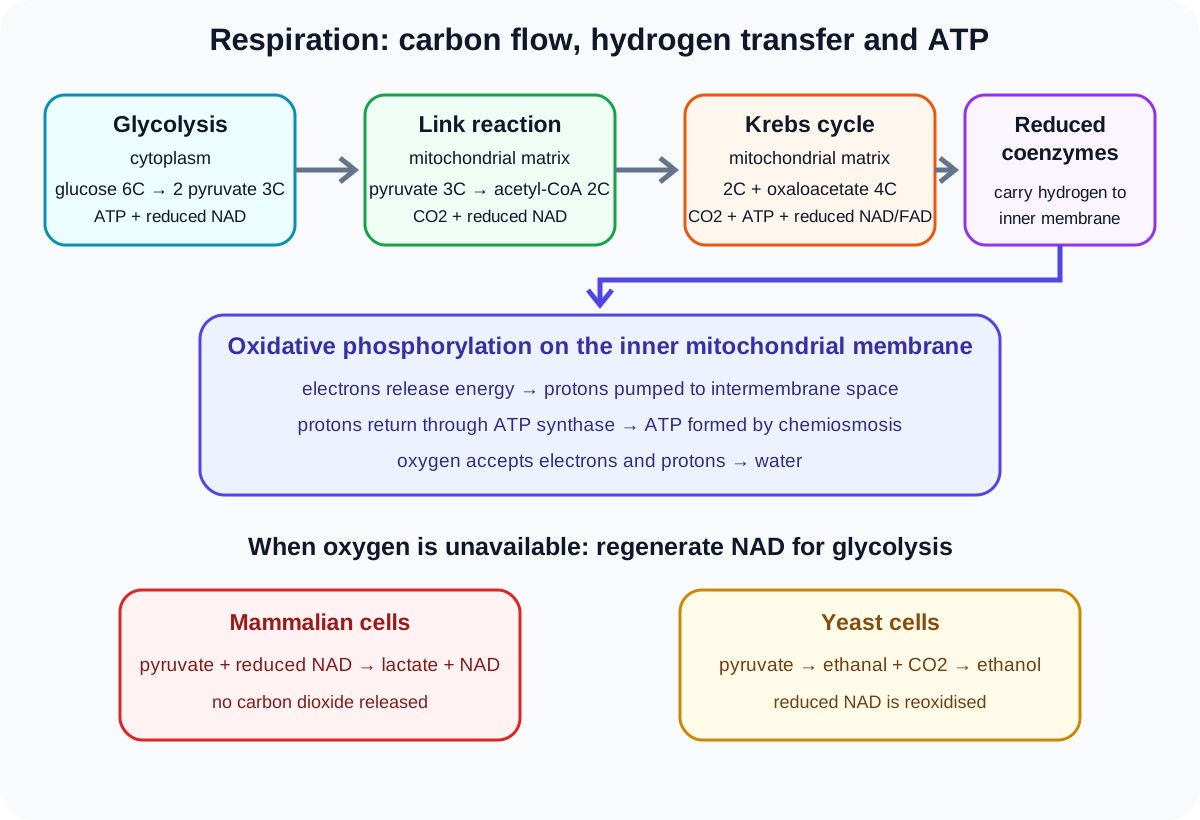
Glycolysis occurs in the cytoplasm. ATP first phosphorylates glucose, helping form fructose 1,6-bisphosphate. The six-carbon compound splits into two three-carbon triose phosphate molecules.
Each triose phosphate is oxidised to pyruvate. Hydrogen is transferred to NAD, producing reduced NAD. Substrate-level phosphorylation produces ATP. Per glucose, glycolysis produces two pyruvate, reduced NAD and a small net ATP gain after the initial ATP investment.
Glycolysis does not require oxygen directly and occurs in aerobic and anaerobic conditions. Its later products depend on whether reduced NAD can be reoxidised through mitochondria or fermentation.
6. The link reaction in the mitochondrial matrix
When oxygen is available, pyruvate enters a mitochondrion and the link reaction occurs in the matrix. Each three-carbon pyruvate is decarboxylated, releasing carbon dioxide, and dehydrogenated, reducing NAD.
The remaining two-carbon acetyl group combines with coenzyme A to form acetyl coenzyme A. Coenzyme A transfers the acetyl group into the Krebs cycle. Because one glucose produces two pyruvate, the link reaction occurs twice per glucose.
The link reaction does not make ATP directly. Its products connect glycolysis to the cycle and supply reduced NAD for oxidative phosphorylation.
7. The Krebs cycle
In the mitochondrial matrix, the two-carbon acetyl group from acetyl coenzyme A combines with four-carbon oxaloacetate to form six-carbon citrate. Citrate is converted through a series of small enzyme-controlled steps back to oxaloacetate, allowing the acceptor to be reused.
Decarboxylation releases carbon dioxide. Dehydrogenation transfers hydrogen to NAD and FAD, producing reduced NAD and reduced FAD. One substrate-level phosphorylation also forms ATP during each turn.
The cycle is a pathway rather than a circular movement of one unchanged molecule. Acetyl carbon enters, carbon dioxide leaves, reduced coenzymes carry hydrogen away and oxaloacetate is regenerated.
8. Reduced coenzymes and the electron transport chain
Reduced NAD and reduced FAD carry hydrogen from glycolysis, the link reaction and the Krebs cycle to carriers in the inner mitochondrial membrane. Hydrogen atoms separate into protons and energetic electrons.
Electrons pass through an electron transport chain and release energy in stages. The syllabus does not require details of individual carriers. The released energy drives proton transfer from the matrix across the inner membrane into the intermembrane space.
This creates an electrochemical proton gradient. The membrane must restrict uncontrolled proton return so the stored gradient can be coupled to ATP synthesis.
9. Oxidative phosphorylation and chemiosmosis
Protons return to the matrix by facilitated diffusion through ATP synthase. The flow provides energy for phosphorylation of ADP to ATP. This coupling of a proton gradient to ATP production is chemiosmosis; the overall ATP-forming process linked to electron transfer is oxidative phosphorylation.
Oxygen acts as the final electron acceptor. It combines with electrons and protons to form water. Without oxygen, electron flow stops, reduced NAD and FAD cannot be reoxidised through the chain, and the link reaction and Krebs cycle cannot continue at their aerobic rates.
Do not say oxygen directly combines with glucose at the start. Its specific role is at the end of the electron transport chain.
10. Mitochondrial structure and function
The outer mitochondrial membrane encloses the organelle. The inner membrane contains electron carriers and ATP synthase. It is folded into cristae, increasing the area available for oxidative phosphorylation. The intermembrane space is a small compartment in which protons accumulate, supporting a steep gradient.
The matrix contains enzymes for the link reaction and Krebs cycle, along with mitochondrial DNA and ribosomes. Its compartmentation keeps substrates and enzymes near one another. The inner membrane separates matrix from intermembrane space, making chemiosmosis possible.
In electron micrographs, identify structures from membranes, folds and compartments rather than from colour or an idealised outline.
11. Anaerobic respiration and fermentation
When oxygen is insufficient in mammalian cells, pyruvate accepts hydrogen from reduced NAD and forms lactate. NAD is regenerated so glycolysis can continue. Lactate fermentation does not release carbon dioxide.
In yeast, pyruvate is decarboxylated to ethanal, releasing carbon dioxide. Ethanal then accepts hydrogen from reduced NAD and forms ethanol, regenerating NAD. Both pathways allow continued glycolysis but do not add the large ATP yield from oxidative phosphorylation.
Anaerobic energy yield is much lower because glucose is only partly oxidised and the electron transport chain does not operate. A detailed total ATP count for aerobic glucose respiration is not expected.
12. Rice roots under water
Waterlogged soil contains little available oxygen because gas diffuses slowly through water and microorganisms and roots consume oxygen. Rice develops aerenchyma, tissue with large air spaces that supports oxygen movement through roots.
Root cells can use ethanol fermentation when oxygen remains limited, regenerating NAD for glycolysis. Faster stem growth can raise leaves above floodwater, restoring access to air and light. These three named adaptations form the official boundary; they should be connected to oxygen supply or anaerobic survival.
13. Redox-indicator and temperature investigations
DCPIP and methylene blue can act as redox indicators. As respiration transfers hydrogen or electrons, the indicator becomes reduced and changes colour. A shorter decolourisation time indicates a faster measured reduction rate when volumes, concentrations and endpoint rules are controlled.
Increasing substrate concentration can increase rate until another factor limits respiration. Increasing temperature initially raises kinetic energy and collision frequency, but excessive temperature disrupts enzyme and membrane function. A water bath, equilibration time, repeats and a non-respiring control help separate the tested effect from background change.
Simple respirometers can also compare respiration rate at different temperatures. The practical hub owns apparatus, safety and evaluation; theory owns the predicted enzyme-controlled pattern and the distinction between oxygen uptake, carbon dioxide production and net gas change.
Worked application: calculating and interpreting RQ
A germinating-seed respirometer indicates that 12.0 cubic centimetres of oxygen were taken up while 8.4 cubic centimetres of carbon dioxide were produced over the same interval under identical conditions. The RQ is 8.4 divided by 12.0, giving 0.70. Because the value is close to the typical lipid value and below the carbohydrate value of 1.00, lipid is likely the dominant respiratory substrate at that stage. The conclusion is not that only lipid was used: a mixture can produce an intermediate value, and leakage, incomplete carbon dioxide absorption or unequal temperature would distort the inferred gas volumes.
Common misconceptions and corrections
Calling ATP a long-term energy store. It is a rapidly regenerated transfer molecule.
Saying ATP hydrolysis releases all energy in glucose. It transfers a manageable amount.
Equating substrate-level phosphorylation with chemiosmosis. The mechanisms differ.
Saying lipid gives less energy because it is less soluble. Its many reduced bonds give more energy per mass.
Inverting the RQ formula. Carbon dioxide produced is divided by oxygen taken in.
Calling every RQ below 1 protein. Lipid is commonly near 0.7 and mixtures vary.
Saying a respirometer directly measures ATP. It infers gas exchange.
Putting glycolysis in mitochondria. It occurs in cytoplasm.
Saying glycolysis starts by splitting unmodified glucose. Phosphorylation precedes splitting.
Putting oxygen directly into glycolysis. Glycolysis does not use it directly.
Calling acetyl coenzyme A a three-carbon molecule. The transferred acetyl group has two carbons.
Saying the link reaction regenerates oxaloacetate. The Krebs cycle does.
Saying carbon dioxide is produced in oxidative phosphorylation. It is released in decarboxylation steps.
Calling NAD and FAD enzymes. They are hydrogen-carrying coenzymes.
Saying protons pass freely through the inner membrane. Controlled return occurs through ATP synthase.
Saying oxygen pumps protons. Electron-transfer energy drives pumping; oxygen is the final acceptor.
Putting the Krebs cycle on cristae. It occurs in the matrix.
Saying mammalian fermentation produces ethanol. It produces lactate.
Saying yeast fermentation releases no carbon dioxide. Decarboxylation releases it.
Giving a precise total aerobic ATP yield as required. Detailed total yield is explicitly not expected.
Calling aerenchyma stored food. Its air spaces support gas movement.
Equating indicator decolourisation with oxygen uptake without qualification. It reports indicator reduction.
Assessment guidance
Anchor every respiration stage to its cellular location, carbon changes, ATP mechanism and coenzyme products. Use RQ only after balancing or reading carbon dioxide and oxygen in the correct order, then qualify substrate conclusions. Glycolysis, link and Krebs answers should track carbon without inventing detailed intermediates. Oxidative-phosphorylation explanations need electron energy, proton pumping, the gradient, ATP synthase and oxygen in causal order. Compare fermentations by products and NAD regeneration. For investigation questions, distinguish the measured proxy from respiration itself and route execution detail to the practical hub while retaining variables, controls, predicted patterns and data interpretation in theory.
Retrieval practice
Build a four-stage respiration table with location, carbon input and output, ATP mechanism and reduced coenzymes. Calculate RQ from three balanced equations and diagnose a respirometer design. Trace hydrogen from a substrate to water through NAD or FAD, electron carriers, protons and oxygen. Compare mammalian and yeast fermentation, then explain the aerobic yield difference. Finish by linking each rice adaptation and each redox-indicator observation to its underlying mechanism.