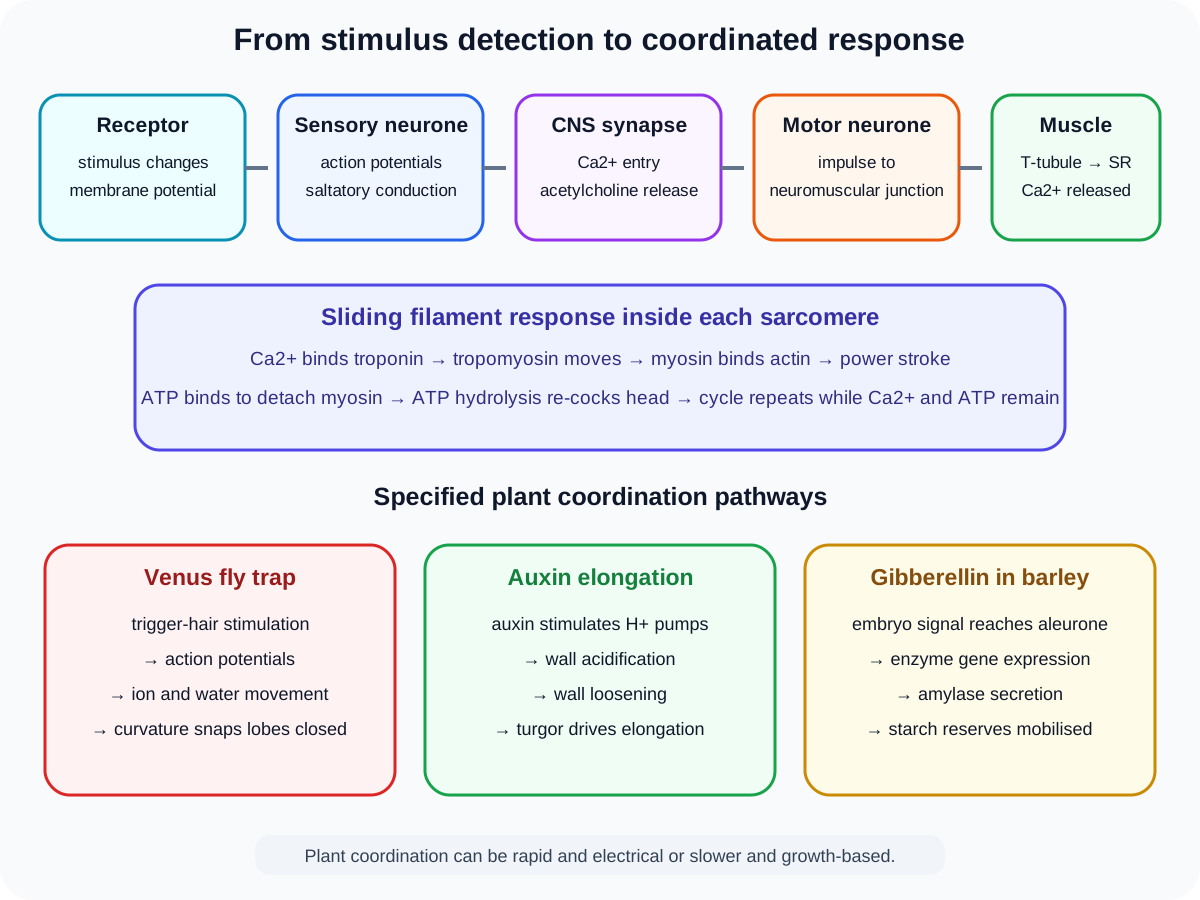
Control and Coordination is Cambridge International Biology 9700 Topic 15. It links endocrine and nervous signalling to sensory transduction, action potentials, myelinated conduction, cholinergic synapses, neuromuscular transmission, sarcomeres and sliding filaments. It also covers the specified Venus fly trap, auxin and barley-germination responses. Theory owns the mechanisms and trace interpretation; experimental execution remains in the dedicated practical hub.
1. Endocrine and nervous coordination
The endocrine system consists of glands that release hormones into blood. Hormones travel throughout the circulation but act only on target cells with complementary receptors. ADH, glucagon and insulin illustrate endocrine coordination of water potential and blood glucose.
Endocrine responses commonly begin more slowly, last longer and can affect multiple target tissues. Nervous communication uses electrical impulses along neurones and chemical transmission at synapses. It is rapid, short-lived and directed to specific effectors.
These are tendencies rather than claims that one system is always slow and the other always fast. Both depend on receptors, signals and responsive target cells, and they can interact.
2. Sensory, intermediate and motor neurones
A sensory neurone carries impulses from a receptor toward the central nervous system. It commonly has a long dendron from receptor to cell body and an axon leading into the CNS. A motor neurone has its cell body and dendrites in the CNS and a long axon carrying impulses to an effector such as muscle.
Intermediate neurones connect sensory and motor neurones within the CNS. Myelin sheaths electrically insulate sections of axon, while gaps called nodes of Ranvier permit ion movement. Axon terminals form synapses with the next cell.
Structure supports direction and speed, but dendron and axon labels should follow impulse direction and cell-body position rather than fibre length alone.
3. Sensory transduction in a taste bud
Sensory receptor cells detect a stimulus and convert its energy or chemistry into an electrical response. In a taste bud, a dissolved chemical interacts with receptor proteins on a chemoreceptor cell. Membrane permeability changes and the receptor cell depolarises.
The receptor cell releases neurotransmitter onto a sensory neurone. If depolarisation reaches threshold in the sensory neurone, voltage-gated channels generate action potentials. Stronger stimulation can increase impulse frequency, but each action potential remains all-or-nothing.
The receptor potential is graded; the propagated action potential is not. Confusing these two electrical events obscures how stimulus intensity is encoded.
Check this topic from memory
Attempt the matching topic bank before reopening the notes. Use each missed idea to decide what to review next.
At rest, a neurone membrane is polarised with the inside negative relative to the outside. The sodium-potassium pump uses ATP to move three sodium ions out for every two potassium ions moved in, establishing concentration gradients.
The membrane is more permeable to potassium through leak channels than to sodium. Potassium diffuses out, leaving a net negative interior. Large negatively charged molecules remain inside. The resting potential therefore depends on selective permeability and ion gradients, not on the pump acting alone.
5. Action potential
When depolarisation reaches threshold, voltage-gated sodium channels open. Sodium ions enter down their electrochemical gradient, causing rapid depolarisation and reversal of membrane potential. Positive feedback opens more sodium channels.
Near the peak, sodium channels inactivate and voltage-gated potassium channels open. Potassium exits, repolarising the membrane. Slow closure of potassium channels can cause brief hyperpolarisation below resting potential.
The sodium-potassium pump and leak movements maintain or restore long-term ion distributions. The immediate falling phase is mainly potassium efflux, not the pump suddenly reversing the voltage.
6. Refractory period and impulse frequency
During the refractory period, inactivated sodium channels cannot reopen immediately and the membrane is restoring its resting state. A second action potential cannot be generated during the absolute refractory period, and a stronger stimulus is needed during the relative refractory period.
This limits maximum impulse frequency and ensures action potentials propagate away from the recently active region rather than immediately backwards. A stronger stimulus is represented mainly by higher impulse frequency, not larger action-potential amplitude.
7. Saltatory conduction
Myelin restricts ion movement across internodal membrane. Local current spreads rapidly beneath the sheath, and action potentials are regenerated at nodes of Ranvier where voltage-gated channels are concentrated.
The impulse appears to jump from node to node, called saltatory conduction. Fewer membrane regions undergo full ion exchange, increasing speed and reducing the ion pumping needed afterward. Myelin does not carry the electrical signal itself; it changes where membrane depolarisation can occur.
8. Cholinergic synapses
At a cholinergic synapse, an arriving action potential depolarises the presynaptic membrane and opens voltage-gated calcium channels. Calcium ions enter the synaptic knob and trigger vesicles containing acetylcholine to fuse with the presynaptic membrane.
Acetylcholine diffuses across the synaptic cleft and binds receptors on the postsynaptic membrane. Ligand-gated ion channels open, sodium enters and the membrane depolarises. If threshold is reached, a postsynaptic action potential forms.
Acetylcholinesterase hydrolyses acetylcholine, stopping continuous stimulation. Choline can be taken back up and reused. Transmission is one-way because vesicle release machinery and receptors occupy different sides.
9. Neuromuscular junction and calcium release
A neuromuscular junction is a cholinergic synapse between a motor neurone and a skeletal-muscle fibre. Acetylcholine depolarises the sarcolemma and initiates a muscle action potential.
The action potential travels along the sarcolemma and down T-tubules, carrying depolarisation deep into the fibre. This triggers the sarcoplasmic reticulum to release calcium ions into the sarcoplasm, bringing the signal close to all myofibrils.
Calcium links electrical excitation to mechanical contraction. Removal of calcium into the sarcoplasmic reticulum permits relaxation.
10. Sarcomere ultrastructure
Myofibrils contain repeating sarcomeres between Z lines. Thin actin filaments attach to Z lines and extend inward. Thick myosin filaments lie centrally and have projecting heads.
The A band spans the full length of thick filaments. The I band contains thin filaments without thick overlap and crosses a Z line. The H zone is the central thick-only region, and the M line stabilises thick filaments.
During contraction, sarcomeres shorten, Z lines approach, and I bands and H zones narrow. A-band length remains constant because thick filament length does not change.
11. Sliding filament mechanism
At rest, tropomyosin blocks myosin-binding sites on actin. Calcium binds to troponin, changing its shape and moving tropomyosin away. Energised myosin heads bind exposed sites and form cross-bridges.
Release of phosphate and ADP accompanies the power stroke, in which the myosin head pivots and pulls actin toward the sarcomere centre. ATP then binds to myosin and causes detachment from actin. ATP hydrolysis re-cocks and re-energises the head for another cycle.
Repeated cycles slide thin filaments past thick filaments. The filaments do not shorten. ATP is also needed to pump calcium back into the sarcoplasmic reticulum during relaxation.
12. Venus fly trap response
The Venus fly trap has modified leaves with sensory hairs. Mechanical stimulation of hairs generates electrical signals. Repeated stimulation within a short interval helps distinguish likely prey movement from a single accidental touch.
Action potentials spread across the lobes and trigger rapid ion and water movements. Turgor and curvature change, and the pre-stressed lobes snap from an open to a closed configuration. Marginal projections interlock and initially retain prey.
The response is rapid and does not depend on growth. It demonstrates that plants can use electrical signals and reversible cell changes for coordination.
13. Auxin and elongation growth
Auxin promotes elongation in responsive shoot cells by stimulating proton pumps in the cell-surface membrane. Hydrogen ions are pumped into the cell wall, lowering wall pH.
Acidification activates proteins that loosen interactions within the cellulose-wall network. With a more extensible wall, water entry and turgor pressure drive cell elongation. New wall material stabilises the enlarged cell.
Auxin does not directly stretch cellulose like a mechanical force. It initiates signalling and proton transport that change wall properties.
14. Gibberellin in barley germination
After a barley grain absorbs water, the embryo produces gibberellin. Gibberellin moves to the aleurone layer and stimulates gene expression leading to production and secretion of hydrolytic enzymes, including amylase.
Amylase hydrolyses starch reserves in the endosperm to soluble sugars. These can move to the embryo and provide substrate for respiration and material for growth before the seedling is photosynthetically self-sufficient.
Gibberellin is the signal, not the digestive enzyme. Its role connects embryo activation to mobilisation of stored reserves.
Worked application: locating a failure in neuromuscular transmission
A toxin prevents voltage-gated calcium channels in a motor neurone terminal from opening. The action potential can still travel along the motor axon, but calcium does not enter the synaptic knob, so acetylcholine vesicles do not fuse efficiently. The muscle end plate receives little transmitter and may not reach threshold. Without a muscle action potential, T-tubules do not trigger normal calcium release from the sarcoplasmic reticulum. Troponin remains without sufficient calcium, tropomyosin continues blocking actin sites and cross-bridge cycling falls. The weakness therefore begins at presynaptic calcium entry, not because actin or myosin filaments have shortened incorrectly.
Common misconceptions and corrections
Calling hormones electrical impulses. They are chemical signals carried in blood.
Saying every cell responds to every hormone. Target cells require receptors.
Saying sensory neurones carry impulses to effectors. Motor neurones do.
Calling receptor potentials all-or-nothing. They are graded.
Saying stronger stimuli make taller action potentials. They mainly increase frequency.
Saying the sodium-potassium pump alone creates the resting potential. Selective permeability also matters.
Saying potassium enters during repolarisation. It leaves the neurone.
Calling hyperpolarisation permanent. It is a brief part of recovery.
Saying the refractory period increases unlimited frequency. It sets an upper limit.
Saying impulses jump through empty space. Local current spreads under myelin.
Saying calcium is the cholinergic transmitter. It triggers acetylcholine release.
Putting acetylcholine receptors on only the presynaptic membrane. Functional receptors are postsynaptic.
Saying acetylcholinesterase releases acetylcholine. It hydrolyses it.
Calling a T-tubule a motor neurone branch. It is an invagination of muscle membrane.
Saying the sarcoplasmic reticulum releases acetylcholine. It releases calcium.
Saying actin and myosin shorten. They slide past each other.
Saying the A band shortens. Thick-filament length remains constant.
Saying calcium binds tropomyosin directly in this model. It binds troponin.
Saying ATP binding causes the power stroke. ATP binding detaches myosin.
Calling fly-trap closure a slow growth response. It is a rapid electrical and turgor response.
Saying auxin is a wall-digesting enzyme. It stimulates proton pumping.
Saying gibberellin hydrolyses starch. It induces enzymes such as amylase.
Assessment guidance
For nervous-system comparisons, name signal type, route, speed, duration and targeting. Action-potential answers should track channels, ion direction and membrane potential in order, while separating immediate repolarisation from gradient maintenance. Synapse explanations need calcium entry before vesicle fusion and transmitter removal after receptor binding. In muscle questions, follow the signal from neuromuscular junction through T-tubules and sarcoplasmic reticulum before describing troponin, tropomyosin and ATP-dependent cross-bridge cycling. Plant answers should distinguish rapid electrical-turgor responses from auxin-driven elongation and gibberellin-driven enzyme production.
Retrieval practice
Compare endocrine and nervous signalling, then label sensory and motor neurones. Reconstruct a taste-receptor response, resting potential, action potential, refractory period and saltatory conduction. Draw a cholinergic synapse and trace excitation to muscle calcium release. Annotate a sarcomere before and during contraction and narrate one cross-bridge cycle. Finish by writing separate causal chains for Venus fly trap closure, auxin acid growth and gibberellin-stimulated barley reserve mobilisation.