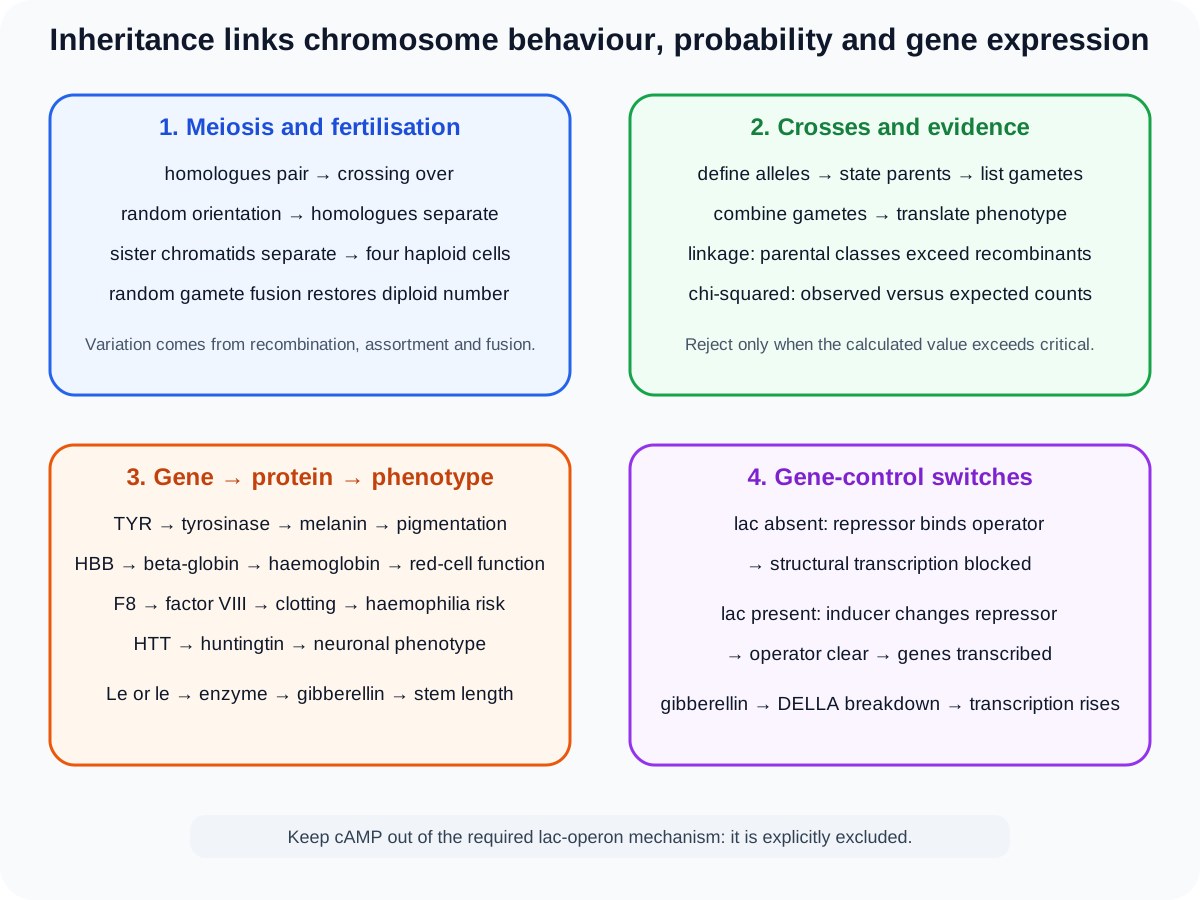
Inheritance is Cambridge International Biology 9700 Topic 16. It connects meiosis and fertilisation to genetic crosses, statistical testing, gene-protein-phenotype relationships and gene control in prokaryotes and eukaryotes. Theory owns chromosome reasoning, cross construction, chi-squared inference and regulatory mechanisms; specimen preparation and data-collection execution remain in the dedicated practical hub.
1. Ploidy and homologous chromosomes
A haploid cell has one set of chromosomes, written n. A diploid cell has two sets, written 2n. In a diploid organism, one chromosome of each homologous pair came from each parent.
Homologous chromosomes carry the same genes at the same loci but may carry different alleles. They are similar in length, centromere position and gene order. They are not necessarily genetically identical.
Gametes must be haploid so fertilisation restores the diploid number rather than doubling chromosome number in every generation. Meiosis provides this reduction division.
2. Meiosis I
Before meiosis, DNA replicates so each chromosome has two sister chromatids. In prophase I, homologous chromosomes pair as bivalents. Crossing over can occur between non-sister chromatids at chiasmata. Chromosomes condense, the nuclear envelope breaks down and a spindle forms.
At metaphase I, homologous pairs align at the equator with random orientation. At anaphase I, homologous chromosomes separate to opposite poles while sister chromatids remain joined. Telophase I and cytokinesis can produce two haploid cells whose chromosomes still contain two chromatids.
The subdivisions of prophase I are not required. The important distinction is that homologues separate in the first division.
3. Meiosis II and image recognition
No further DNA replication occurs before meiosis II. At prophase II, chromosomes condense and new spindles form. At metaphase II, chromosomes align individually at the equator.
At anaphase II, centromeres divide and sister chromatids separate. Telophase II and cytokinesis produce four haploid cells. Chromosome behaviour resembles mitosis in the second division, but the cells are already haploid and may contain recombinant chromatids.
In images, determine whether homologous pairs or individual chromosomes align, whether centromeres have divided and how many cells or nuclei are present. Do not identify a stage from condensation alone.
4. Sources of genetic variation
Crossing over exchanges corresponding DNA segments between non-sister chromatids of homologous chromosomes, producing new combinations of linked alleles. Random orientation of homologous pairs at metaphase I produces independent assortment of maternal and paternal homologues.
Check this topic from memory
Attempt the matching topic bank before reopening the notes. Use each missed idea to decide what to review next.
Random orientation of chromosomes and sister chromatids during meiosis II adds further combinations where chromatids differ after crossing over. Finally, random fusion of genetically different gametes at fertilisation multiplies possible genotypes.
Meiosis generates variation by reshuffling existing alleles. Mutation is the ultimate source of new alleles but is not the named mechanism in this outcome.
5. Core genetic vocabulary
A gene is a DNA sequence contributing to a functional product, and its locus is its chromosome position. Alleles are alternative forms of a gene. A dominant allele is expressed in a heterozygote; a recessive allele is expressed only when no dominant allele is present. Codominant alleles both contribute to the heterozygous phenotype.
Genotype is an organism's allele combination; phenotype is its observable characteristic. Homozygous individuals carry two identical alleles at a locus, while heterozygous individuals carry different alleles.
The F1 generation is the first filial offspring of a parental cross. Crossing F1 individuals can produce an F2 generation. A test cross mates an individual showing a dominant phenotype with a homozygous recessive individual to reveal the unknown genotype.
6. Constructing monohybrid and dihybrid crosses
A complete genetic diagram states parental phenotypes and genotypes, uses defined allele symbols, lists gametes, shows fertilisation outcomes and reports offspring genotype and phenotype ratios or probabilities.
Monohybrid crosses follow one locus. Dihybrid crosses follow two. For independently assorting loci, a double heterozygote can produce four gamete types. Do not apply a memorised ratio unless dominance, independence and viability conditions match the problem.
Multiple alleles means more than two alleles exist in the population, although a diploid individual still carries only two. In codominance, use notation that does not imply one allele dominates the other.
7. Sex linkage and autosomal linkage
A sex-linked gene lies on a sex chromosome. For an X-linked locus, males with one X chromosome are hemizygous and express whichever allele is present. Genetic diagrams must show chromosome-linked notation and different male and female gametes.
Linked autosomal genes lie on the same chromosome and do not assort independently. A heterozygote's allele arrangement matters: coupling places two specified alleles on one homologue, while repulsion places them on opposite homologues.
Crossing over can produce recombinant gametes. Parental combinations are generally more frequent when loci are linked, but the problem data should determine the inference.
8. Epistasis and test crosses
Epistasis occurs when an allele at one locus affects expression of a gene at another locus. Construct the cross from the stated biological rule, then translate each genotype into phenotype. Cambridge does not require memorisation of expected ratios for different epistasis types.
A test cross distinguishes an unknown dominant-phenotype genotype. If all offspring show the dominant phenotype in a sufficiently informative cross, homozygosity is supported; if recessive offspring appear, the tested parent carried the recessive allele. For linked loci, offspring classes can also reveal parental and recombinant gametes.
9. Chi-squared testing
The chi-squared test compares observed counts with counts expected under a genetic hypothesis. State a null hypothesis that any difference is due to chance. Calculate expected numbers from the proposed ratio and total sample size, then sum the contribution from every category using the supplied formula.
Degrees of freedom are normally the number of independent categories minus one. Compare the calculated value with the critical value at the selected probability, commonly 0.05. A value greater than the critical value leads to rejection of the null hypothesis; a smaller value means there is insufficient evidence to reject it.
Statistical non-significance does not prove the genetic model true. It means the observed deviation is compatible with sampling chance at the chosen threshold.
10. From genes to phenotype
The TYR gene codes for tyrosinase, an enzyme needed for melanin production. Alleles producing absent or ineffective tyrosinase can greatly reduce pigment and cause albinism.
The HBB gene codes for beta-globin in haemoglobin. A sickle-cell allele changes the beta-globin amino-acid sequence, producing haemoglobin that can polymerise at low oxygen tension. Red blood cells distort, affecting oxygen transport and causing sickle-cell anaemia.
The F8 gene codes for clotting factor VIII. A non-functional allele reduces normal clotting and causes haemophilia. Because F8 is X-linked, inheritance differs between males and females.
The HTT gene codes for huntingtin. A disease-associated allele produces altered huntingtin and is dominant, leading to progressive effects on nervous-system phenotype. Each example should follow gene sequence to protein structure or amount, cellular function and organism phenotype.
11. Gibberellin alleles and stem elongation
The dominant Le allele codes for a functional enzyme in the gibberellin synthesis pathway. Plants with at least one Le allele produce sufficient active gibberellin for normal stem elongation.
The recessive le allele codes for a non-functional enzyme. A homozygous le plant has reduced gibberellin synthesis and a dwarf phenotype. This example shows how an allele can alter an enzyme, metabolic pathway, hormone concentration, cell elongation and whole-plant form.
Dominance describes phenotype in the heterozygote, not molecular strength or population frequency.
12. Structural and regulatory genes
Structural genes code for proteins with cellular roles, such as enzymes or transport proteins. Regulatory genes code for products that control expression of other genes.
Inducible enzymes are produced in response to the presence of a substrate or signal. Repressible enzymes are normally produced but their synthesis is reduced when a product or signal indicates they are not needed.
These terms describe regulation of production, not whether the enzyme itself can be chemically inhibited after it has formed.
13. The lac operon without lactose
The lac operon contains structural genes for proteins involved in lactose use, along with promoter and operator control regions. A separate regulatory gene produces a repressor protein.
When lactose is absent, the active repressor binds the operator. This blocks RNA polymerase from transcribing the structural genes, so the lactose-use enzymes are not produced in substantial amounts.
The operator is a DNA sequence, not a protein. The repressor is the regulatory protein that binds it.
14. The lac operon with lactose
When lactose is present, an inducer derived from lactose binds the repressor and changes its shape. The repressor can no longer bind the operator. RNA polymerase transcribes the structural genes, and translation produces proteins needed for lactose uptake and metabolism.
The enzymes are inducible because their production rises when the substrate is available. Knowledge of cAMP control is explicitly not expected in this syllabus, so it should not be inserted into the required mechanism.
Removing lactose permits active repressor to bind again and reduce transcription, conserving resources.
15. Eukaryotic transcription factors and DELLA proteins
Transcription factors are proteins that bind DNA and increase or decrease transcription rate. They allow gene expression to respond to cell type, developmental state and signals.
In the named gibberellin mechanism, DELLA proteins act as repressors that inhibit factors promoting transcription. Gibberellin signalling causes DELLA breakdown. The transcription-promoting factors are released from inhibition, target genes are expressed and growth responses such as elongation or germination can proceed.
Gibberellin does not act as a transcription factor by directly binding DNA. It changes the stability of a repressor.
Worked application: linkage evidence and a statistical decision
A test cross produces 82 AB, 78 ab, 21 Ab and 19 aB offspring. The two large classes are parental combinations and the two small classes are recombinants, supporting linkage rather than independent assortment. Under a 1:1:1:1 independent-assortment hypothesis, 50 offspring would be expected in each class. Each observed-minus-expected difference contributes to chi-squared after squaring and dividing by 50. With four categories, the usual degrees of freedom are three. If the calculated value exceeds the supplied 0.05 critical value, reject the null hypothesis that deviations are due only to chance. This supports linkage but does not identify a molecular mechanism beyond recombination between loci.
Common misconceptions and corrections
Calling haploid cells chromosome-free. They contain one chromosome set.
Calling homologous chromosomes identical. They may carry different alleles.
Saying sister chromatids separate in anaphase I. Homologues separate.
Adding DNA replication between meiosis I and II. None occurs.
Using prophase I subdivision names as required content. They are excluded.
Saying crossing over occurs between sister chromatids. It involves non-sister chromatids.
Calling independent assortment a directed arrangement. Orientation is random.
Saying meiosis creates new alleles. It reshuffles alleles.
Calling a locus an allele. It is the gene's chromosome position.
Calling dominant alleles more common. Dominance concerns heterozygous expression.
Saying a diploid person carries every multiple allele. An individual carries two at a locus.
Using a standard dihybrid ratio for linked genes. Linkage changes gamete frequencies.
Ignoring coupling or repulsion. Allele arrangement determines parental gametes.
Memorising epistasis ratios without reading the rule. Expected ratios are not required.
Calling every dominant-phenotype cross a test cross. The partner must be homozygous recessive.
Using percentages instead of counts directly in chi-squared without justification. Expected and observed categories must share a count scale.
Saying non-significance proves the null hypothesis. It is not rejected.
Saying TYR codes directly for melanin. It codes for tyrosinase.
Saying HBB codes for a whole red blood cell. It codes for beta-globin.
Calling F8 autosomal. It is X-linked in this example.
Saying Le is the gibberellin molecule. It is an allele coding for an enzyme.
Calling an operator a regulatory protein. It is a DNA control sequence.
Adding cAMP as required lac-operon content. Cambridge explicitly excludes it.
Calling DELLA a transcription-promoting factor. It represses such factors.
Saying gibberellin binds DNA directly. It promotes DELLA breakdown.
Assessment guidance
For meiosis, name the division and track homologues, sister chromatids, centromeres, spindle and ploidy. Genetic diagrams need defined symbols, parental genotypes, gametes and translated phenotypes. Treat linkage and epistasis from the information given rather than forcing standard ratios. Chi-squared answers require a null hypothesis, expected counts, degrees of freedom, critical comparison and a bounded conclusion. Gene examples should connect DNA to protein to cellular function to phenotype. Keep the lac sequence centred on repressor, operator and structural-gene transcription without excluded cAMP, and distinguish gibberellin signalling from DELLA and transcription-factor roles.
Retrieval practice
Track chromosomes and chromatids through all eight named meiosis stages and identify variation points. Construct crosses for dominance, codominance, multiple alleles, sex linkage, autosomal linkage, epistasis and a test cross. Complete a chi-squared decision from raw offspring counts. Build four gene-protein-phenotype chains and the Le-to-stem pathway. Finish by comparing structural and regulatory genes, switching the lac operon off and on, and tracing gibberellin through DELLA breakdown to transcription.