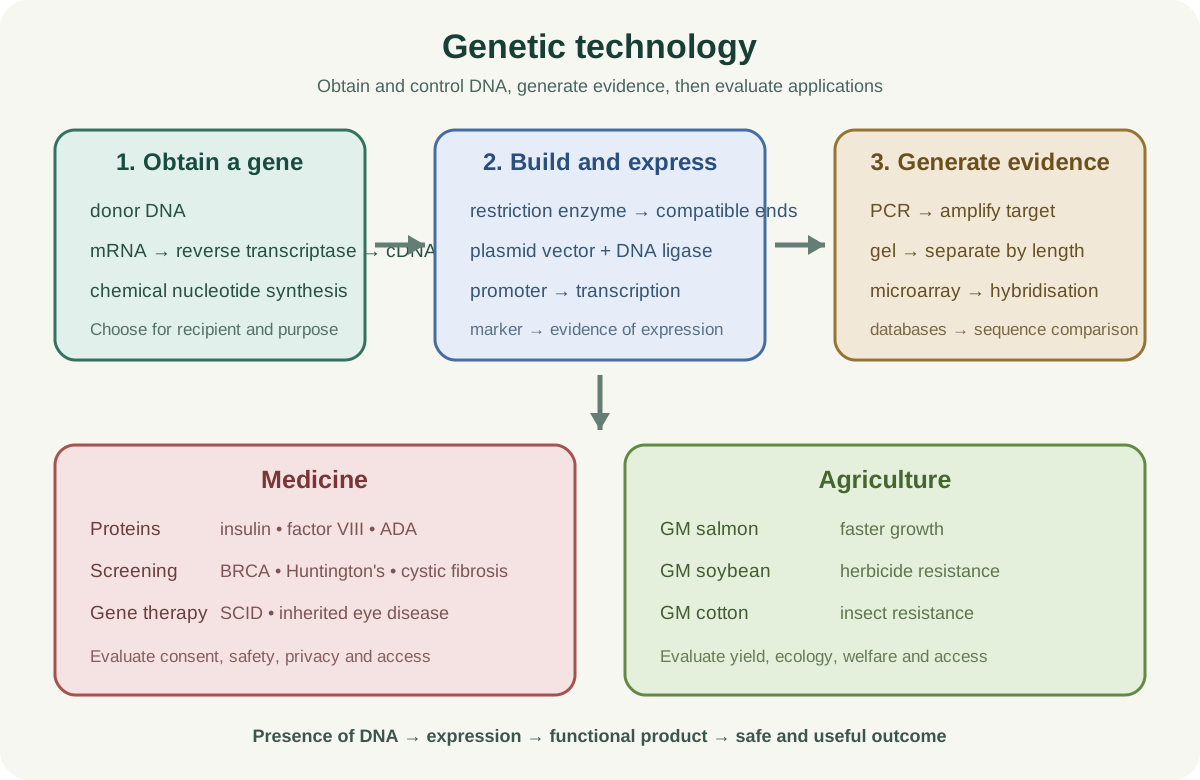
Genetic Technology is Cambridge International Biology 9700 Topic 19. It links deliberate DNA manipulation to amplification, separation and large-scale analysis, then evaluates named medical and agricultural applications. Theory owns mechanisms, evidence and evaluation. Pipetting, sterile handling, loading gels, electrical safety and collection of experimental data remain in the dedicated practical hub.
1. Recombinant DNA and genetic engineering
Recombinant DNA contains DNA combined from two different sources. Genetic engineering is the deliberate manipulation of genetic material to modify specific characteristics of an organism. It can involve transferring a gene into an organism so that the gene is expressed.
These ideas are related but not identical. Recombinant DNA describes a DNA product. Genetic engineering describes a deliberate process and can also include gene editing that inserts, deletes or replaces DNA at a specific genomic site.
Successful transfer is not enough on its own. The gene must be present in suitable cells, controlled by regulatory sequences and expressed to produce the intended RNA or protein. Evidence should distinguish DNA insertion from functional expression.
2. Three ways to obtain a gene
A gene can be extracted directly from donor DNA. A restriction endonuclease may cut around it, but a eukaryotic genomic sequence commonly contains introns. A prokaryotic recipient cannot perform eukaryotic RNA splicing, so a genomic copy may be unsuitable for bacterial protein production.
A gene can be synthesised from mature donor mRNA. Reverse transcriptase uses the mRNA as a template to make complementary DNA, or cDNA. Because mature mRNA has already been spliced, the cDNA lacks introns. DNA polymerase can make the second DNA strand.
A gene can also be synthesised chemically from nucleotides when its sequence is known. This avoids extracting material from a donor and allows deliberate sequence design, but the correct sequence and regulatory requirements must be known.
Choose the route from the recipient and purpose. The phrase “taken from a donor” is incomplete when introns would prevent expression.
3. Enzymes and vectors in gene transfer
Restriction endonucleases cut DNA at specific recognition sequences. Cutting donor DNA and a plasmid with the same enzyme can produce complementary sticky ends. Base pairing between these ends aligns the fragments.
DNA ligase forms phosphodiester bonds in the sugar-phosphate backbone, sealing the desired DNA into the vector. It does not create complementary bases or cut DNA.
Plasmids are small circular DNA molecules used as vectors to carry genes into bacteria. They replicate inside suitable host cells. Useful plasmids contain features such as a replication origin, a selectable or detectable marker and a site where foreign DNA can be inserted.
Check this topic from memory
Attempt the matching topic bank before reopening the notes. Use each missed idea to decide what to review next.
DNA polymerase synthesises DNA using a template and nucleotides. Reverse transcriptase synthesises DNA from an RNA template. Each enzyme role should be attached to its substrate and product rather than listed as an isolated name.
4. Promoters and marker genes
A promoter is a DNA sequence needed for transcription to begin. The recipient's transcription machinery must recognise a suitable promoter. A transferred coding sequence without a functional promoter may be present but not transcribed.
Promoter choice can also affect where, when and how strongly a gene is expressed. In an exam explanation, connect the promoter to RNA polymerase binding and transcription, not to translation directly.
A marker gene coding for a fluorescent product can help confirm gene expression. Fluorescence shows that the marker is being expressed under the construct's conditions. If linked appropriately to the desired transfer, it supports identification of successfully modified cells. It does not automatically prove that every desired protein has the correct amount, structure or biological effect.
5. Gene editing
Gene editing is genetic engineering that inserts, deletes or replaces DNA at specific sites in the genome. Targeting permits a chosen sequence to be altered rather than relying only on random insertion.
Possible purposes include correcting a harmful variant, disrupting a gene or introducing a useful allele. Evidence should confirm the intended edit and investigate unintended changes. Editing a somatic cell affects the treated person but is not normally inherited; editing cells that contribute to gametes could make changes heritable and raises additional ethical concerns.
The official outcome requires the principle, not a detailed named editing platform. Do not let memorised platform detail replace the required insertion, deletion or replacement at a specific site.
6. Polymerase chain reaction
PCR clones and amplifies a selected DNA region through repeated temperature cycles. The mixture contains template DNA, primers, free DNA nucleotides, thermostable Taq DNA polymerase and a suitable buffer.
During denaturation, high temperature breaks hydrogen bonds so the two template strands separate. During annealing, lower temperature allows primers to bind to complementary sequences flanking the target. During extension, Taq polymerase builds new DNA strands from the primers using free nucleotides.
Each new product can become a template in the next cycle, so the target increases approximately exponentially under ideal conditions. Primers determine the boundaries and provide free ends from which polymerase can extend. Taq is used because it remains functional after repeated high-temperature denaturation.
Contamination can also be amplified. Negative controls, clean technique and careful interpretation are therefore important. A visible product of the expected length supports amplification but does not by itself prove every base has the intended sequence.
7. Gel electrophoresis
Gel electrophoresis separates DNA fragments by length. Samples are loaded into wells in a gel and an electric potential difference is applied. DNA has negatively charged phosphate groups, so fragments move toward the positive electrode through pores in the gel.
Shorter fragments move more easily and travel farther in a given time than longer fragments. A DNA ladder containing fragments of known length provides a scale for estimation. After staining or labelling, bands show DNA at different positions.
Band position indicates fragment length relative to standards, while band intensity can give limited information about amount. A band does not reveal the complete base sequence. Smearing may reflect degraded DNA, overloading or a mixture of many lengths, so interpretation should use controls and the experimental context.
8. Microarrays and genome analysis
A microarray contains many known single-stranded DNA probes fixed at identified positions. Labelled sample nucleic acid is applied and complementary sequences hybridise to matching probes. After washing, fluorescence at a position indicates hybridisation.
Genome analysis can use probe patterns to detect particular nucleotide sequences or variants. Gene-expression studies begin with mRNA from cells or tissues, commonly converted into labelled cDNA. More signal at a probe generally indicates more complementary transcript in the starting sample, subject to normalisation and technical limits.
Microarrays detect sequences represented by their probes. They do not discover every unknown sequence automatically, and mRNA abundance does not always equal final protein abundance because translation and protein degradation also affect protein level.
9. Biological databases
Databases can store and compare nucleotide sequences of genes and genomes, amino acid sequences, and protein structures. Researchers can identify similar sequences, infer possible function, locate conserved regions, compare variants, study evolutionary relationships and design primers or probes.
Large shared datasets allow evidence from many laboratories to be reused and updated. Their value depends on data quality, correct annotation, representative sampling and appropriate comparison. A database match is evidence for a hypothesis, not automatic proof of function.
10. Recombinant human proteins
Genetically modified cells can produce human insulin, factor VIII and adenosine deaminase for treatment. A human coding sequence is placed in a suitable expression system, the cells produce the protein, and the product is harvested and purified.
Recombinant production can provide a reliable large-scale supply with consistent composition. It avoids some dependence on animal tissues or human donations and reduces risks associated with contaminating pathogens from biological sources. A human protein can also produce fewer unwanted immune reactions than a sufficiently different animal version.
Quality control remains essential. The protein must fold and, where required, undergo suitable processing or modification. Production hosts and purification systems are chosen according to the protein.
Insulin replaces missing or insufficient hormone in diabetes. Factor VIII supports blood clotting in haemophilia A. Adenosine deaminase can replace deficient enzyme activity in some forms of severe combined immunodeficiency.
11. Genetic screening
Genetic screening identifies variants associated with a condition or altered risk. Cambridge names BRCA1 and BRCA2 variants associated with increased breast-cancer risk, the Huntington's disease allele and variants causing cystic fibrosis.
Potential advantages include earlier monitoring, preventive choices, diagnosis, treatment planning and informed reproductive decisions. Relatives may also learn about shared inherited risk. For Huntington's disease, a predictive result can be obtained before symptoms; for cystic fibrosis, carrier information can inform reproductive counselling.
Interpretation differs between conditions. A pathogenic BRCA variant increases risk but does not guarantee cancer. A positive predictive test for a highly penetrant late-onset disorder has different implications. Screening also has false positives, false negatives, uncertain variants and sampling limits.
Consent, confidentiality, psychological impact, family implications, possible discrimination and equitable access all require consideration. People may value the right not to know as well as the opportunity to know.
12. Gene therapy
Gene therapy treats disease by adding, replacing, editing or controlling genetic material in a patient's cells. In SCID, target cells can receive a functional gene so immune function improves. Modification of suitable stem cells can provide longer-lasting benefit because their descendants retain the functional sequence.
Inherited eye diseases can be treated by delivering a functional gene to cells in the eye when disease mechanism and target tissue are suitable. The eye is localised and accessible, and treatment aims to restore a missing function or slow loss.
Delivery may be in vivo, directly into the body, or ex vivo, where cells are removed, modified, checked and returned. Challenges include delivering the construct to enough correct cells, controlling expression, immune responses, limited duration, unintended insertion or editing, and cost.
Most medical gene therapy targets somatic cells. Its effects are restricted to the treated person and are not passed through gametes. Heritable editing would affect future generations who cannot consent and demands a distinct ethical evaluation.
13. Social and ethical evaluation in medicine
Benefits include prevention, earlier intervention, reduced disease burden and treatment of previously intractable conditions. Risks include physical harm, uncertain long-term effects, distress, privacy loss and unequal access.
A balanced evaluation identifies who benefits, who bears risk, whether consent is informed, how data are protected and whether alternatives exist. It distinguishes treatment of serious disease from enhancement, somatic intervention from heritable change, and individual choice from effects on biological relatives.
An ethical concern is not evidence that a technology never works, and technical success does not settle ethical acceptability. Conclusions should be conditional on evidence, safeguards and the specific use.
14. GM salmon
Genetic engineering can increase the growth rate of farmed salmon by introducing genetic material that supports growth-hormone production under a suitable regulatory sequence. Faster growth can increase productivity and reduce time to market, contributing to food supply.
Evaluation must include feed and resource use, animal welfare, containment, escape and possible effects on wild populations. Sterility and physical containment can reduce risk but are not simply assumed perfect. Compare benefit and risk using evidence from the production system.
15. Herbicide-resistant soybean
Herbicide-resistant soybean survives application of a herbicide that kills competing weeds. This can simplify weed control, reduce competition and support yield. It may also enable particular cultivation practices.
Repeated use can select herbicide-resistant weeds. Gene flow to related plants, changing herbicide use, effects on non-target organisms, seed ownership and farmer dependence are relevant concerns. The crop is resistant to a named control agent, not to all chemicals or every environmental stress.
16. Insect-resistant cotton
Insect-resistant cotton produces a protein toxic to particular insect pests. Reduced crop damage can improve yield and may reduce use of some insecticides, lowering costs and exposure.
Strong selection can favour resistant pest alleles. Resistance-management strategies, such as maintaining refuges of susceptible insects, can slow this change. Effects on non-target organisms, local ecology, seed cost and access should be assessed rather than assumed.
17. GMO implications in food production
GM animals and crops may improve productivity, quality, disease or pest control and resource efficiency. They may also affect biodiversity, gene flow, resistance evolution, welfare, consumer choice, trade and control of seed or breeding material.
Risk depends on the trait, organism, receiving environment and management. “GM” is not one uniform exposure. Compare the engineered organism with relevant alternatives, including the consequences of conventional farming and of not meeting food demand.
Transparent labelling, monitoring, regulation and fair access can address some social concerns, but do not replace case-specific evidence. A strong conclusion states the conditions under which benefits outweigh risks.
Worked application: from mRNA to evidence of expression
A laboratory aims to produce a human protein in bacteria. Mature human mRNA is isolated and reverse transcriptase makes cDNA, avoiding introns that bacteria could not remove. DNA polymerase produces double-stranded DNA. The gene and plasmid are cut to create complementary ends, DNA ligase seals the recombinant plasmid, and a bacterial promoter permits transcription. PCR can amplify a diagnostic region, while gel electrophoresis checks whether its fragment length matches a ladder. Fluorescence from a linked marker supports expression in selected cells, but the final protein must still be tested for identity, correct structure, activity and purity before medical use.
Common misconceptions and corrections
Calling every genetic engineering product recombinant DNA. Gene editing may alter DNA without combining two sources.
Saying transferred DNA guarantees a new phenotype. Expression and functional protein are also required.
Using eukaryotic genomic DNA in bacteria without considering introns. Mature-mRNA-derived cDNA lacks introns.
Saying reverse transcriptase makes RNA from DNA. It makes DNA from an RNA template.
Saying restriction endonuclease joins DNA. It cuts specific sequences.
Saying ligase base-pairs sticky ends. Ligase seals the sugar-phosphate backbone.
Treating a plasmid as an enzyme. It is a DNA vector.
Saying a promoter starts translation. It enables transcription.
Treating marker fluorescence as proof of perfect therapeutic protein. More functional evidence is needed.
Calling gene editing only gene insertion. It can insert, delete or replace DNA.
Describing PCR as one heating step. It cycles through denaturation, annealing and extension.
Saying primers separate DNA strands. High temperature denatures the template.
Saying Taq is used because it works only at low temperature. Its value is thermostability.
Saying PCR cannot amplify contamination. It can amplify unintended templates.
Saying DNA travels to the negative electrode. Its phosphate backbone is negative, so it moves positive.
Saying longer fragments move farther. Shorter fragments move farther through the gel.
Calling a gel band a complete DNA sequence. Position mainly estimates fragment length.
Saying microarrays reveal every unknown gene. Detection depends on known probes.
Equating mRNA abundance with protein abundance. Translation and degradation intervene.
Treating database similarity as proven function. It supports a hypothesis requiring evidence.
Saying recombinant proteins need no purification. Identity, activity and purity need control.
Treating a BRCA variant as certainty of breast cancer. It alters risk.
Ignoring the right not to know a screening result. Consent includes that choice.
Calling all gene therapy heritable. Most medical approaches target somatic cells.
Saying successful delivery guarantees permanent cure. Expression may be incomplete or temporary.
Treating all GMOs as one risk category. Risk depends on trait, organism and environment.
Saying herbicide-resistant soybean resists all chemicals. Resistance is specific.
Assuming insect resistance cannot evolve. Selection can increase resistant pest alleles.
Assuming containment eliminates every escape risk. Safeguards reduce rather than magically remove risk.
Assessment guidance
Mechanism answers should follow material from source to product: gene source, enzyme substrate and product, vector, promoter, host and evidence of expression. PCR and electrophoresis questions require direction, temperature purpose or charge, not just named stages. For microarrays and databases, state what the signal or match supports and its limits. Medical answers must use the named insulin, factor VIII, adenosine deaminase, BRCA, Huntington's disease, cystic fibrosis, SCID and inherited-eye examples accurately. GMO evaluations should link each engineered trait to productivity and then weigh organism-specific ecological, welfare, social and economic evidence before a conditional judgement.
Retrieval practice
Rebuild three routes for obtaining a gene and assign each named enzyme one substrate and product. Explain a full recombinant-plasmid pathway, then redraw one PCR cycle and predict gel movement for three fragment lengths. Compare microarray and database evidence. Create benefit-risk tables for screening and gene therapy using the named diseases. Finish by writing separate causal chains for GM salmon, herbicide-resistant soybean and insect-resistant cotton, including one management safeguard and one limitation for each.