

Cambridge International AS and A Level Biology Practical 3: Rates, Enzymes and Membrane Investigations
Cambridge International Biology 9700 practical notes on rates, enzyme and membrane investigations, continuous variables, controls and evaluation.
Rates, Enzymes and Membrane Investigations develops Cambridge Biology 9700 Paper 3 and Paper 5 skills using continuous variables, time courses, biological material and controlled comparisons. Theory explains enzyme action and membrane structure; this practical note owns range selection, measurement, rate calculation, controls, safety, data quality and method evaluation.
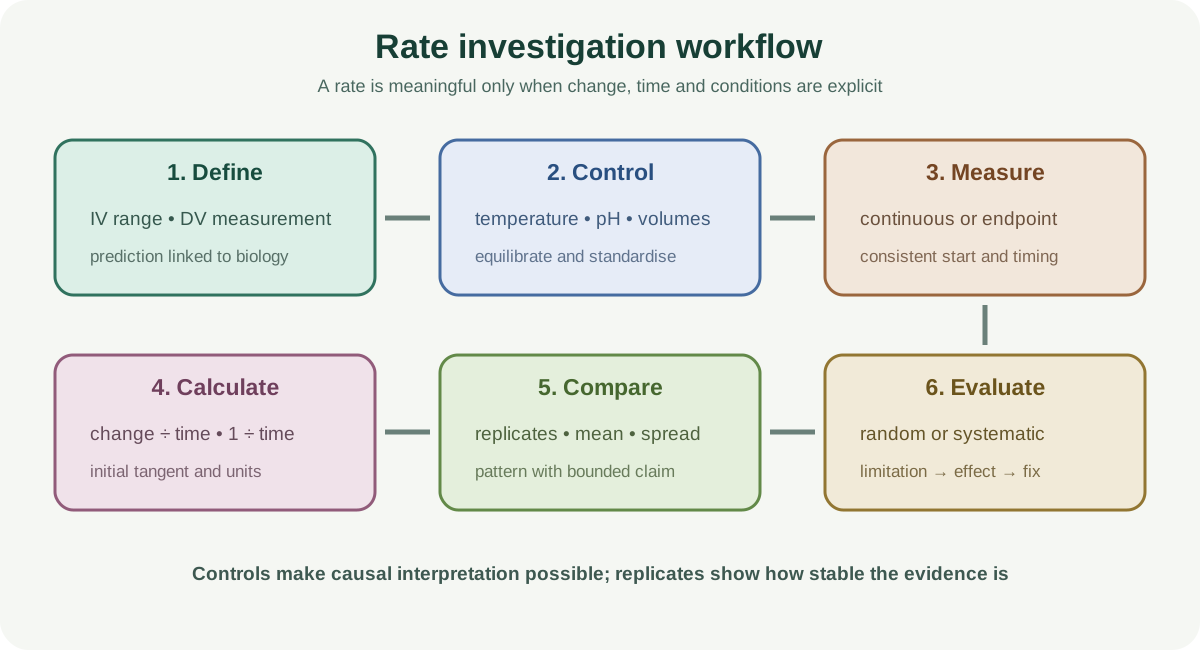
1. Define a measurable rate question
State a prediction that links the independent variable to the dependent variable. Suitable independent variables include temperature, pH, substrate concentration, enzyme concentration or solvent concentration. Use at least five values across a safe and biologically informative range.
The dependent variable must be operational: volume of gas produced per unit time, decrease in substrate concentration, increase in product concentration, time to an endpoint, or absorbance change per unit time. “Reaction speed” is not a measurement until the apparatus and interval are defined.
Standardise quantities that would otherwise change rate, such as enzyme source and concentration, substrate volume and concentration, pH, temperature, total volume, mixing, reaction time and dimensions of biological samples.
2. Decide how to measure rate
A continuous method records change at repeated times, giving a time course and allowing an initial gradient. Examples include gas volume, mass loss or colorimeter absorbance. It normally provides more information than a single endpoint.
An endpoint method measures the time until a defined event, such as disappearance of starch. Rate can then be represented by one divided by time, provided the same amount of change defines every endpoint. Shorter time means faster rate.
Choose an objective endpoint. Human judgement of colour can vary, so standardise lighting, background and observer or use an instrument. If reaction delay during mixing is large relative to total time, redesign addition and timing so every tube starts consistently.
3. Control temperature
Use a thermostatically controlled water bath and allow enzyme, substrate and apparatus to equilibrate before mixing. Measure the actual reaction temperature rather than assuming it equals the bath setting. Keep immersion depth and equilibration time consistent.
Temperature affects rate even when it is not the independent variable. Hand warmth, room changes or adding cold solution can shift conditions. A water bath reduces this variation but does not guarantee identical internal temperatures without equilibration.
Avoid unsafe high temperatures and handle hot water or glass with suitable protection. If temperature is the independent variable, choose intervals that can reveal an optimum and decline without damaging equipment or creating an unmanageable reaction.
Check this topic from memory
Attempt the matching topic bank before reopening the notes. Use each missed idea to decide what to review next.
Start the topic quiz