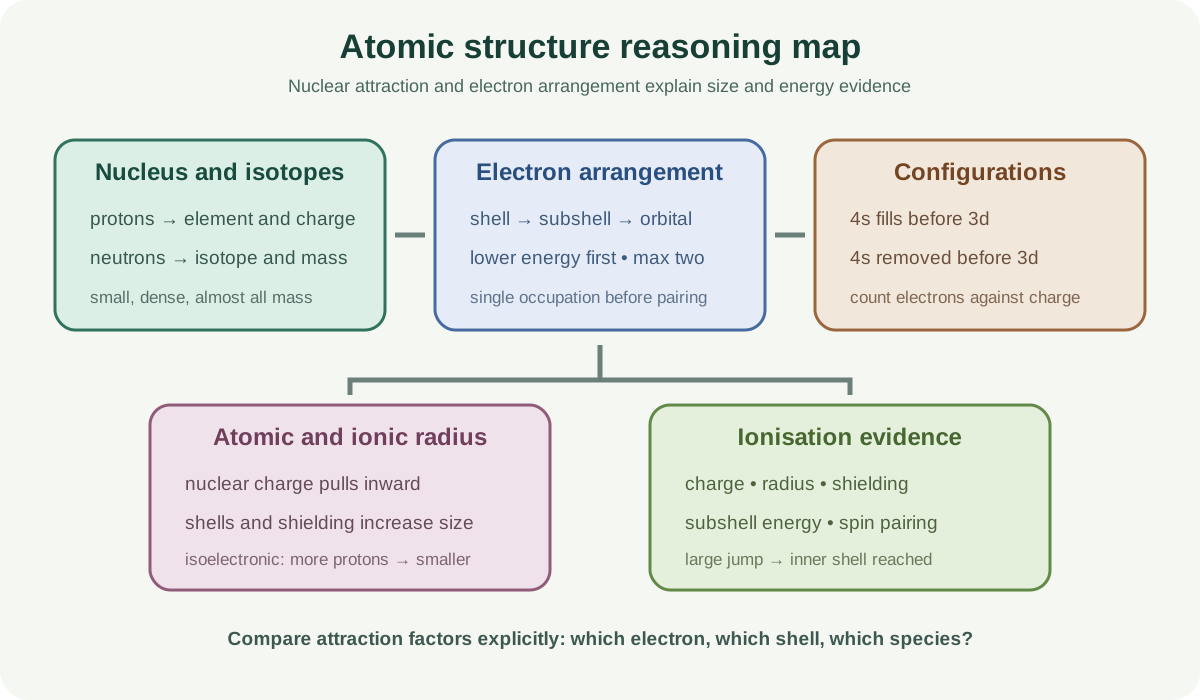
Atomic Structure is Cambridge International Chemistry 9701 Topic 1. It develops particles and radii, isotopes, shells and orbitals, ground-state electronic configurations, radicals and ionisation-energy evidence. The official boundary assesses ground-state atoms and ions from hydrogen to krypton. Experimental apparatus and measurement remain in the practical hub; this theory note owns models, configurations, trends and deduction.
1. The nuclear atom
An atom is mostly empty space around a very small, dense nucleus. Protons and neutrons are concentrated in the nucleus, while electrons occupy shells in the surrounding space.
A proton has relative charge plus one and relative mass one. A neutron has charge zero and relative mass one. An electron has relative charge minus one and a relative mass about one over 1840.
Almost all atomic mass lies in the nucleus because electron mass is negligible by comparison. Positive charge is also concentrated in the nucleus, while negative charge occupies the much larger electron region.
2. Atomic and mass numbers
The atomic number, also called proton number, is the number of protons in the nucleus. It identifies the element. The mass number, also called nucleon number, is the total number of protons and neutrons.
Therefore neutron number equals mass number minus atomic number. A neutral atom has equal numbers of protons and electrons. A positive ion has lost electrons; a negative ion has gained them. Nuclear particle counts do not change during ordinary ion formation.
For an ion with charge 2 plus, electron number is atomic number minus two. For an ion with charge 3 minus, electron number is atomic number plus three. Interpret the sign before performing arithmetic.
3. Charged-particle beams in an electric field
Protons and electrons moving at the same velocity deflect toward oppositely charged plates because their charges have opposite signs. Neutrons are undeflected because they have no charge.
The electron beam bends much more strongly than the proton beam. The particles have equal charge magnitude, but the electron's much smaller mass gives it a far larger charge-to-mass ratio and therefore greater acceleration in the same electric field.
Direction alone identifies charge sign; degree of deflection also depends on mass under the stated same-velocity condition.
4. Atomic radius trends
Across a period, atomic radius generally decreases. Proton number and nuclear charge increase, while added electrons enter the same principal shell. Shielding does not rise enough to cancel the stronger attraction, so the outer electron density is drawn closer to the nucleus.
Check this topic from memory
Attempt the matching topic bank before reopening the notes. Use each missed idea to decide what to review next.
Down a group, atomic radius increases because each step introduces another occupied principal shell. The outer electrons are farther from the nucleus and more shielded, outweighing increased nuclear charge.
Do not explain an across-period trend by saying atoms lose shells. The principal shell remains the same across a period.
5. Ionic radii
A cation is smaller than its parent atom. Electron loss can remove an outer shell, reduce electron-electron repulsion and increase attraction per remaining electron. An anion is larger than its parent atom because added electrons increase repulsion within the same outer shell while nuclear charge is unchanged.
For an isoelectronic series, all species have the same electron number. Radius decreases as proton number rises because a stronger nuclear charge attracts the same electron arrangement more strongly. State that the species are isoelectronic before using this comparison.
Across a sequence containing cations and anions, a sudden radius increase can occur when the comparison moves to a different electron arrangement. One simple monotonic statement is then insufficient.
6. Isotopes and notation
Isotopes are atoms of the same element with the same number of protons but different numbers of neutrons. Their atomic number is the same and their mass numbers differ.
In nuclide notation, the mass number appears at the upper left of the element symbol and atomic number at the lower left. Use their difference to find neutrons. Charge, when present, appears at the upper right and changes electron number only.
Isotopes of one element have the same chemical properties because neutral atoms have the same electron configuration, especially the same outer electrons. They differ in physical properties limited here to mass and density because their neutron counts and therefore masses differ.
7. Shells, subshells and orbitals
A shell is identified by principal quantum number n. Each shell contains one or more subshells, and each subshell contains orbitals. An orbital is a region of space that can contain a maximum of two electrons with opposite spins.
An s subshell has one orbital and holds two electrons. A p subshell has three orbitals and holds six. A d subshell has five orbitals and holds ten.
Ground state means the lowest-energy electronic configuration. Electrons occupy lower-energy orbitals first, subject to orbital capacities and repulsion rules.
8. Energy order and filling
The relevant increasing-energy order is 1s, 2s, 2p, 3s, 3p, 4s, 3d and 4p. The 4s subshell fills before 3d in neutral atoms in this range.
Within equal-energy p or d orbitals, electrons occupy separate orbitals with parallel spins before pairing. This reduces electron-electron repulsion. An orbital holds at most two electrons, and paired electrons have opposite spins.
The written order of a configuration can place 3d before 4s, as Cambridge's iron example does, while the filling logic still puts 4s before 3d.
9. Electron configurations of atoms
Use atomic number to obtain the neutral electron count, then fill orbitals in energy order. Full notation records every occupied subshell. Shorthand notation replaces the completed inner configuration with the preceding noble gas in brackets.
For iron, the accepted configuration is 1s2 2s2 2p6 3s2 3p6 3d6 4s2, or [Ar] 3d6 4s2. Check that superscripts add to 26.
Chromium and copper have ground-state exceptions commonly represented as [Ar] 3d5 4s1 and [Ar] 3d10 4s1. The arrangement reflects the close energies and stability effects involved. Do not force every atom into a simple filling pattern without checking its ground state.
10. Electron configurations of ions
For main-group ions, add or remove electrons from the highest occupied outer shell according to charge. For transition-metal cations, remove 4s electrons before 3d electrons, even though 4s filled first in the neutral atom.
Thus Fe2+ is [Ar] 3d6 and Fe3+ is [Ar] 3d5. Writing Fe2+ as [Ar] 3d4 4s2 incorrectly retains the electrons that are removed first.
Check the final electron count against atomic number and charge. Different species can be isoelectronic even though their nuclear charges differ.
11. Electrons-in-boxes notation
Represent each orbital by a box and each electron by an arrow. An s subshell has one box, p has three and d has five. Place one electron in each equal-energy orbital before pairing, with parallel spins for the single electrons.
This notation reveals unpaired electrons that compact superscript notation can hide. It also exposes errors such as placing three electrons in one orbital or pairing p electrons before each orbital is singly occupied.
Apply the same ground-state and ion rules used for ordinary configurations.
12. Shapes of s and p orbitals
An s orbital is spherical around the nucleus. A p orbital has two lobes on opposite sides of the nucleus, often described as dumbbell shaped. The three p orbitals have the same general shape but different spatial orientations.
An orbital drawing represents a region of high probability for finding an electron, not a fixed path around the nucleus. The nucleus lies at the centre of the s orbital and at the node between the two p lobes.
The official outcome requires description and sketches of s and p shapes, not detailed d-orbital shapes.
13. Free radicals
A free radical is a species with one or more unpaired electrons. The unpaired electron is commonly shown with a dot in a formula.
Radicals can be atoms, molecules or ions. Their high reactivity often arises because reactions can pair the unpaired electron, but “radical” is defined by electron pairing rather than by a charge or one particular reaction.
Use an electrons-in-boxes representation or appropriate dot notation to justify whether a species has unpaired electrons.
14. First ionisation energy
First ionisation energy is the energy required to remove one electron from each atom in one mole of gaseous atoms to form one mole of gaseous singly charged positive ions.
The equation must show gaseous species and one electron: X(g) becomes X+(g) plus e−. Ionisation energy is positive because energy is required to overcome electrostatic attraction between nucleus and electron.
Do not define it for solid atoms or omit the per-mole and gaseous conditions.
15. Successive ionisation energies
Second ionisation energy removes one electron from each ion in one mole of gaseous singly charged ions, forming gaseous doubly charged ions. The nth ionisation removes an electron from gaseous ions already carrying charge n minus one.
Successive ionisation energies increase because each electron is removed from an increasingly positive species. A very large jump occurs when removal begins from a lower principal shell that is closer to the nucleus and less shielded.
The number of electrons removed before the large jump gives the number of outer-shell electrons and can identify the group for a main-group element.
16. Factors controlling ionisation energy
Greater nuclear charge strengthens attraction and tends to increase ionisation energy. Greater atomic or ionic radius places the electron farther away and tends to decrease it. Shielding by inner shells and subshells reduces the effective attraction felt by an outer electron.
Spin-pair repulsion can make one of two electrons in the same orbital easier to remove than an unpaired electron in an otherwise comparable orbital. Subshell energy also matters: a higher-energy p electron can be easier to remove than an s electron in the same principal shell.
A complete explanation compares all relevant factors rather than naming nuclear charge alone.
17. Trends and deviations
First ionisation energy generally increases across a period because nuclear charge rises while shielding and principal shell remain broadly similar, so atomic radius decreases and attraction strengthens.
The drop from magnesium to aluminium occurs because aluminium's removed electron is in the higher-energy 3p subshell rather than 3s. The drop from phosphorus to sulfur occurs because sulfur has a paired 3p electron; spin-pair repulsion makes removal easier than from phosphorus's three singly occupied p orbitals.
Down a group, first ionisation energy generally decreases because the outer electron is in a higher shell, farther from the nucleus and more shielded. These effects outweigh increased nuclear charge.
Worked application: deduce position from successive ionisation energies
An element has successive ionisation energies that rise moderately for the first three removals, followed by a very large jump before the fourth. Three electrons are removed before the process reaches a lower, less shielded shell, so the atom has three outer-shell electrons and belongs to Group 13 under modern numbering. If the values are consistent with an outer electron in the third shell, its period is 3 and the element is aluminium. Its configuration is [Ne] 3s2 3p1. The large jump is evidence for the shell boundary, not merely a numerical irregularity, and the exact period needs absolute values or other evidence.
Common misconceptions and corrections
Saying the nucleus fills most atomic volume. The atom is mostly empty space.
Giving an electron relative mass of one. Its relative mass is about one over 1840.
Calling mass number the number of neutrons. It is protons plus neutrons.
Changing proton number when forming an ion. Ion formation changes electrons.
Making a neutron beam curve in an electric field. Neutrons have no charge.
Predicting equal proton and electron deflection. Electron mass is far smaller.
Saying radius falls across a period because shells are lost. Electrons enter the same shell.
Calling every cation larger than its atom. Cations are smaller.
Comparing isoelectronic radii without nuclear charge. More protons give smaller radius.
Defining isotopes by electrons. They differ in neutron number.
Saying isotopes have different chemical properties because masses differ. Their electron configurations match.
Calling a subshell one orbital. Only an s subshell has one orbital.
Putting more than two electrons in an orbital. Two is the maximum.
Pairing p electrons before single occupation. Occupy equal-energy orbitals singly first.
Filling 3d before 4s in neutral atoms. 4s fills first in this range.
Removing 3d electrons before 4s from transition ions. Remove 4s first.
Ignoring chromium and copper ground states. They are filling exceptions.
Drawing an orbital as an electron path. It is a probability region.
Drawing detailed d shapes for this outcome. Only s and p sketches are required.
Defining a radical as a charged species. It has an unpaired electron.
Omitting gaseous states from ionisation equations. They are definition conditions.
Defining first ionisation for one atom rather than one mole. Use molar wording.
Removing the second electron from a neutral atom. It comes from a gaseous 1+ ion.
Saying successive energies always rise smoothly. Shell boundaries cause large jumps.
Explaining every trend by nuclear charge alone. Radius, shielding, subshell and pairing matter.
Calling the magnesium-aluminium drop extra shielding by a new shell. The electron enters 3p.
Calling the phosphorus-sulfur drop lower nuclear charge. Spin-pair repulsion explains it.
Assessment guidance
Particle questions need correct relative charge and mass plus explicit electron accounting for ions. Radius explanations should compare nuclear charge, shell, shielding and electron repulsion. For configurations, show energy order, check the electron total, apply chromium and copper exceptions and remove 4s before 3d for transition cations. Orbital boxes must show single occupation before pairing. Ionisation definitions and equations require one mole, gaseous species and correct charge progression. When interpreting trends or successive values, identify the electron's shell or subshell and build a comparative attraction argument rather than listing factors without direction.
Retrieval practice
Complete particle and isotope tables for neutral atoms and ions. Rank atomic and isoelectronic radii with explanations. Rebuild the orbital-capacity and energy-order sequence, then write configurations and box diagrams from hydrogen to krypton, including transition ions. Sketch s and p orbitals and identify radicals. Finish by writing three successive-ionisation equations, explaining the period deviations and deducing group and configuration from two unfamiliar datasets.