Atoms, Molecules and Stoichiometry is Cambridge International Chemistry 9701 Topic 2. It connects relative mass and the mole to chemical formulae, equations, reacting masses, gas volumes, solution concentrations, yield and limiting reagents. Practical weighing, volumetric technique and titration execution remain in the practical hub; this theory note owns chemical representation and quantitative reasoning.
1. The unified atomic mass unit
The unified atomic mass unit is one twelfth of the mass of one carbon-12 atom. It provides the reference against which atomic and molecular masses are compared.
Relative quantities are ratios and therefore have no unit. A numerical atomic-scale mass in unified atomic mass units and a relative mass can share a numerical value, but their definitions are not interchangeable.
Carbon-12 is the defined reference, not an average carbon atom and not one mole of carbon.
2. Relative isotopic and atomic mass
Relative isotopic mass is the mass of one atom of a specified isotope relative to one twelfth of the mass of one carbon-12 atom.
Relative atomic mass, Ar, is the weighted mean mass of the atoms of an element relative to one twelfth of the mass of one carbon-12 atom. It accounts for isotopic abundances, so it is commonly not a whole number.
To calculate Ar, multiply each relative isotopic mass by its fractional or percentage abundance, add the products and divide by the total abundance scale used. Do not take a simple mean unless abundances are equal.
3. Relative molecular and formula mass
Relative molecular mass, Mr, is the mass of one molecule relative to one twelfth of the mass of one carbon-12 atom. Add the Ar values for every atom in the molecular formula.
Relative formula mass is used for ionic or giant structures that do not consist of discrete molecules. It is calculated from the formula unit in the same arithmetic way.
Neither relative molecular nor relative formula mass has a unit. Molar mass has the same numerical value but carries units such as grams per mole.
4. The mole and Avogadro constant
One mole contains the Avogadro constant number of specified entities. The entity may be atoms, molecules, ions, electrons or formula units, so it must be named.
Amount in moles equals number of entities divided by the Avogadro constant. Conversely, number of entities equals amount multiplied by the Avogadro constant.
One mole of oxygen atoms and one mole of oxygen molecules contain the same number of specified entities but different numbers of atoms and different masses. Chemical wording matters.
5. Formulae of ionic compounds
Check this topic from memory
Attempt the matching topic bank before reopening the notes. Use each missed idea to decide what to review next.
An ionic compound is electrically neutral overall. Determine cation and anion charges, then choose the smallest whole-number ratio that makes total positive and negative charge equal.
Charges can be predicted for common main-group ions from periodic position or supplied oxidation numbers. Cambridge requires recall of nitrate NO3−, carbonate CO3²−, sulfate SO4²−, hydroxide OH−, ammonium NH4+, zinc Zn²+, silver Ag+, hydrogencarbonate HCO3− and phosphate PO4³−.
Use brackets when more than one polyatomic ion is required, as in Ca(NO3)2. Do not alter subscripts inside a polyatomic ion when balancing charge.
6. Oxidation numbers in names
A Roman numeral in an ionic compound's name gives the oxidation number of the named element, not the number of atoms. Iron(III) oxide contains Fe3+ and O2−, giving Fe2O3.
Check neutrality after constructing the formula. The formula ratio must be simplest; writing Fe4O6 obscures the empirical formula even though its charges also balance.
Do not assign a Roman numeral to a fixed-charge ion merely because the compound contains several atoms.
7. Balanced equations and state symbols
A balanced chemical equation conserves each element's atoms and total charge. Change coefficients in front of formulae, never subscripts within correct formulae.
Use state symbols accurately: solid (s), liquid (l), gas (g) and aqueous (aq). A substance dissolved in water is aqueous; a pure liquid is not automatically aqueous.
Coefficients give mole ratios. They can also give molecule ratios and, for gases under the same conditions, volume ratios. They do not give mass ratios directly.
8. Ionic equations
An ionic equation shows the species that undergo chemical change and omits spectator ions. Begin with a balanced full equation, separate appropriate strong aqueous electrolytes into ions, cancel species unchanged on both sides, then check atoms and charge.
Do not split solids, liquids, gases or weak molecular species without justification. For precipitation of silver chloride, the net equation is Ag+(aq) plus Cl−(aq) forms AgCl(s).
A spectator ion is present but chemically unchanged. Omitting all ions because they are “spectators” can remove reacting ions as well.
9. Empirical and molecular formulae
An empirical formula gives the simplest whole-number ratio of atoms of each element. A molecular formula gives the actual number of each atom in one molecule.
From masses or percentages, divide each amount by its Ar to obtain moles, divide all mole values by the smallest and convert near-simple ratios to whole numbers. Small departures can reflect rounding; large departures require rechecking data and arithmetic.
Calculate empirical formula mass, then divide Mr by it. The result should be a whole-number multiplier. Multiply every empirical subscript by that number.
10. Anhydrous and hydrated salts
An anhydrous substance contains no water of crystallisation. A hydrated salt contains water molecules in a fixed ratio within its crystal structure. Water of crystallisation is represented after a dot in the formula.
To determine a hydrate formula from heating data, find moles of anhydrous salt and moles of water lost, then simplify their ratio. The mass lost is treated as water only when the procedure and information support that assumption.
Incomplete heating gives too little measured water loss, while decomposition or loss of solid can distort the inferred ratio in other directions. Those method issues belong to practical evaluation.
11. The central stoichiometric pathway
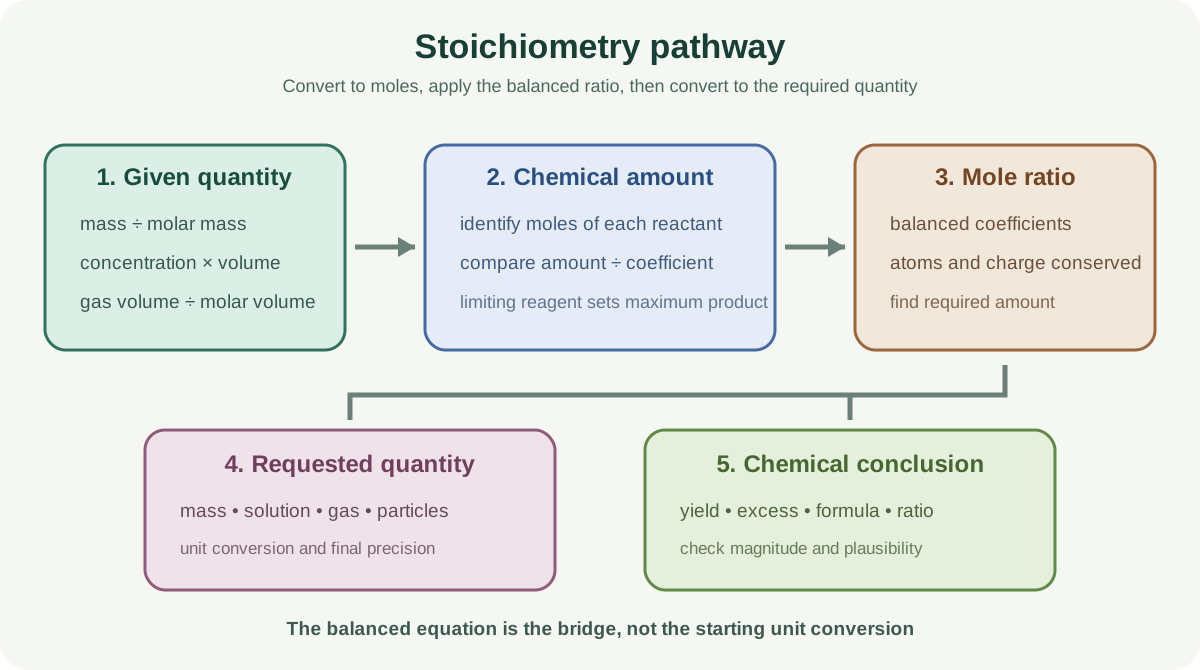
Most calculations follow the same route: convert the given quantity to moles, use the balanced-equation mole ratio, then convert moles of the required substance to the requested quantity.
Mass converts to amount by dividing by molar mass. Solution amount equals concentration multiplied by volume in cubic decimetres. Gas amount uses the molar gas volume at the stated conditions or other supplied relationship.
Write the balanced equation before applying ratios. A correct mole conversion attached to the wrong equation ratio produces a chemically wrong answer.
12. Reacting-mass calculations
Convert the known mass to moles using molar mass. Multiply by the required coefficient ratio, then multiply required moles by the product molar mass.
Keep full calculator values during intermediate stages and round at the end. Check whether the requested mass is plausible from the equation and relative molar masses.
If reactant purity is given, first find the mass of pure reacting substance. If the product yield is less than 100 percent, distinguish theoretical from actual product.
13. Percentage yield
Percentage yield equals actual yield divided by theoretical yield, multiplied by 100. The theoretical yield comes from stoichiometry and the limiting reagent. Actual yield is measured or supplied.
A yield below 100 percent can result from incomplete reaction, side reactions, equilibrium, product loss or purification. A calculated yield above 100 percent signals wet or impure product, measurement error or incorrect calculation; it is not evidence that more atoms were created.
Do not use reactant mass as the denominator unless it happens to equal the theoretical product mass, which is not the general definition.
14. Gas-volume calculations
At the same temperature and pressure, gas volumes are proportional to amounts. Use the molar gas volume specified or appropriate to the stated conditions, keeping units consistent.
For combustion, balance carbon and hydrogen first, then oxygen. Convert the hydrocarbon amount or volume through the equation to oxygen consumed or carbon dioxide and water produced. Remember that water's physical state depends on the stated conditions.
Do not apply a room-condition molar gas volume to a gas at unspecified different conditions without justification.
15. Solution concentration calculations
Amount in moles equals concentration in moles per cubic decimetre multiplied by volume in cubic decimetres. Convert cubic centimetres to cubic decimetres by dividing by 1000.
Use the equation ratio after finding moles in the measured aliquot. If the question asks about the original solution, account for dilution, aliquot fraction or total volume.
Mass concentration and molar concentration are different quantities. Convert using molar mass when required rather than inserting grams per cubic decimetre into a molar formula.
16. Limiting and excess reagents
The limiting reagent is consumed first and determines the maximum product. The excess reagent remains after the limiting reagent is used.
Convert each reactant to moles and compare moles divided by its equation coefficient. The smaller reaction extent identifies the limiting reagent. Comparing raw masses or moles alone ignores stoichiometric ratios.
Use only the limiting reagent to calculate theoretical yield. To find excess remaining, calculate how much excess reagent reacts with the limiting amount, then subtract from its initial amount.
17. Deduce stoichiometric relationships
Experimental masses, gas volumes or solution amounts can reveal an unknown coefficient ratio. Convert each measured quantity to moles, simplify the ratio and use chemical context to construct the equation.
Uncertainty can produce ratios close to whole numbers rather than exact integers. Use justified rounding, not arbitrary forcing. Charge balance and plausible formulae provide additional checks.
The ratio describes the reaction under the stated conditions. A different product or oxidation state can change it.
18. Significant figures and checks
Final answers should reflect the number of significant figures given or requested. Do not round early and lose information, but do not report unjustified calculator digits.
Track units through every conversion. Check formula mass, equation balance, mole ratio, limiting reagent and final unit. Estimate order of magnitude to detect a missing factor of 1000.
Chemical sense is a validation tool: yields should not exceed theoretical yield for a pure dry product, mole ratios should match the equation and atom counts must be conserved.
Worked application: limiting reagent and percentage yield
Magnesium reacts with oxygen according to 2Mg plus O2 forms 2MgO. A mixture contains 4.80 g Mg and 2.40 g O2. Using molar masses 24.0 and 32.0 g per mole gives 0.200 mol Mg and 0.0750 mol O2. The equation needs 0.100 mol O2 for all magnesium, so oxygen is limiting. It forms 0.150 mol MgO, giving a theoretical mass of 6.00 g when Mr is 40.0. If 5.10 g dry product is isolated, percentage yield is 5.10 divided by 6.00 multiplied by 100, or 85.0 percent. The unused magnesium amount is 0.050 mol.
Common misconceptions and corrections
Defining the atomic mass unit from one mole of carbon-12. It uses one atom.
Giving Ar a unit. Relative masses are dimensionless.
Taking an unweighted isotope mean. Use abundances.
Calling an ionic formula mass Mr without qualification. Use relative formula mass.
Treating a mole as a mass. It is an amount containing specified entities.
Omitting the entity from a particle count. Atoms, ions and molecules differ.
Balancing ionic formulae by changing polyatomic-ion subscripts. Preserve the ion.
Reading a Roman numeral as atom count. It is an oxidation number.
Balancing equations by changing formula subscripts. Change coefficients only.
Calling every dissolved-looking liquid aqueous. Aqueous means dissolved in water.
Using equation coefficients as mass ratios. They are mole ratios.
Splitting solids into ions in an ionic equation. Split suitable aqueous electrolytes.
Leaving spectator ions in the net equation. Cancel unchanged ions.
Calling molecular formula the simplest ratio. That is the empirical formula.
Rounding a 1.5 mole ratio directly to 2. Multiply all ratios to whole numbers.
Calculating a molecular formula without Mr. The multiplier needs molecular mass.
Calling surface water water of crystallisation. Crystal water has fixed stoichiometry.
Assuming every heating mass loss is water. Decomposition or solid loss may occur.
Starting with the equation ratio before converting to moles. Convert given quantity first.
Rounding every intermediate value. Round the final answer.
Using actual yield to calculate theoretical yield. Theory comes from stoichiometry.
Using reactant mass as the yield denominator. Use theoretical product mass.
Accepting yield above 100 percent without evaluation. Product may be wet or impure.
Using 24 cubic decimetres per mole under all conditions. Follow stated conditions.
Using cubic centimetres directly with molar concentration. Convert to cubic decimetres.
Confusing mass and molar concentration. Molar mass links them.
Choosing the smaller reactant mass as limiting. Compare stoichiometric amounts.
Using excess reagent to find theoretical product. Use the limiting reagent.
Forcing an experimental ratio to convenient integers. Use uncertainty and chemistry.
Reporting excessive significant figures. Match the data.
Assessment guidance
Write the chemical formula and balanced equation before calculating. Show the route from given quantity to moles, through the coefficient ratio, then to the requested quantity with units. For formula questions, preserve polyatomic ions and prove charge neutrality. Empirical-formula work needs mole ratios and justified conversion to integers. Hydrate work must distinguish water lost from anhydrous salt. In limiting-reagent questions, compare coefficient-adjusted amounts and use the limiter for theoretical yield. Keep unrounded intermediate values, apply dilution and aliquot factors explicitly, and report a final precision supported by the data.
Retrieval practice
Define all four relative masses and the mole. Reconstruct the required ion list and write ten neutral formulae. Balance molecular and ionic equations with states. Solve empirical, molecular and hydrate formula problems. Complete reacting-mass, gas-volume and solution calculations through the common mole-ratio pathway. Finish with three limiting-reagent and percentage-yield problems, checking units, significant figures and chemical plausibility at every stage.