Cambridge International AS and A Level Chemistry 3: Chemical bonding
Cambridge International AS and A Level Chemistry 3: Chemical bonding
Study guide/
Cambridge International Chemistry 9701 notes on electronegativity, ionic, metallic and covalent bonding, orbital overlap, shapes and intermolecular forces.
Chemical Bonding is Cambridge International Chemistry 9701 Topic 3. It connects electronegativity with ionic, metallic, covalent and coordinate bonding, orbital overlap, hybridisation, bond energy and length, molecular shape, polarity, intermolecular forces and dot-and-cross representation. Structure-property analysis of crystalline solids is developed separately in Topic 4.
1. Electronegativity
Electronegativity is the power of an atom to attract electrons to itself. It applies to an atom within a bond, not an isolated ion's general attraction to any electron.
Greater nuclear charge increases attraction. Smaller atomic radius brings bonding electrons closer. Less shielding by inner shells and subshells allows stronger effective attraction.
Across a period, electronegativity generally increases because nuclear charge increases and radius decreases while shielding changes relatively little. Down a group, it generally decreases because additional shells increase radius and shielding.
2. Predicting bond type
A large difference in Pauling electronegativity values favours electron transfer and ionic bonding; a smaller difference favours electron sharing and covalent bonding. Values will be supplied where needed.
This is a predictive continuum rather than a magic universal cut-off. Apply the data and chemical context given. The current outcome explicitly excludes assessment of covalent character in ionic compounds, so do not introduce polarisation rules when the question asks only for this boundary.
Equal electronegativities give a non-polar covalent bond. Unequal values can give a polar covalent bond with partial charges.
3. Ionic bonding
Ionic bonding is the electrostatic attraction between oppositely charged ions. Cations and anions form an extended arrangement rather than isolated bonded pairs.
In sodium chloride, Na+ and Cl− attract. In magnesium oxide, Mg2+ and O2− have larger charge magnitudes. Calcium fluoride contains Ca2+ and twice as many F− ions to maintain neutrality.
The bond is the attraction throughout the ionic structure, not the act of electron transfer. Electron transfer explains ion formation; electrostatic attraction describes bonding.
4. Metallic bonding
Metallic bonding is the electrostatic attraction between positive metal ions and delocalised electrons. The electrons are not attached to one particular ion and can move through the structure.
Both parts are essential. “A sea of electrons” alone omits the positive ions and the attraction that holds the structure together. The ions are metal ions, not neutral atoms floating among electrons.
Check this topic from memory
Attempt the matching topic bank before reopening the notes. Use each missed idea to decide what to review next.
Metallic property explanations are developed with lattice structures in Topic 4, but the bonding definition belongs here.
5. Covalent bonding
Covalent bonding is the electrostatic attraction between the nuclei of two atoms and a shared pair of electrons. Sharing alone is an incomplete definition because the attractive forces are the bond.
Hydrogen and chlorine have single bonds, oxygen a double bond and nitrogen a triple bond. Hydrogen chloride has a polar single bond. Carbon dioxide contains two C=O double bonds. Ammonia has three N-H bonds and a lone pair; methane has four C-H bonds.
Ethane has one C-C single bond and six C-H bonds. Ethene has a C=C double bond and four C-H bonds. Bond multiplicity must match valence electron accounting.
6. Expanded octets in Period 3
Period 3 elements can be represented with expanded octets in the named compounds sulfur dioxide, phosphorus pentachloride and sulfur hexafluoride.
PCl5 has five bonding pairs around phosphorus and SF6 has six. Appropriate dot-and-cross diagrams show more than eight electrons around the central Period 3 atom.
Do not apply expanded-octet reasoning to Period 2 central atoms such as carbon, nitrogen or oxygen in the specified simple structures.
7. Coordinate bonding
A coordinate, or dative covalent, bond is a covalent bond in which both electrons in the shared pair originate from the same atom. Once formed, the shared pair is attracted to both nuclei like another covalent bond.
Ammonia donates its nitrogen lone pair to H+ from hydrogen chloride, forming NH4+. An arrow can show electron-pair donation from N to H during formation. The ammonium ion then contains four equivalent N-H bonds in its structure.
Electron-deficient AlCl3 forms Al2Cl6. Lone pairs on bridging chlorine atoms donate into empty orbitals on aluminium, producing coordinate bonds that link the two units.
8. Sigma bonds
A sigma bond forms by direct, head-on overlap of orbitals along the internuclear axis. Every single covalent bond is a sigma bond, and a multiple bond contains one sigma bond.
H2 forms by direct overlap of two 1s orbitals. In ethane, the C-C bond and all C-H bonds are sigma bonds. Direct overlap concentrates electron density between the nuclei and allows rotation around many isolated single bonds.
Do not count a double bond as two sigma bonds. Its second component is a pi bond.
9. Pi bonds
A pi bond forms by sideways overlap of adjacent parallel p orbitals, producing electron density above and below the sigma-bond axis. It forms only after the sigma framework places the atoms appropriately.
Ethene's C=C bond contains one sigma and one pi bond. HCN has a C≡N bond containing one sigma and two mutually perpendicular pi bonds. Nitrogen's N≡N bond has the same one-sigma, two-pi pattern.
Sideways overlap restricts rotation because twisting destroys parallel alignment. A pi bond is not located solely “above” the molecule; its electron density has connected regions above and below the axis.
10. Hybridisation
Hybridisation describes mixing of atomic orbitals on one atom to give equivalent bonding orbitals. sp hybridisation produces two orbitals oriented linearly at 180 degrees. sp2 produces three trigonal-planar orbitals at 120 degrees, leaving one unhybridised p orbital. sp3 produces four orbitals directed tetrahedrally at 109.5 degrees.
In ethane, each carbon is sp3 hybridised and forms four sigma bonds. In ethene, each carbon is sp2 hybridised; three sp2 orbitals form sigma bonds and the remaining p orbitals form the pi bond. In HCN, carbon is sp hybridised, with two unhybridised p orbitals available for two pi bonds.
Hybridisation describes the bonding model; it is not the same as molecular shape when lone pairs are present.
11. Bond energy and length
Bond energy is the energy required to break one mole of a particular covalent bond in the gaseous state. Bond breaking requires energy, so the quoted breaking value is positive.
Bond length is the internuclear distance between two covalently bonded atoms. Greater bond order commonly gives a shorter, stronger bond for the same pair of elements. A C=C bond is shorter and stronger than C-C, although a double-bond energy is not simply twice a single-bond energy.
Weaker bonds require less energy to break and can contribute to greater reactivity when bond breaking is important. Reactivity also depends on polarity, mechanism and other bonds, so one bond energy does not settle every comparison.
12. VSEPR theory
Electron pairs around a central atom repel and arrange to minimise repulsion. Lone-pair to lone-pair repulsion is greater than lone-pair to bonding-pair repulsion, which is greater than bonding-pair to bonding-pair repulsion.
Count regions of electron density around the central atom. A double or triple bond counts as one region for basic shape prediction. Use the electron-pair arrangement, then name the molecular shape from atom positions.
Lone pairs compress bond angles because their electron density occupies more space near the central atom.
13. Named shapes and angles
BF3 has three bonding regions and no lone pair on boron: trigonal planar, 120 degrees. CO2 has two bonding regions: linear, 180 degrees. CH4 has four bonding regions: tetrahedral, 109.5 degrees.
NH3 has three bonds and one lone pair: pyramidal, about 107 degrees. H2O has two bonds and two lone pairs: non-linear, about 104.5 degrees. The successive angle decrease reflects stronger lone-pair repulsion.
PF5 has five bonding regions: trigonal bipyramidal, with 120-degree equatorial and 90-degree axial-equatorial angles. SF6 has six: octahedral, with adjacent bonds at 90 degrees.
Analogous molecules and ions can be predicted by matching their central electron-region and lone-pair counts.
14. Bond polarity and molecular dipoles
An electronegativity difference creates a bond dipole, with partial negative charge on the more electronegative atom and partial positive charge on the other.
Molecular polarity depends on both bond dipoles and geometry. In symmetrical CO2, equal C=O dipoles point in opposite directions and cancel, so the molecule has no overall dipole. In non-linear H2O, O-H dipoles do not cancel, so water is polar.
Do not decide molecular polarity from one polar bond without considering vector direction and shape.
15. Van der Waals forces as a generic term
In this syllabus, van der Waals forces is a generic term for intermolecular forces between molecular entities other than forces due to bond formation. The named types are instantaneous dipole-induced dipole forces and permanent dipole-permanent dipole forces, including hydrogen bonding.
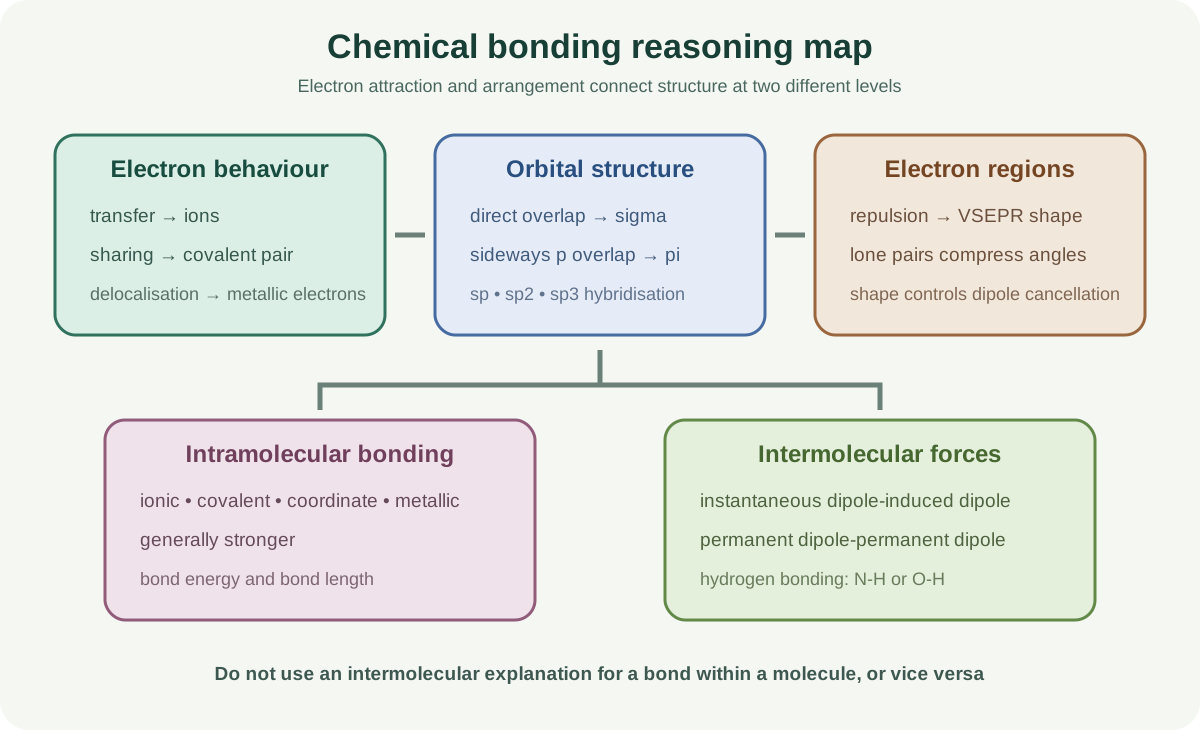
Intermolecular forces act between molecules. They are generally weaker than ionic, covalent and metallic bonding. Melting or boiling a simple molecular substance normally overcomes intermolecular attractions rather than breaking covalent bonds within molecules.
The existence of intermolecular forces does not mean a molecule lacks covalent bonds; the two forces act at different levels.
16. Instantaneous dipole-induced dipole forces
Electron movement can create a temporary uneven distribution and an instantaneous dipole. This distorts electron density in a neighbouring molecule, inducing a dipole. Attractions between the temporary dipoles are also called London dispersion forces.
They occur between all atoms and molecules, including non-polar species. Their strength generally increases with electron number and polarisability, and also depends on contact between molecular surfaces.
Do not describe them as permanent charges or as present only in polar molecules.
17. Permanent dipole forces
Polar molecules have permanent partial charges. Their positive and negative ends attract in favourable orientations, giving permanent dipole-permanent dipole forces.
For otherwise comparable substances, these attractions can raise melting or boiling points relative to non-polar molecules. Size, shape and dispersion forces also matter, so compare the whole intermolecular-force profile.
A polar bond does not guarantee permanent dipole forces between molecules if molecular symmetry cancels the overall dipole.
18. Hydrogen bonding
Hydrogen bonding is a special strong permanent dipole-permanent dipole attraction. Within this syllabus boundary, it occurs between molecules containing N-H or O-H groups, where the hydrogen bonded to a highly electronegative atom is attracted to a lone pair on N or O in another molecule.
Ammonia and water form hydrogen bonds. Show the intermolecular attraction with a dotted line from the partially positive H of one molecule to the N or O lone-pair region of another.
Do not draw the hydrogen bond as the covalent N-H or O-H bond, and do not count every molecule containing nitrogen or oxygen as hydrogen-bonding to itself.
19. Anomalous properties of water
Water's hydrogen-bond network requires relatively large energy to disrupt, helping explain its relatively high melting and boiling points. Cohesion from hydrogen bonding contributes to high surface tension.
In ice, hydrogen bonds hold water molecules in an open structure. The molecules are farther apart on average than in liquid water, making ice less dense so it floats.
Melting disrupts enough of the open network for molecules to pack more closely. It does not break all O-H covalent bonds or remove all hydrogen bonds from liquid water.
20. Dot-and-cross diagrams
Dot-and-cross diagrams distinguish the original outer electrons of different atoms. For ionic bonding, show bracketed ions, charges and completed outer shells. For covalent bonding, place shared pairs between atoms and show lone pairs.
For coordinate bonding, both symbols in the donated pair originate from the donor atom. Diagrams may include expanded octets or odd-electron species where specified.
Count electrons, charge and bonding pairs after drawing. A structurally plausible sketch that omits lone pairs or ion brackets can still be incomplete.
Worked application: shape, polarity and intermolecular forces
Compare BF3, NH3 and H2O. BF3 has three bonding regions and no central lone pair, so it is trigonal planar at 120 degrees. Its polar B-F bond dipoles cancel symmetrically, giving no molecular dipole; dispersion forces remain. NH3 has three bonding pairs and one lone pair, so it is pyramidal at about 107 degrees and polar. H2O has two bonding pairs and two lone pairs, so it is non-linear at about 104.5 degrees and polar. Both NH3 and H2O form hydrogen bonds, but water can develop an extensive network that helps explain its anomalously high boiling point and surface tension.
Common misconceptions and corrections
Defining electronegativity as electron affinity. It is an atom's power to attract bonded electrons.
Using one fixed electronegativity cut-off universally. Apply supplied values and context.
Discussing covalent character in ionic compounds here. The outcome excludes it.
Calling electron transfer the ionic bond. The bond is electrostatic attraction between ions.
Drawing ionic compounds as isolated pairs only. Ionic attraction extends through the structure.
Defining metallic bonding as free electrons. Include positive ions and attraction.
Defining a covalent bond as sharing alone. Include nuclei attracting the shared pair.
Giving oxygen a single bond in O2. It has a double bond.
Giving nitrogen a double bond in N2. It has a triple bond.
Forcing every Period 3 centre to obey an octet. Named species can expand it.
Expanding the octet of carbon or nitrogen. Period 2 atoms do not do so here.
Saying each atom supplies one coordinate-bond electron. Both originate from the donor.
Calling ammonium's coordinate bond permanently different. The four N-H bonds are equivalent after formation.
Counting a double bond as two sigma bonds. It contains one sigma and one pi.
Describing pi overlap as head-on. It is sideways p-orbital overlap.
Allowing free rotation around C=C. Rotation disrupts pi overlap.
Equating hybridisation directly with molecular shape. Lone pairs alter atom positions.
Saying bond energy is released on breaking. Breaking requires energy.
Omitting gaseous state from bond-energy definition. It is part of the definition.
Assuming a double bond energy is exactly twice a single bond. Bond energies are not simply additive that way.
Counting a double bond as two VSEPR regions. It is one region.
Making NH3 tetrahedral in molecular shape. Its atom arrangement is pyramidal.
Giving H2O a 109.5-degree angle. Two lone pairs compress it to about 104.5 degrees.
Calling PF5 octahedral. It is trigonal bipyramidal.
Calling SF6 trigonal bipyramidal. It is octahedral.
Saying any polar bond makes a polar molecule. Dipoles can cancel.
Calling intermolecular forces covalent bonds. They act between molecular entities.
Saying boiling breaks covalent bonds. It normally overcomes intermolecular forces.
Restricting dispersion forces to non-polar molecules. They occur in all species.
Giving a temporary dipole permanent charge. Electron fluctuations create it.
Calling every N-containing molecule hydrogen-bonding. An appropriate N-H group is required here.
Drawing a hydrogen bond within one O-H bond. It is an intermolecular attraction.
Saying ice is denser than water. Its open network makes it less dense.
Omitting lone pairs and charges from dot-and-cross diagrams. Electron accounting must be complete.
Assessment guidance
Bond definitions require the named charged or shared particles and the electrostatic attraction between them. Use electronegativity with nuclear charge, radius and shielding, then distinguish bond polarity from molecular polarity. Orbital-overlap answers should count sigma and pi bonds and connect sp, sp2 or sp3 hybridisation to remaining p orbitals. For shapes, count electron regions and lone pairs, name the geometry and give the Cambridge angle. Intermolecular-force comparisons must identify dispersion, permanent dipoles or hydrogen bonding without breaking intramolecular bonds. Complete dot-and-cross diagrams with lone pairs, brackets, charges and donor-origin symbols.
Retrieval practice
Rebuild definitions for electronegativity and four bonding types. Draw dot-and-cross diagrams for every named molecule, ion and expanded-octet example. Count sigma and pi bonds in the specified molecules and assign hybridisation. Predict shapes and angles from electron regions. Decide bond and molecular polarity for a mixed set, then rank intermolecular forces and explain all four anomalous water properties without confusing intermolecular and covalent bonds.