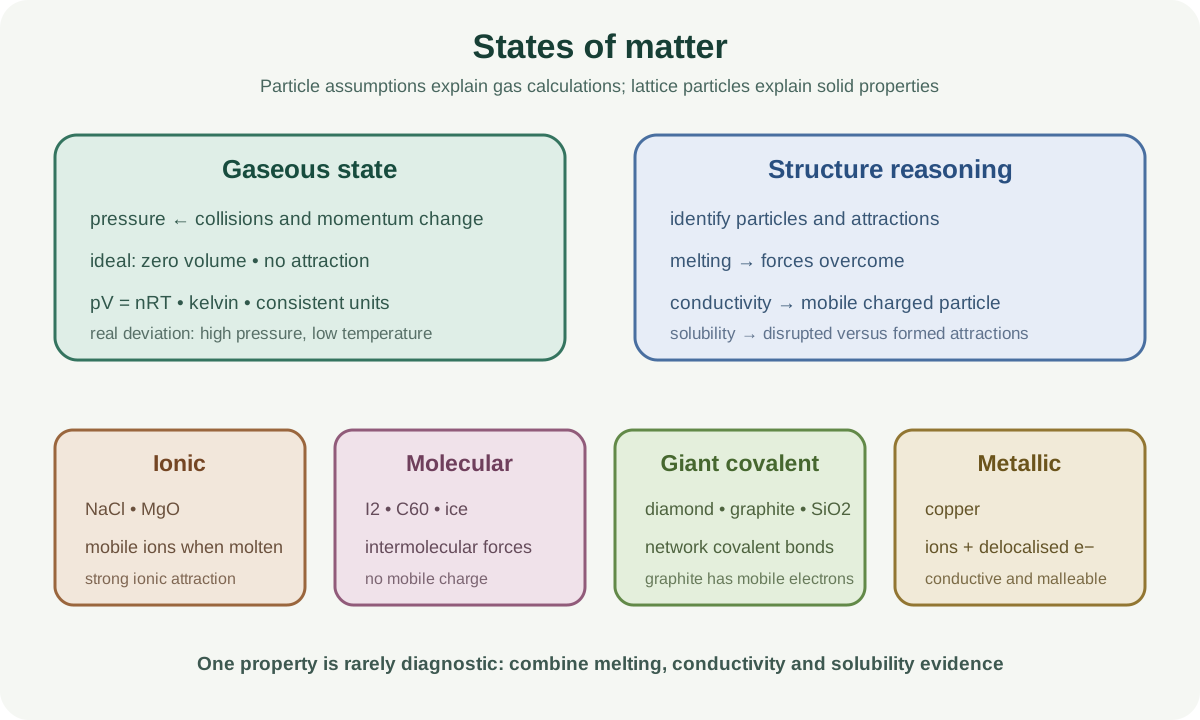
States of Matter is Cambridge International Chemistry 9701 Topic 4. It connects the particle origin of gas pressure and the ideal gas equation with crystalline structures and their melting point, boiling point, conductivity and solubility. Theory owns particle and lattice reasoning; practical gas collection, heating, conductivity testing and measurement evaluation remain in the practical hub.
1. Origin of gas pressure
Gas particles move rapidly and randomly. When they collide with container walls, their momentum changes. The wall exerts a force on the particles, and the particles exert an equal and opposite force on the wall. Force per unit area is pressure.
More frequent collisions or greater momentum change per collision can increase pressure. Heating at fixed volume raises average kinetic energy and collision effects. Compressing at fixed temperature shortens travel distances and increases collision frequency per unit wall area.
Gas pressure is not caused by particles simply “taking up space” or by their weight alone. It arises from collisions with the walls.
2. The ideal gas model
An ideal gas consists of particles with zero volume and no intermolecular attractions. Collisions are treated as elastic, so total kinetic energy is conserved in them.
Zero particle volume means particle size is negligible compared with container volume. No attraction means potential-energy interactions between particles do not alter the pressure-volume relationship.
This is a model. Real particles have volume and intermolecular forces, but gases can behave approximately ideally under suitable conditions.
3. Real-gas deviations
Real gases depart most from ideal behaviour at high pressure and low temperature. High pressure places particles close enough that their own volume is no longer negligible. Low temperature reduces kinetic energy so intermolecular attractions have greater relative influence.
At low pressure, particles are far apart. At high temperature, their kinetic energy makes attractions less influential. These conditions therefore favour more ideal behaviour.
Do not say a real gas becomes literally made of point particles. Its behaviour merely approaches the ideal prediction.
4. The ideal gas equation
The equation is pV = nRT, where p is pressure, V is volume, n is amount in moles, R is the gas constant and T is absolute temperature.
Use units consistent with the supplied value of R. For R in joules per mole per kelvin, pressure in pascals and volume in cubic metres give consistent SI units. Convert kilopascals to pascals and cubic decimetres to cubic metres before substitution.
Check this topic from memory
Attempt the matching topic bank before reopening the notes. Use each missed idea to decide what to review next.
Temperature must be in kelvin. Convert degrees Celsius by adding 273 under ordinary examination precision. Never substitute a Celsius value directly.
5. Rearranging and checking pV = nRT
Rearrange symbolically before inserting values. Amount is pV divided by RT. Pressure is nRT divided by V. Volume is nRT divided by p.
Check the scale: one cubic decimetre is 0.001 cubic metre, while one cubic centimetre is one millionth of a cubic metre. Unit errors can create factors of one thousand or one million.
The calculated amount should be chemically plausible. Use the stated pressure and temperature of the gas rather than unrelated room conditions.
6. Determining relative molecular mass
If gas mass m is known, amount equals mass divided by molar mass. First calculate n from pV = nRT, then molar mass equals mass divided by amount. Its numerical value gives Mr.
Mass and amount must refer to the same gas sample. Correct for container mass if necessary and use a dry-gas value when water vapour would otherwise contribute to pressure.
An implausible Mr often signals a unit conversion, temperature or sample-purity problem before it signals an unknown new molecule.
7. Crystalline lattices
A crystalline solid has a regular repeating arrangement of particles. The particles and forces differ among giant ionic, simple molecular, giant molecular and giant metallic structures.
Property explanations must name the particles, the attractive force and what must move or be overcome. “Strong bonds” is too vague when comparing lattices.
Melting disrupts enough attractive forces for particles to move past one another. It does not necessarily separate every particle completely as boiling does.
8. Giant ionic structures
Sodium chloride and magnesium oxide form giant ionic lattices of alternating oppositely charged ions. Strong electrostatic attractions act in all directions.
They have high melting and boiling points because much energy is required to overcome these attractions. MgO commonly has stronger attractions than NaCl because its ions have charges of magnitude two and are relatively small.
Ionic solids do not conduct because ions are fixed in lattice positions. When molten or dissolved in water, mobile ions can carry charge. Solubility depends on the balance between attractions in the lattice and interactions with the solvent, so not every ionic compound is automatically soluble.
9. Simple molecular structures
Iodine, buckminsterfullerene C60 and ice are named simple molecular crystals. Their molecules are held to neighbouring molecules by intermolecular forces.
Iodine and C60 have dispersion forces. Their relatively large, polarisable electron clouds give stronger dispersion forces than small molecules, but melting still overcomes intermolecular forces rather than the covalent bonds within each molecule.
Ice is a molecular solid held in an open hydrogen-bond network. Its unusual density and water's anomalous properties were introduced in Topic 3.
Simple molecular substances generally have lower melting and boiling points than giant structures. They do not conduct because they lack mobile charged particles.
10. Diamond
Diamond is a giant molecular, or giant covalent, lattice. Each carbon forms four covalent bonds in a three-dimensional tetrahedral network.
Many strong covalent bonds must be broken for melting, so diamond has a very high melting point. It does not conduct electricity because all outer electrons are localised in bonds.
Its rigid three-dimensional network explains hardness. Insolubility follows because ordinary solvents cannot provide interactions strong enough to separate the covalently linked network.
11. Graphite
Graphite is a giant covalent structure in layers. Each carbon forms three covalent bonds, leaving one electron per carbon delocalised within a layer.
Strong covalent bonds give a high melting point. Delocalised electrons move along layers and carry charge, so graphite conducts parallel to its layers.
Weak attractions between layers allow them to slide, making graphite soft and useful as a lubricant. Do not describe the covalent bonds within a layer as weak.
12. Silicon(IV) oxide
Silicon(IV) oxide forms a giant covalent network. Each silicon is bonded to four oxygen atoms, and each oxygen bridges two silicon atoms in the extended structure.
Strong Si-O covalent bonds throughout the lattice give a high melting point. There are no mobile ions or delocalised electrons, so the solid does not conduct electricity.
The formula SiO2 is an empirical ratio within the network, not a claim that the solid contains separate SiO2 molecules.
13. Buckminsterfullerene
C60 consists of discrete cage-shaped carbon molecules. Strong covalent bonds act within each cage, while dispersion forces act between cages.
Its melting or sublimation behaviour is governed mainly by intermolecular attractions, so it differs fundamentally from diamond and graphite even though all are carbon allotropes.
Pure C60 lacks the extended delocalised electron system of graphite and is not explained as a conventional good electrical conductor.
14. Giant metallic structures
Copper forms a giant metallic lattice of positive metal ions attracted to delocalised electrons. Strong metallic bonding gives relatively high melting and boiling points.
Mobile delocalised electrons carry electrical charge and thermal energy. Because metallic bonding is non-directional, layers of ions can shift while attraction through the electron cloud remains, supporting malleability and ductility.
Do not describe electrical conduction as movement of positive ions through solid copper; the delocalised electrons move.
15. Solubility reasoning
Solubility depends on whether new solute-solvent attractions can compensate for attractions disrupted in solute and solvent. Polar water often stabilises ions and polar molecules; non-polar solvents favour molecules dominated by dispersion interactions.
“Like dissolves like” is a useful starting pattern, not a complete mechanism. Compare polarity, hydrogen bonding and lattice strength where relevant.
Giant covalent structures are generally insoluble because dissolving would require breaking an extended covalent network. Metals do not simply dissolve as intact neutral lattices; chemical reactions may occur instead.
16. Deduce structure from properties
A high melting point plus conduction only when molten suggests a giant ionic structure. High melting point plus conduction as a solid may suggest metallic bonding or graphite, distinguished by other evidence.
A low melting point and no conductivity commonly suggest a simple molecular substance. A very high melting point, insolubility and no conductivity suggest a giant covalent structure such as diamond or silicon(IV) oxide.
Use multiple properties because one observation is rarely unique. High melting point alone cannot distinguish ionic, metallic and giant covalent solids.
17. Compare at the correct structural level
For melting or boiling, identify which attractions between structural particles are overcome. For conductivity, identify a mobile charged particle. For solubility, compare disrupted and formed attractions.
Do not say molecular substances melt by breaking molecules into atoms. Do not say solid ionic compounds conduct because they contain charged ions if those ions cannot move.
A complete answer has a chain: structure, particles, force or mobility, energy or movement, property.
Worked application: determine Mr from gas data
A 0.580 g sample of gas occupies 240 cubic centimetres at 100 kPa and 300 K. Convert pressure to 100000 Pa and volume to 0.000240 cubic metres. Using R = 8.31 joules per mole per kelvin, amount is pV divided by RT, giving about 0.00963 mol. Molar mass is 0.580 divided by 0.00963, or about 60.2 g per mole, so Mr is about 60.2. The calculation assumes sufficiently ideal behaviour and that the mass, pressure and volume describe the same pure gas sample. Retaining cubic centimetres would make the result wrong by a factor of one million.
Common misconceptions and corrections
Saying gas pressure is particle weight. It arises from wall collisions.
Saying faster particles always mean more particles. Speed and number are distinct.
Giving ideal particles a small finite volume. The model uses zero particle volume.
Adding intermolecular attractions to an ideal gas. The model excludes them.
Saying real gases deviate most at low pressure. High pressure makes volume important.
Saying high temperature strengthens deviations. It generally favours ideal behaviour.
Using degrees Celsius in pV = nRT. Convert to kelvin.
Mixing kilopascals with SI R. Convert to pascals.
Treating cubic centimetres as cubic metres. Convert by one million.
Using gas mass as n. Convert mass to moles.
Giving Mr units. Relative molecular mass is dimensionless.
Calling every solid a lattice of molecules. Structural particles differ.
Calling electron transfer the ionic attraction. Ions form a giant electrostatic lattice.
Saying solid NaCl conducts because ions are charged. They are not mobile.
Saying every ionic solid dissolves in water. Lattice and hydration balance matters.
Breaking covalent bonds when iodine melts. Intermolecular forces are overcome.
Calling ice giant covalent. It is a hydrogen-bonded molecular solid.
Saying diamond has free electrons. All outer electrons are localised in bonds.
Calling graphite's layers internally weak. Covalent bonds within layers are strong.
Saying graphite conducts by mobile ions. Delocalised electrons carry charge.
Calling SiO2 a collection of separate molecules. It is a network ratio.
Calling C60 giant covalent because each molecule has many carbon atoms. The cages are discrete.
Saying copper contains neutral atoms in an electron sea. Use positive ions and delocalised electrons.
Saying metal ions move to conduct in the solid. Electrons move.
Using “like dissolves like” as a complete explanation. Compare attractions.
Identifying structure from melting point alone. Use multiple properties.
Saying any high-melting conductor is ionic. Metals and graphite conduct as solids.
Giving a property with no particle-force chain. Connect structure to mechanism.
Assessment guidance
Gas explanations should connect wall collisions, momentum change and force per area. In pV = nRT work, list values with units, convert to a unit-consistent set, use kelvin and show the rearrangement. For structures, name the structural particles and the exact attractive force. Melting and boiling answers state what is overcome; conductivity answers identify a mobile ion or electron; solubility answers compare lattice and solvent interactions. Deduce structure from a combination of properties and distinguish graphite from metals with chemical identity and structural evidence. Avoid breaking intramolecular bonds when explaining molecular phase changes.
Retrieval practice
Explain pressure from a particle-wall collision and predict how fixed-volume heating changes it. Complete five pV = nRT calculations with unit conversions and one Mr determination. Rebuild a comparison table for NaCl, MgO, iodine, C60, ice, diamond, graphite, SiO2 and copper. For each, name particles, attractions, melting behaviour, conductivity and solubility. Finish by deducing structures from six unfamiliar property sets using complete structure-particle-force-property chains.