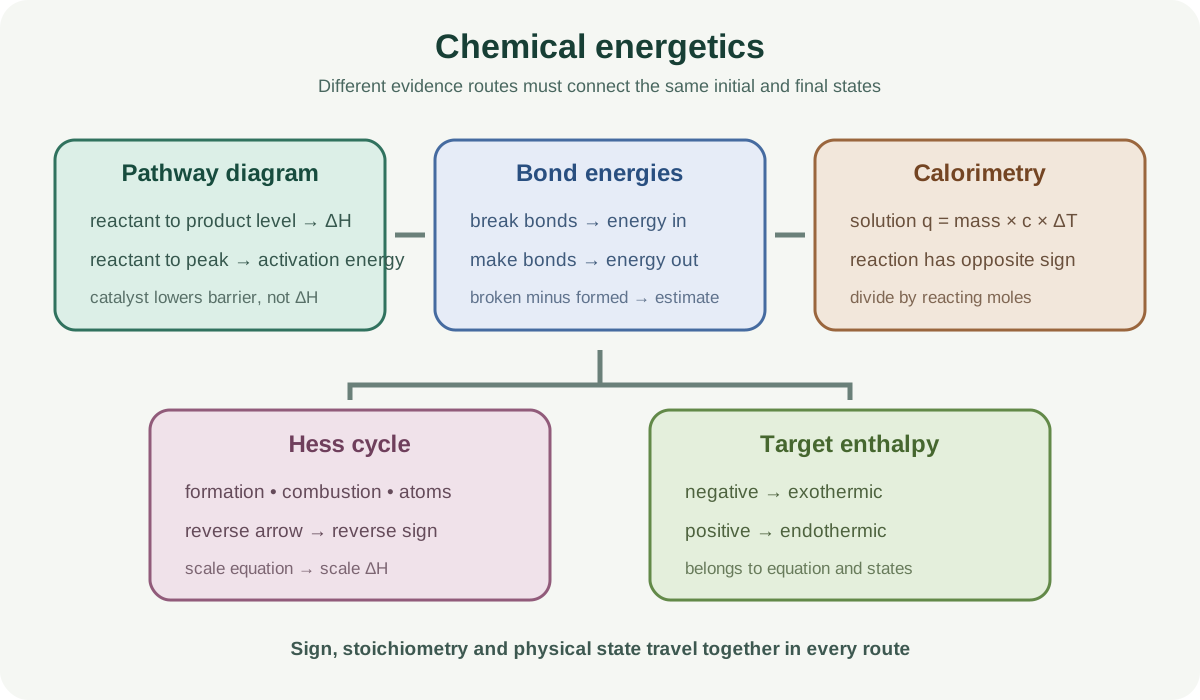
Chemical Energetics is Cambridge International Chemistry 9701 Topic 5. It develops enthalpy signs and definitions, reaction pathway diagrams, bond-energy and calorimetry calculations, and Hess cycles. Practical calorimeter assembly, measurements and heat-loss evaluation remain in the practical hub; this theory note owns energy accounting, definitions and quantitative inference.
1. Enthalpy changes in reactions
Chemical reactions are accompanied by enthalpy changes. An exothermic reaction transfers energy from the reacting system to the surroundings and has negative ΔH. An endothermic reaction takes in energy from the surroundings and has positive ΔH.
The sign refers to the system's enthalpy change. In an exothermic reaction, the system loses enthalpy while the surroundings commonly warm. In an endothermic reaction, the system gains enthalpy while the surroundings commonly cool.
Temperature change is evidence of energy transfer under the method; it is not itself the definition of enthalpy change.
2. Reaction pathway diagrams
A pathway diagram plots enthalpy or energy on the vertical axis against reaction progress on the horizontal axis. Reactants and products occupy their respective levels.
For an exothermic reaction, products lie below reactants and ΔH points downward. For an endothermic reaction, products lie above reactants and ΔH points upward.
Activation energy is the energy difference from the reactant level to the top of the pathway barrier. It is not the same as ΔH, which is the difference between reactant and product levels.
3. Forward and reverse activation energies
The forward activation energy is measured from reactants to the peak. The reverse activation energy is measured from products to the same peak.
For an exothermic forward reaction, reverse activation energy is larger than forward activation energy by the magnitude of the negative enthalpy change. For an endothermic forward reaction, the reverse barrier is smaller.
A catalyst provides a different pathway with lower activation energy in both directions. It does not change reactant or product enthalpy and therefore does not change ΔH.
4. Standard conditions
The syllabus uses standard conditions of 298 K and 101 kPa. A standard-state enthalpy symbol carries the standard mark, and substances are taken in their specified standard states.
Standard conditions are not the same as “room conditions” written vaguely, nor are they standard temperature and pressure from every other convention. Use the Cambridge values for this syllabus.
State symbols matter because enthalpy changes depend on physical state. Formation of liquid water and gaseous water are different processes.
Check this topic from memory
Attempt the matching topic bank before reopening the notes. Use each missed idea to decide what to review next.
The enthalpy change of reaction is the enthalpy change when reactants in the stoichiometric amounts shown in the equation react to form products under stated conditions.
If the equation is reversed, the enthalpy sign reverses. If every coefficient is multiplied, the enthalpy change is multiplied by the same factor. ΔH belongs to the equation as written.
Always compare the requested equation with the thermochemical equation before using a value.
6. Enthalpy change of formation
Standard enthalpy change of formation is the enthalpy change when one mole of a compound is formed from its constituent elements in their standard states under standard conditions.
The product coefficient must be one, even if this requires fractional reactant coefficients. The standard formation enthalpy of an element in its standard state is zero by definition.
Forming carbon monoxide from graphite and half a mole of oxygen is a valid formation equation; forming two moles at once does not match the molar definition unless the enthalpy is adjusted.
7. Enthalpy change of combustion
Standard enthalpy change of combustion is the enthalpy change when one mole of a substance is completely burned in oxygen under standard conditions, with reactants and products in standard states.
Combustion values are normally negative. Complete combustion of a hydrocarbon produces carbon dioxide and water in the specified states. An equation forming carbon monoxide or soot does not represent complete combustion.
The equation must burn exactly one mole of the named substance.
8. Enthalpy change of neutralisation
Standard enthalpy change of neutralisation is the enthalpy change when one mole of water is formed by reaction of an acid with an alkali under standard conditions.
For strong monoprotic acid and strong alkali solutions, the net reaction is H+(aq) plus OH−(aq) forms H2O(l), so values are similar. Weak acids or bases require energy for further ionisation, changing the measured enthalpy.
The definition is per mole of water formed, not per mole of acid solution mixed.
9. Bond breaking and bond making
Breaking a covalent bond requires energy and is endothermic. Making a covalent bond releases energy and is exothermic.
Reaction enthalpy can be estimated as total energy required to break reactant bonds minus total energy released when product bonds form. A negative result means bond formation releases more than bond breaking requires.
Count every bond using balanced molecular structures. Coefficients multiply bond counts.
10. Exact and average bond energies
A bond energy for a particular bond in a specified gaseous molecule can be exact for that environment. Many tabulated values are averages from the same bond type across several gaseous compounds.
Average values give estimates because bond environments differ. A result from average bond energies may not match an experimental enthalpy exactly.
Bond-energy calculations use gaseous species. Additional state changes would be needed to compare directly with equations involving liquids or solids.
11. Bond-energy calculation method
Draw or inspect full displayed structures. Count bonds broken in all reactant molecules and bonds formed in all product molecules. Multiply counts by bond energies, sum each side, then subtract formed from broken.
Do not subtract reactant bond energies from product bond energies without retaining the sign convention. “Broken minus formed” is a reliable statement because both tabulated breaking energies are positive.
A catalyst cannot be included as changing these initial and final bond-energy totals; it changes the pathway, not ΔH.
12. Calorimetry energy transfer
For a solution approximated as water, q = mcΔT, where m is the mass heated, c is specific heat capacity and ΔT is temperature change. With grams and a heat capacity in joules per gram per kelvin, q is in joules.
The surroundings' q has the sign of its temperature change. The reaction enthalpy has the opposite sign when the measured surroundings receive or lose that heat, giving ΔH = negative mcΔT divided by reacting amount n under the simple model.
Convert joules to kilojoules and divide by moles of the reaction quantity specified.
13. Choose the reacting amount
For combustion, n is commonly moles of fuel burned. For neutralisation, n is moles of water formed. For another reaction, use the amount corresponding to the equation or definition.
Identify the limiting reagent before selecting n. Adding both reactant mole amounts or using the excess amount gives an incorrect molar enthalpy.
If a temperature change is negative in an endothermic process, the leading negative relationship converts the surroundings' heat loss into positive reaction ΔH.
14. Calorimetry limitations
Heat exchange with the surroundings, calorimeter heat capacity, incomplete combustion, evaporation, splashing and delayed temperature measurement can make the measured temperature change differ from the ideal value.
In simple combustion experiments, heat loss and incomplete combustion commonly make the measured energy release too small in magnitude, so ΔH appears less negative than the accepted value.
Practical improvements include insulation, a lid, a draught shield, improved temperature logging and accounting for calorimeter heat capacity. They do not change the theoretical definition.
15. Hess's law
Hess's law states that the enthalpy change for a reaction is independent of the route taken, provided initial and final states are the same. Enthalpy is a state function.
Construct a cycle linking the target reaction to one or more alternative routes with known enthalpy changes. Follow arrows consistently. Reverse an arrow and reverse its sign; multiply an equation and multiply its ΔH.
The algebra must reproduce the target equation with intermediate species cancelled.
16. Formation-enthalpy cycles
Using standard formation enthalpies, reaction enthalpy equals the sum of formation enthalpies of products, each multiplied by its coefficient, minus the corresponding sum for reactants.
This follows a route from elements in standard states to reactants and products. Elements in standard states contribute zero formation enthalpy.
Do not omit coefficients or use “reactants minus products” for this formation convention.
17. Combustion-enthalpy cycles
Using combustion enthalpies, both reactants and products can be taken to common complete-combustion products. The target reaction enthalpy is the sum of reactant combustion values minus the sum of product combustion values, with coefficients.
This algebra differs in appearance from the formation formula because the cycle arrows point toward common combustion products. Drawing the cycle prevents memorised sign errors.
Species that do not combust to the chosen products need appropriate treatment rather than an invented combustion value.
18. Hess cycles with bond energies
Bond energies can form a Hess route through separated gaseous atoms. Breaking all reactant bonds to atoms requires energy; forming product bonds from atoms releases energy.
The resulting calculation is again bonds broken minus bonds formed. The cycle explains why this sign convention works.
Because average bond energies and gaseous states are involved, the answer is an estimate unless all required values are exact for the species.
Worked application: calorimetry and sign
Mix 50.0 cubic centimetres of 1.00 mol per cubic decimetre HCl with 50.0 cubic centimetres of 1.00 mol per cubic decimetre NaOH. The temperature rises by 6.80 K. Assume density 1.00 g per cubic centimetre and specific heat capacity 4.18 J per gram per kelvin. The 100 g solution gains 2842 J. Both reactants supply 0.0500 mol, so 0.0500 mol water forms. The reaction enthalpy is negative 2.842 kJ divided by 0.0500 mol, giving negative 56.8 kJ per mole. The negative sign matches heat release, while heat loss would make the measured magnitude too small.
Common misconceptions and corrections
Calling every temperature rise positive ΔH. The reacting system is exothermic and ΔH is negative.
Equating ΔH with activation energy. They are different vertical differences.
Drawing exothermic products above reactants. They lie below.
Changing ΔH when adding a catalyst. A catalyst changes activation energy only.
Using 273 K as Cambridge standard temperature. This syllabus uses 298 K.
Ignoring state symbols in thermochemical equations. Enthalpy depends on state.
Treating ΔH as independent of equation coefficients. It scales with the equation.
Forgetting to reverse ΔH with a reversed equation. Direction sets sign.
Forming two moles in a formation definition. It is defined for one mole.
Giving a non-zero formation enthalpy to a standard-state element. It is zero.
Calling incomplete combustion a combustion enthalpy equation. Combustion is complete.
Defining neutralisation per mole of acid. It is per mole of water formed.
Saying bond breaking releases energy. It requires energy.
Saying bond making requires energy overall. It releases energy.
Using formed minus broken with positive bond energies. Use broken minus formed.
Counting a double bond as two single bonds. Use the specified double-bond energy.
Treating all bond energies as exact. Many are averages.
Using liquid bonds directly with gaseous bond energies. State changes matter.
Using container volume as mass without density. Justify the conversion.
Leaving q in joules while reporting kilojoules per mole. Convert units.
Giving reaction ΔH the same sign as solution q. They have opposite signs.
Using moles of excess reagent for molar enthalpy. Use reacting amount.
Adding both reactant mole amounts for neutralisation. Use water formed.
Assuming calorimetry captures all heat. Losses and apparatus absorption occur.
Saying heat loss makes exothermic ΔH more negative. It makes the measured magnitude smaller.
Treating Hess's law as route-dependent. Initial and final states determine ΔH.
Reversing an equation without reversing sign. Both must reverse.
Omitting coefficients in Hess sums. Enthalpy is stoichiometric.
Using reactants minus products for formation enthalpies. Use products minus reactants.
Memorising the combustion sign formula without a cycle. Arrow direction controls it.
Assessment guidance
Give enthalpy definitions with one mole, standard conditions and correct states. Pathway diagrams need labelled reactant, product, activation-energy and ΔH levels. Bond-energy work should show displayed structures, bond counts and broken-minus-formed arithmetic. Calorimetry answers identify solution mass, temperature change, reacting moles, joule-to-kilojoule conversion and the reaction sign. State assumptions and predict the direction of heat-loss effects. For Hess cycles, draw common states, label arrows, reverse signs when reversing equations, multiply coefficients and verify that algebra cancels to the target reaction.
Retrieval practice
Draw exothermic and endothermic pathways with forward and reverse activation energies. Write formation, combustion and neutralisation definitions and equations. Complete four bond-energy calculations from displayed structures. Solve calorimetry problems for combustion and neutralisation, including limiting reagents and error direction. Finish by constructing formation, combustion and bond-energy Hess cycles, checking every coefficient, state and sign against the target equation.