Cambridge International AS and A Level Chemistry 7: Equilibria
Cambridge International AS and A Level Chemistry 7: Equilibria
Study guide/
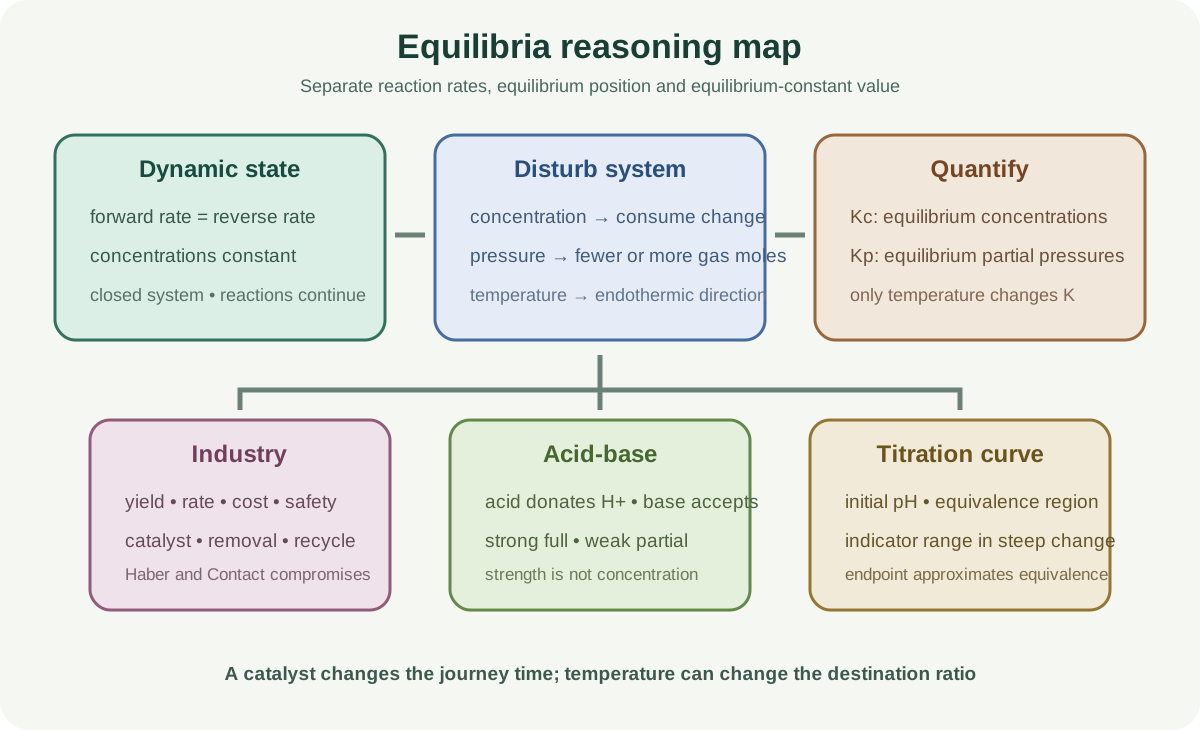
Cambridge International Chemistry 9701 notes on dynamic equilibrium, Kc, Kp, Haber and Contact processes, acids, bases, titration curves and indicators.
Equilibria is Cambridge International Chemistry 9701 Topic 7. It develops dynamic equilibrium, Le Chatelier reasoning, Kc and Kp calculations, industrial compromises, Brønsted-Lowry acids and bases, neutralisation, titration curves and indicator choice. Practical titration setup and endpoint technique remain in the practical hub; this note owns equilibrium models, calculations and qualitative acid-base interpretation.
1. Reversible reactions
A reversible reaction can proceed in both forward and reverse directions under suitable conditions. Use a reversible arrow rather than assuming conversion ends with only products.
At first, forward reaction may dominate because reactants are abundant. As products accumulate, reverse reaction begins and its rate increases.
Reversibility does not mean the reaction repeatedly stops and restarts. Both directions can occur continuously.
2. Dynamic equilibrium
Dynamic equilibrium is reached when forward and reverse reaction rates are equal and concentrations of reactants and products remain constant.
Equal rates do not mean equal concentrations. Constant macroscopic composition coexists with ongoing molecular reactions, which is why the state is dynamic.
A closed system is needed so reactants and products cannot escape or be added continuously. If a gas leaves an open vessel, a stable equilibrium composition may not be established.
3. Le Chatelier's principle
If a change is made to a system at dynamic equilibrium, the position of equilibrium moves to minimise that change. The principle predicts direction, not the speed or exact final amounts.
Describe which reaction direction is favoured and which species increase or decrease. Avoid saying equilibrium “moves left” without connecting the shift to the imposed change.
The system establishes a new equilibrium with equal forward and reverse rates after the transient response.
4. Concentration changes
Adding a reactant favours the direction that consumes it. Removing a product favours the direction that replaces it. Similar logic applies to other species in the equilibrium expression.
Immediately after a concentration change, one rate changes more than the other. As composition adjusts, rates become equal again.
Changing concentration can alter equilibrium position but does not change Kc at constant temperature.
5. Pressure changes
For gas equilibria, increasing total pressure by decreasing volume favours the side with fewer moles of gas. Decreasing pressure favours the side with more gaseous moles.
Check this topic from memory
Attempt the matching topic bank before reopening the notes. Use each missed idea to decide what to review next.
If both sides contain equal total gaseous coefficients, pressure change does not shift equilibrium. Ignore solids and liquids when counting gas moles.
Adding an inert gas at constant volume does not change reacting-gas partial pressures and therefore does not shift the ideal equilibrium. Follow the exact scenario stated rather than using “higher pressure” mechanically.
6. Temperature changes
Treat heat as a reactant in an endothermic direction and a product in an exothermic direction. Increasing temperature favours the endothermic direction; decreasing temperature favours the exothermic direction.
Temperature is the only named change here that alters the value of Kc or Kp. For an exothermic forward reaction, increasing temperature decreases the equilibrium constant for that forward equation. For an endothermic forward reaction, it increases it.
State the reaction enthalpy or direction before predicting the effect.
7. Catalysts and equilibrium
A catalyst provides a lower-activation-energy pathway for forward and reverse reactions. It increases both rates and allows equilibrium to be reached sooner.
It does not change equilibrium position, equilibrium composition or Kc or Kp. It cannot improve equilibrium yield by thermodynamic shifting.
In industry, a catalyst can improve production rate at a chosen compromise temperature without changing the theoretical equilibrium yield at that temperature.
8. Constructing Kc expressions
For aA plus bB in equilibrium with cC plus dD, Kc is concentration of C to power c times concentration of D to power d, divided by concentration of A to power a times concentration of B to power b.
Stoichiometric coefficients become powers. Pure solids and pure liquids are omitted because their effective concentrations remain constant. Gaseous and aqueous species are included as appropriate.
The expression belongs to the balanced equation as written. Reversing the equation gives the reciprocal equilibrium constant; multiplying every coefficient raises K to that factor.
9. Kc calculations and units
Find equilibrium concentrations, not initial concentrations, before substitution. Use an initial-change-equilibrium table when amounts change during reaction.
Convert moles to concentration by dividing by volume in cubic decimetres. If the vessel volume is common to all species, do not cancel it unless the algebra genuinely permits cancellation.
Derive units from the expression after cancelling concentration powers. Depending on total powers, Kc can have units or be unitless under the syllabus convention used in calculations.
10. Equilibrium composition from data
Use stoichiometry to express changes. If x moles of a reactant with coefficient one are consumed, a species with coefficient two changes by 2x.
Subtract consumption from initial reactants and add formation to initial products. Divide by volume where Kc requires concentrations. The stated problems will not require solving a quadratic equation.
Reject negative or chemically impossible quantities. Check that the final composition recreates the supplied K value within rounding.
11. Mole fraction and partial pressure
Mole fraction of a gas is its amount divided by total amount of all gases in the mixture. Mole fractions sum to one.
Partial pressure equals mole fraction multiplied by total pressure. Partial pressures sum to total pressure for the mixture.
Use equilibrium mole amounts. A coefficient is not a mole fraction unless the actual mixture happens to be in that ratio.
12. Constructing Kp expressions
Kp has the same coefficient-to-power structure as Kc, but uses equilibrium partial pressures of gaseous species. Omit solids and liquids.
For N2 plus 3H2 in equilibrium with 2NH3, Kp is partial pressure of NH3 squared divided by partial pressure of N2 times partial pressure of H2 cubed.
Use one pressure unit consistently and derive the final unit from net powers. The relationship between Kp and Kc is explicitly not required here.
13. What changes equilibrium constants
Only temperature changes the value of Kc or Kp for a given equation. Concentration and pressure changes alter the reaction quotient and equilibrium position, but the system returns to the same K at unchanged temperature.
A catalyst changes how quickly the equilibrium composition is reached, not the constant. Adding more solid does not affect an expression that omits the pure solid, provided some solid remains.
Always state “at constant temperature” when asserting K is unchanged.
14. Haber process
The Haber process uses nitrogen and hydrogen to make ammonia. The forward reaction is exothermic and reduces gaseous moles from four to two.
High pressure favours ammonia and increases collision frequency, but raises compression and equipment costs and safety demands. Lower temperature favours exothermic yield but slows rate. Industry therefore uses a compromise temperature around 450 degrees Celsius, high pressure around 200 atmospheres and an iron catalyst.
Ammonia is removed by cooling, and unreacted gases are recycled. Removal shifts equilibrium toward further product while recycling improves overall resource use.
15. Contact process
The Contact process oxidises sulfur dioxide to sulfur trioxide. The forward reaction is exothermic and reduces gaseous moles.
A temperature around 450 degrees Celsius balances equilibrium yield and rate. A vanadium(V) oxide catalyst increases rate. Moderate pressure, often near 1 to 2 atmospheres, is used because equilibrium yield is already high and greater compression adds cost for limited benefit.
Excess oxygen and product management support conversion. Describe conditions as economic and kinetic compromises, not as values that maximise every factor simultaneously.
16. Common acids and alkalis
The named acids are hydrochloric acid HCl, sulfuric acid H2SO4, nitric acid HNO3 and ethanoic acid CH3COOH. The named alkalis are sodium hydroxide NaOH, potassium hydroxide KOH and ammonia NH3.
An alkali is a base that dissolves in water and produces or accepts protons to increase hydroxide availability. Ammonia is molecular and accepts H+; it does not contain OH− in its formula.
Formula recall should include correct subscripts and acid names.
17. Brønsted-Lowry acids and bases
A Brønsted-Lowry acid is a proton donor. A Brønsted-Lowry base is a proton acceptor.
When an acid donates H+, it forms its conjugate base. When a base accepts H+, it forms its conjugate acid. Conjugate pairs differ by one proton.
Water can act as acid or base depending on its reaction partner. Define roles from proton transfer in the given equation.
18. Strong and weak acids and bases
A strong acid or base is fully dissociated in aqueous solution. A weak acid or base is partially dissociated and establishes an equilibrium.
Strength is not concentration. A dilute strong acid may contain less acid per unit volume than a concentrated weak acid, while still being more fully dissociated.
At equal analytical concentration, a strong acid generally has higher H+ concentration, lower pH, greater conductivity and faster initial reaction with a reactive metal than a weak acid, subject to controlled conditions.
19. pH and qualitative evidence
At the standard school boundary here, water has pH 7, acidic solutions below 7 and alkaline solutions above 7. A pH meter gives quantitative evidence; universal indicator gives an approximate colour-based value.
Conductivity reflects mobile ion concentration and mobility. A strong acid at equal concentration normally conducts better than a weak acid because dissociation is more complete.
Reaction rate with a metal depends on available H+ as well as surface area, temperature and metal identity, so comparisons require controls.
20. Neutralisation and salts
Neutralisation occurs when H+(aq) and OH−(aq) form H2O(l). The net ionic equation shows the shared core of strong acid-strong alkali reactions.
Salts form when an acid's replaceable hydrogen is replaced by a metal ion or another positive ion such as ammonium. The full equation includes the associated spectator ions and correct salt formula.
A neutralisation reaction need not always finish at pH exactly 7 when weak acids or bases and their conjugates remain.
21. Titration-curve features
A pH titration curve plots pH against volume of titrant added. It shows initial pH, gradual change, a steep equivalence region and the final excess-titrant region.
Strong acid-strong alkali has a large steep change centred near pH 7. Weak acid-strong alkali starts at a higher pH and has an equivalence point above 7. Strong acid-weak alkali has an equivalence point below 7. Weak acid-weak alkali has a less pronounced steep region.
Equivalence is the stoichiometric point. Endpoint is the indicator's observed colour change and should lie close to equivalence.
22. Indicator selection
An indicator changes colour over a pH transition range. Select one whose transition range lies within the steep pH change around equivalence.
For strong acid-strong alkali, several common indicators can be suitable because the vertical region is broad. A weak acid-strong alkali titration needs an indicator changing on the alkaline side; a strong acid-weak alkali titration needs one changing on the acidic side.
Weak acid-weak alkali curves lack a sharp enough vertical change for a reliable ordinary indicator endpoint. Given indicator transition data, compare ranges directly; pKa values are not used in this AS selection task.
Worked application: equilibrium composition and Kc
One mole of ethanoic acid and one mole of ethanol are placed in a 2.00 cubic decimetre vessel with no ester or water. At equilibrium, 0.60 mol of each reactant has reacted in the one-to-one-to-one-to-one equation. Equilibrium amounts are therefore 0.40, 0.40, 0.60 and 0.60 mol, giving concentrations 0.20, 0.20, 0.30 and 0.30 mol per cubic decimetre. Kc is ester concentration times water concentration divided by acid concentration times alcohol concentration, giving 0.30 squared divided by 0.20 squared, or 2.25. The volume powers cancel, so Kc has no unit for this expression.
Common misconceptions and corrections
Calling a reversible reaction one that alternates directions. Both directions can occur continuously.
Saying equilibrium means reactions stop. Rates remain non-zero.
Saying forward and reverse concentrations are equal. Rates are equal; concentrations are constant.
Ignoring the need for a closed system. Escape prevents stable composition.
Using Le Chatelier to predict rate only. It predicts position response.
Saying added reactant changes Kc. It changes position at fixed temperature.
Applying pressure rules to solids and liquids. Count gaseous moles.
Predicting a shift when gas coefficients are equal. Volume pressure change gives none.
Saying higher temperature always favours products. It favours the endothermic direction.
Saying a catalyst increases equilibrium yield. It changes time to equilibrium.
Including pure solids in Kc. Omit them.
Ignoring equation coefficients in K expressions. They become powers.
Using initial rather than equilibrium concentrations. K uses equilibrium values.
Assuming Kc is always unitless. Derive units from powers.
Calling coefficient fraction a mole fraction. Use actual amount divided by total.
Using total pressure in every Kp term. Use partial pressures.
Using the Kp-Kc relationship. It is outside this stated AS requirement.
Saying pressure changes Kp. Only temperature changes the constant.
Calling Haber conditions maximum-yield conditions. They are industrial compromises.
Saying the iron catalyst shifts Haber equilibrium. It does not.
Demanding extreme pressure in Contact process. Added benefit does not justify cost.
Defining an acid as any H-containing substance. It donates a proton.
Defining a base as containing OH−. A base accepts a proton.
Calling strength concentration. Strength is extent of dissociation.
Saying weak acids do not dissociate. They dissociate partially.
Comparing acid rates without controlling concentration and metal area. The comparison is confounded.
Saying every neutralisation finishes at pH 7. Weak systems can differ.
Calling endpoint equivalence. Endpoint is observed; equivalence is stoichiometric.
Centred-at-7 curves for every titration. Weak components shift equivalence pH.
Choosing an indicator by initial solution colour. Match transition range to the steep region.
Claiming a normal indicator is ideal for weak-weak titration. The curve lacks a sharp jump.
Assessment guidance
Equilibrium definitions require equal forward and reverse rates, constant concentrations and a closed system. For disturbances, name the endothermic direction or gaseous mole difference, then separate position from K value. Build Kc and Kp from the balanced equation, use equilibrium values, show mole-fraction and partial-pressure steps and derive units. Industrial answers must balance yield, rate, cost and safety, including catalyst and recycling roles. Acid-base answers should distinguish strength from concentration and use proton transfer. Titration curves need correct initial and equivalence regions, while indicator choice must match transition data to the steep section.
Retrieval practice
Explain dynamic equilibrium at molecular and macroscopic levels. Predict concentration, pressure, temperature and catalyst effects for five systems and state whether K changes. Construct and calculate Kc and Kp from equilibrium tables, mole fractions and partial pressures. Rebuild Haber and Contact compromise arguments. Classify acids, bases and conjugate pairs, compare strong and weak evidence, sketch all four titration combinations and select indicators from supplied transition ranges.