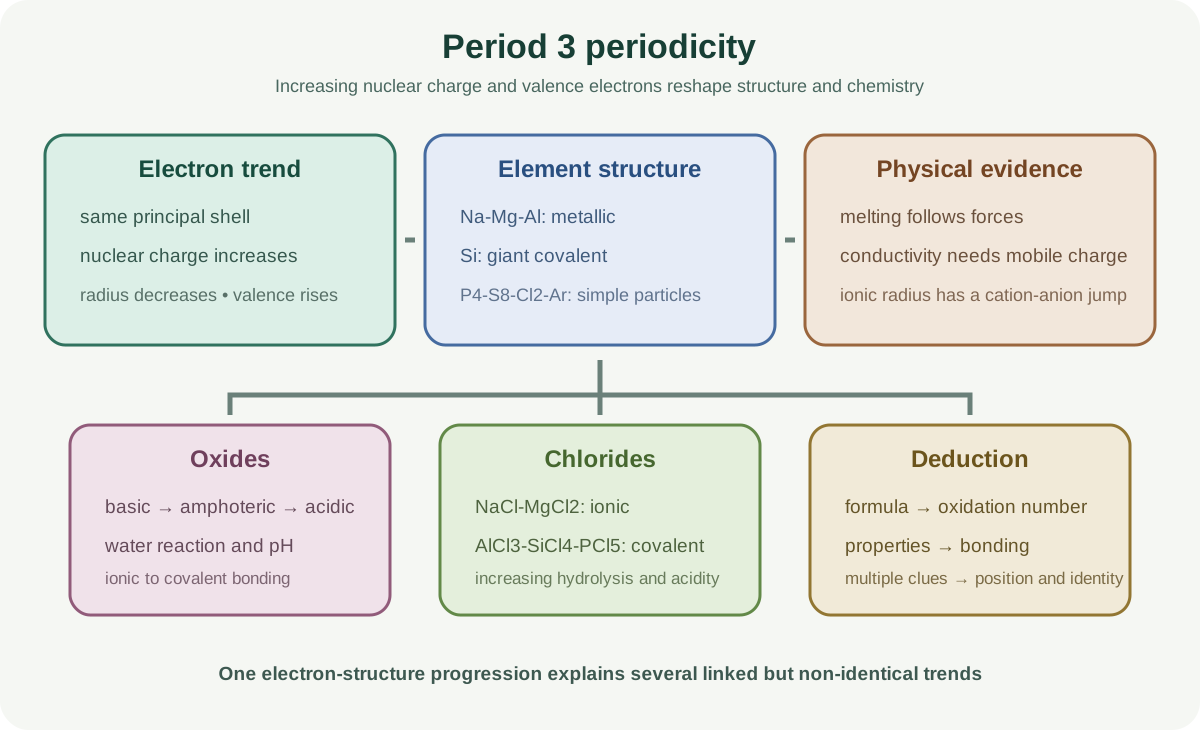
The Periodic Table and Chemical Periodicity is Cambridge International Chemistry 9701 Topic 9. It links Period 3 structure and bonding to radii, melting point, conductivity, oxidation states and reactions of named elements, oxides, hydroxides and chlorides. Practical observation and test execution remain in the practical hub; this theory note owns patterns, equations and deduction.
1. Periodicity across Period 3
Periodicity is recurrence of properties as atomic number increases. Across Period 3, valence electrons occupy the third shell while nuclear charge rises.
The physical pattern changes from metallic sodium, magnesium and aluminium to giant covalent silicon, then simple molecular phosphorus, sulfur and chlorine, followed by monatomic argon.
Chemical trends reflect increasing outer-electron number, electronegativity and a transition from ionic to covalent compounds.
2. Atomic radius
Atomic radius decreases across Period 3. Nuclear charge increases, while added electrons enter the same principal shell and shielding changes relatively little.
The stronger effective attraction pulls electron density closer. Do not attribute the decrease to loss of an occupied shell.
The trend is qualitative because radius definitions differ with bonding environment, but the nuclear-charge explanation remains central.
3. Ionic radius
Positive ions Na+, Mg2+ and Al3+ are isoelectronic. Their radius decreases as proton number rises and the same ten-electron arrangement is attracted more strongly.
Negative ions P3−, S2− and Cl− are isoelectronic with eighteen electrons. Their radius likewise decreases with increasing proton number.
There is a large jump from the small cations to larger anions because the outer occupied shell changes. Do not draw one smooth decrease across both series.
4. Melting-point pattern
From sodium to aluminium, melting points generally rise as ion charge, electron supply and metallic attraction strengthen, though detailed packing contributes to exact values.
Silicon has the highest melting point in the period because many strong covalent bonds extend through a giant network.
Phosphorus, sulfur and chlorine are simple molecular. Their melting points depend on intermolecular forces. S8 is larger and more polarisable than P4 or Cl2, so sulfur has stronger dispersion attractions and a higher melting point. Monatomic argon has only weak dispersion forces and a very low melting point.
5. Electrical conductivity
Sodium, magnesium and aluminium conduct through mobile delocalised electrons, with conductivity generally increasing across the metals as electron density changes.
Check this topic from memory
Attempt the matching topic bank before reopening the notes. Use each missed idea to decide what to review next.
Silicon is a semiconductor rather than a normal metal. Phosphorus, sulfur, chlorine and argon lack mobile charged particles and do not conduct under ordinary stated conditions.
Do not infer conductivity only from melting point. The required evidence is a mobile electron or ion.
6. Reactions with oxygen
The named products are Na2O, MgO, Al2O3, P4O10 and SO2. Representative equations are 4Na plus O2 forms 2Na2O; 2Mg plus O2 forms 2MgO; 4Al plus 3O2 forms 2Al2O3; P4 plus 5O2 forms P4O10; and S plus O2 forms SO2.
Observations include vigorous burning with characteristic light and solid or gaseous products, but equations determine stoichiometry.
The syllabus product list is specific. Do not substitute peroxides, lower phosphorus oxides or SO3 unless the question supplies a different context.
7. Reactions with chlorine
The named products are NaCl, MgCl2, AlCl3, SiCl4 and PCl5. Balanced equations follow electron and atom conservation, such as 2Al plus 3Cl2 forms 2AlCl3 and 2P plus 5Cl2 forms 2PCl5.
Bonding becomes progressively more covalent across the period as electronegativity rises and metal character falls. NaCl and MgCl2 are predominantly ionic; AlCl3, SiCl4 and PCl5 are treated as covalent molecular chlorides in this trend.
The official boundary excludes a required discussion of covalent character within ionic compounds elsewhere, so use the Period 3 observations and named bonding trend carefully.
8. Reactions with water
Sodium reacts vigorously with cold water: 2Na plus 2H2O forms 2NaOH plus H2. The solution becomes strongly alkaline.
Magnesium reacts very slowly with cold water to form magnesium hydroxide and hydrogen: Mg plus 2H2O forms Mg(OH)2 plus H2. It reacts more readily with steam to form MgO and H2.
The named elemental water reactions are sodium and magnesium only. Do not invent parallel room-temperature reactions for every Period 3 element.
9. Oxidation-number trend
In the named highest oxides, oxidation number rises with valence-electron number: Na plus one, Mg plus two, Al plus three, P plus five and S plus four in SO2 or plus six in SO3.
The named chlorides similarly show Na plus one, Mg plus two, Al plus three, Si plus four and P plus five.
Across the period, more valence electrons can participate in bonding. Calculate values from oxygen minus two and chlorine minus one rather than memorising labels alone.
10. Oxides with water
Na2O reacts with water to form NaOH and a solution around pH 13: Na2O plus H2O forms 2NaOH. MgO forms sparingly soluble Mg(OH)2, giving a mildly alkaline suspension around pH 9: MgO plus H2O forms Mg(OH)2.
Al2O3 and SiO2 do not react with water under these conditions, so water remains near neutral. P4O10 forms phosphoric acid and an acidic solution around pH 2: P4O10 plus 6H2O forms 4H3PO4.
SO2 forms sulfurous acid and an acidic solution around pH 2; SO3 forms sulfuric acid and a more strongly acidic solution around pH 1. Equations are SO2 plus H2O forms H2SO3 and SO3 plus H2O forms H2SO4.
The pH values are likely approximate outcomes, not universal constants independent of amount and concentration.
11. Basic oxides and hydroxides
Na2O and MgO are basic oxides. They react with acids to form salt and water, such as MgO plus 2HCl forms MgCl2 plus H2O.
NaOH and Mg(OH)2 are basic hydroxides. NaOH is soluble and strongly alkaline; Mg(OH)2 is less soluble. Both neutralise acids, with two moles of H+ required per mole of Mg(OH)2.
Basicity here concerns proton acceptance or reaction with acids, not simply the presence of oxygen.
12. Amphoteric aluminium compounds
Al2O3 and Al(OH)3 are amphoteric: they react with both acids and bases. With hydrochloric acid, Al2O3 plus 6HCl forms 2AlCl3 plus 3H2O, while Al(OH)3 plus 3HCl forms AlCl3 plus 3H2O.
With aqueous sodium hydroxide, aluminium compounds form soluble aluminate species. A useful representation is Al(OH)3 plus OH− forms [Al(OH)4]−; Al2O3 reacts with hydroxide and water to form the same tetrahydroxoaluminate ion.
Amphoteric does not mean neutral or unreactive. It means acid-base behaviour in both directions.
13. Acidic oxides
P4O10, SO2 and SO3 are acidic oxides. They react with bases, for example P4O10 plus 12NaOH forms 4Na3PO4 plus 6H2O; SO2 plus 2NaOH forms Na2SO3 plus H2O; and SO3 plus 2NaOH forms Na2SO4 plus H2O.
Acidic character increases across the period as bonding becomes covalent and electronegativity rises. These oxides also form acidic solutions on reaction with water.
Follow the exact oxide and base specified. Different hydroxide ratios can produce acid salts under restricted reagent amounts.
14. Sodium and magnesium chlorides with water
NaCl dissolves without significant hydrolysis and gives a solution near pH 7. Its ions derive from a strong acid and strong base in this simplified comparison.
MgCl2 dissolves and hydrated Mg2+ causes slight hydrolysis, giving a mildly acidic solution around pH 6. The small, doubly charged ion polarises O-H bonds in coordinated water.
Do not describe either process as covalent chloride hydrolysis producing hydrogen chloride gas.
15. Aluminium chloride with water
AlCl3 dissolves to form hydrated Al3+ ions. Strong polarisation of coordinated water leads to hydrolysis and H+ release, giving an acidic solution around pH 3.
A representative step is [Al(H2O)6]3+ in equilibrium with [Al(H2O)5(OH)]2+ plus H+. Chloride remains a spectator in this acidifying step.
The acidic solution is not explained by free Al3+ “donating protons”; coordinated water loses them.
16. Silicon and phosphorus chlorides with water
SiCl4 hydrolyses vigorously, producing silicon dioxide and hydrogen chloride: SiCl4 plus 2H2O forms SiO2 plus 4HCl. Moist air can produce steamy HCl fumes and solid silica; the resulting mixture is strongly acidic.
PCl5 hydrolyses, ultimately forming phosphoric acid and hydrogen chloride: PCl5 plus 4H2O forms H3PO4 plus 5HCl. Limited water can give intermediate phosphorus oxychloride, but the complete-hydrolysis equation fits excess water.
Both covalent chlorides hydrolyse because polar bonds and accessible central atoms allow reaction with water. Their products explain acidic pH.
17. Bonding from properties
High melting point and electrical conduction when molten suggest ionic chloride or oxide lattices. Low boiling point, volatility and hydrolysis suggest covalent molecular chlorides.
Giant covalent SiO2 has high melting point but no mobile ions or molecular volatility. Multiple observations are needed to distinguish it from ionic solids.
Use structure-particle-force-property chains from Topic 4 and electronegativity trends from Topic 3.
18. Predicting unknown elements
Use group position to predict valence-electron count, likely ion charge, oxide formula, acid-base character and reaction trends. Use period position to infer shell number and likely size.
To deduce an unknown, combine physical evidence such as conductivity and melting point with chemical evidence such as chloride volatility, oxide pH and formula stoichiometry.
One property rarely fixes identity. A coherent set of periodic patterns is stronger than resemblance to one memorised reaction.
Worked application: identify an unknown Period 3 element
An unknown Period 3 element forms a high-melting oxide X2O3 that reacts with both hydrochloric acid and aqueous sodium hydroxide. It also forms a chloride XCl3 that hydrolyses in water to give an acidic solution. Oxygen at minus two makes X plus three in X2O3. Amphoteric oxide behaviour and a plus-three chloride point to aluminium rather than the neighbouring elements. The equations Al2O3 plus 6HCl forms 2AlCl3 plus 3H2O and Al2O3 plus 2OH− plus 3H2O forms 2[Al(OH)4]− support both directions. Acidic hydrated Al3+ explains the chloride solution without treating AlCl3 as a simple neutral salt.
Common misconceptions and corrections
Saying atomic radius increases across Period 3. Increasing nuclear charge contracts it.
Drawing one smooth ionic-radius trend. Cations and anions occupy different outer shells.
Explaining all melting points with atomic radius. Structure and bonding change.
Calling silicon metallic. It is giant covalent and semiconducting.
Saying sulfur melts below phosphorus because both are molecular. S8 has stronger dispersion than P4.
Giving argon a molecular lattice. It is monatomic.
Saying any solid containing charged particles conducts. Charged particles must move.
Changing the named oxygen products. Use the syllabus product list.
Making SO3 the specified direct sulfur-burning product. The named product is SO2.
Calling AlCl3 an ionic trend endpoint. The chlorides become covalent.
Writing sodium plus water without balancing hydrogen. Use 2:2:2:1.
Saying magnesium reacts rapidly with cold water. It is very slow.
Giving every Period 3 element a water reaction. Only Na and Mg are named.
Memorising oxidation states without valence explanation. Link them to outer electrons.
Calling Na2O acidic because it contains oxygen. It is basic.
Saying MgO gives a strongly alkaline clear solution. Mg(OH)2 is sparingly soluble.
Making Al2O3 react with water. It does not under these conditions.
Making SiO2 react with water. It does not.
Treating approximate oxide pH as concentration-independent. Amount and conditions matter.
Calling amphoteric aluminium oxide neutral. It reacts with acids and bases.
Omitting hydroxide or water from aluminate formation. Balance atoms and charge.
Calling P4O10 a basic oxide. It is acidic.
Giving NaCl solution a strongly acidic pH. It is near neutral.
Explaining MgCl2 acidity as HCl formation. Hydrated Mg2+ hydrolyses slightly.
Saying Al3+ itself contains a removable proton. Coordinated water loses H+.
Writing SiCl4 hydrolysis without HCl. Four HCl form.
Writing complete PCl5 hydrolysis with one water. Four waters are required for H3PO4.
Identifying bonding from melting point alone. Combine volatility, conduction and chemistry.
Identifying an unknown from one familiar property. Use several periodic constraints.
Assessment guidance
Periodicity explanations must name the changing structure, particles and forces. Separate atomic-radius and two isoelectronic ionic-radius series. Reaction questions need the exact named products, balanced equations and appropriate states. For oxides and chlorides, connect oxidation state, bonding, water reaction, pH and acid-base behaviour without treating approximate pH values as universal. Amphoteric answers require both acid and hydroxide reactions. Unknown-element deductions should combine formula-derived oxidation number with several physical and chemical observations, then reject plausible alternatives.
When a question asks for a trend, state the observation before its explanation and identify any discontinuity rather than forcing every value into one smooth pattern.
Retrieval practice
Reconstruct Period 3 atomic and ionic radii, melting and conductivity graphs with structural explanations. Write every named reaction with oxygen, chlorine and water. Calculate oxidation states in the specified oxides and chlorides. Build water-reaction and acid-base tables for all named oxides, hydroxides and chlorides, including pH and equations. Finish by identifying six unknown elements or compounds from mixed structural, physical and reaction evidence.