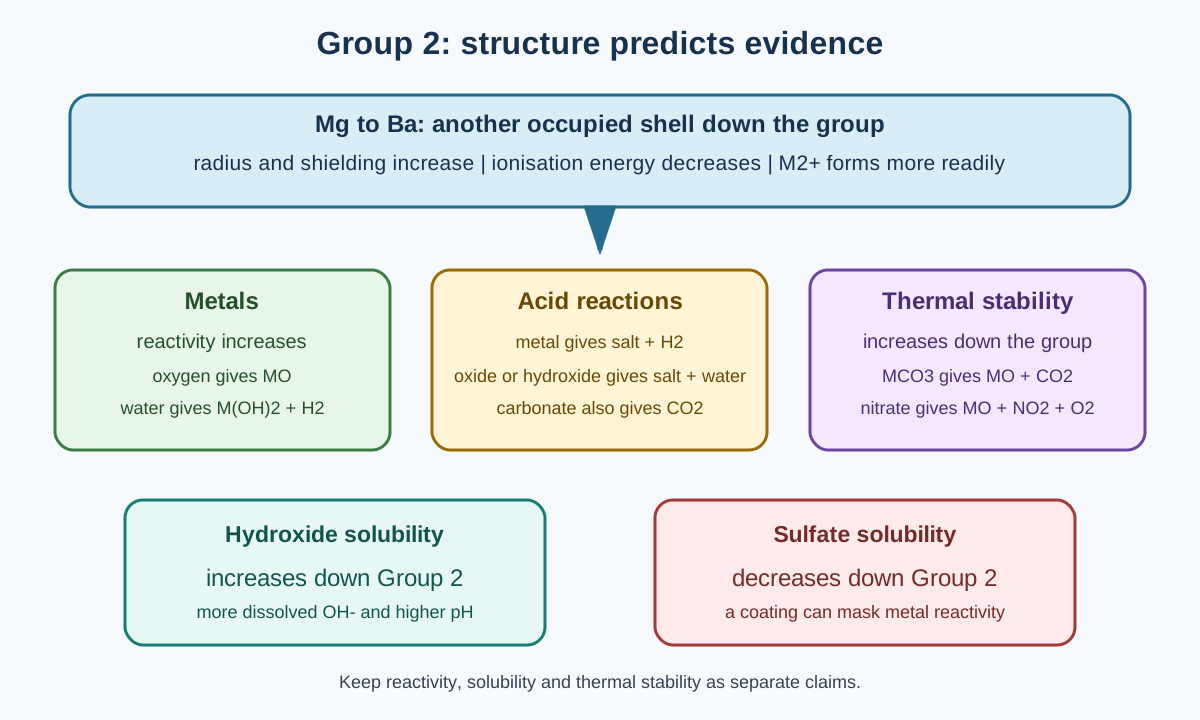
Group 2 is Cambridge International Chemistry 9701 Topic 10. The assessed elements run from magnesium to barium: magnesium, calcium, strontium and barium. This theory note owns reaction equations, periodic explanations, solubility and thermal-stability trends. Experimental execution and observations under practical conditions remain in the practical hub.
1. The common Group 2 pattern
Each atom has two outer-shell electrons and commonly forms an ion with charge (2+):
MMX2++2eX−
Check this topic from memory
Attempt the matching topic bank before reopening the notes. Use each missed idea to decide what to review next.
The formulae of the oxide, hydroxide, carbonate, nitrate, chloride and sulfate are therefore MO, M(OH)X2, MCOX3, M(NOX3)X2, MClX2 and MSOX4.
Down the group, atomic and ionic radii increase because each element has an additional occupied shell. Shielding increases and the outer electrons are farther from the nucleus. First and second ionisation energies generally decrease, so forming MX2+ becomes easier and metallic reactivity increases.
2. Reaction with oxygen
The metals form oxides when burned in oxygen:
2M+OX22MO
For example, magnesium burns with an intense white light to form white magnesium oxide. Calcium, strontium and barium also form their oxides in the syllabus treatment. Reactivity and vigour generally increase down the group because electron loss becomes easier.
Use the requested oxide product. A question about the Cambridge trend does not require importing peroxide chemistry unless the stem introduces it.
3. Reaction with water
Magnesium reacts only very slowly with cold water because a sparingly soluble surface layer restricts contact:
Mg+2HX2OMg(OH)X2+HX2
It reacts more readily with steam:
Mg+HX2O(g)MgO+HX2
Calcium, strontium and barium react with cold water to form hydroxides and hydrogen:
M+2HX2OM(OH)X2+HX2
The reactions become more vigorous down the group. The resulting solutions become more alkaline because hydroxide solubility increases, not because each dissolved hydroxide ion somehow becomes a stronger base.
4. Reaction with dilute hydrochloric acid
Group 2 metals react with dilute hydrochloric acid to form a soluble chloride and hydrogen:
M+2HClMClX2+HX2
The ionic change is oxidation of the metal and reduction of hydrogen ions:
M+2HX+MX2++HX2
The intrinsic tendency to react increases down the group. In comparisons, keep metal surface area, acid concentration and temperature constant before attributing a faster observation to periodic position.
5. Reaction with dilute sulfuric acid
The formal equation is:
M+HX2SOX4MSOX4+HX2
Sulfate solubility decreases down Group 2. Magnesium sulfate is soluble, whereas calcium sulfate is only slightly soluble and strontium sulfate and barium sulfate are effectively insoluble. An insoluble sulfate coating can cover the metal and slow or stop further reaction. Observed vigour with sulfuric acid therefore need not follow the simple intrinsic-reactivity trend.
This is a valuable exam distinction: periodic reactivity describes electron loss, while an observed rate can be limited by physical access through a product layer.
6. Oxides and water
Group 2 oxides are basic. They react with water to form hydroxides:
MO+HX2OM(OH)X2
Magnesium oxide reacts slowly and the sparingly soluble hydroxide gives only a mildly alkaline suspension. Down the group, hydroxide solubility increases, so the solutions contain more OHX− and their pH rises.
The equation shows formation of hydroxide, but solubility determines how much enters solution. Do not equate a solid's basic character with complete dissolution.
7. Hydroxides and water
The relevant process is dissolution:
M(OH)X2(s)⇌MX2+(aq)+2OHX−(aq)
Solubility increases from magnesium hydroxide to barium hydroxide. Consequently, magnesium hydroxide is only sparingly soluble, while barium hydroxide produces a much more concentrated alkaline solution.
Water does not chemically convert one Group 2 hydroxide into another product. The observable change is dissolution and release of ions.
8. Carbonates and water
Group 2 carbonates are treated as insoluble in water. They do not undergo a significant reaction with water under the stated conditions.
This negative result is part of the comparison. A formula containing carbonate does not guarantee an alkaline solution because the solid must dissolve sufficiently before carbonate ions can affect pH.
9. Oxides with dilute acids
Basic oxides neutralise acids to form salt and water. With hydrochloric acid:
MO+2HClMClX2+HX2O
With sulfuric acid:
MO+HX2SOX4MSOX4+HX2O
There is no hydrogen gas because the oxide ion is neutralised rather than a metal being oxidised. With the heavier oxides, an insoluble sulfate can coat the solid during reaction with sulfuric acid.
10. Hydroxides with dilute acids
The hydroxides neutralise acids. Two moles of hydrogen ions are required per mole of hydroxide:
M(OH)X2+2HClMClX2+2HX2O
M(OH)X2+HX2SOX4MSOX4+2HX2O
The ionic core is HX++OHX−HX2O. If a hydroxide is only sparingly soluble, consuming dissolved ions allows more solid to dissolve until the acid or solid is exhausted.
11. Carbonates with dilute acids
Carbonates react with acids to form a salt, carbon dioxide and water:
MCOX3+2HClMClX2+COX2+HX2O
MCOX3+HX2SOX4MSOX4+COX2+HX2O
Effervescence indicates carbon dioxide. With sulfuric acid, decreasing sulfate solubility can again produce a coating and suppress continued contact. A slowing reaction is not evidence that carbonate has stopped being basic.
12. Thermal decomposition of carbonates
On heating, Group 2 carbonates decompose into the oxide and carbon dioxide:
MCOX3MO+COX2
Thermal stability increases down the group, so progressively stronger heating is required. The smaller MgX2+ ion has greater charge density and polarises the electron cloud of the large carbonate ion more strongly. This weakens bonds within carbonate and makes decomposition easier. Larger cations down the group polarise less, so the carbonate ion is less distorted and more stable to heat.
13. Thermal decomposition of nitrates
The nitrates decompose to the oxide, nitrogen dioxide and oxygen:
2M(NOX3)X22MO+4NOX2+OX2
The brown gas is NOX2; oxygen can relight a glowing splint after the gases are handled appropriately in a practical setting. Thermal stability increases down the group for the same polarising-power reason used for carbonates.
Balance the equation from atoms rather than assuming nitrate produces only one gas. Four nitrate groups contain four nitrogen atoms and twelve oxygen atoms, which the products must conserve.
14. Two solubility trends
The two named trends run in opposite directions:
hydroxide solubility increases down Group 2
sulfate solubility decreases down Group 2
These trends should be stated, applied and distinguished from carbonate insolubility. For example, adding sulfate ions to a solution containing barium ions gives a dense white precipitate of BaSOX4:
BaX2+(aq)+SOX4X2−(aq)BaSOX4(s)
The syllabus asks candidates to state these solubility variations. A detailed lattice-enthalpy and hydration-enthalpy derivation is not required for this AS boundary.
15. Predicting unfamiliar Group 2 behaviour
An unfamiliar element below calcium should have a larger radius, lower ionisation energies and greater intrinsic metal reactivity. Its hydroxide should be more soluble than calcium hydroxide, its sulfate less soluble than calcium sulfate, and its carbonate and nitrate more thermally stable.
Predictions must identify which trend is being extended and acknowledge competing effects. With dilute sulfuric acid, for example, greater intrinsic metal reactivity may be masked by a less soluble sulfate coating.
Worked application: identify a Group 2 compound
A white solid X does not dissolve appreciably in water. It effervesces with dilute hydrochloric acid, and the gas turns limewater milky. Strong heating leaves an oxide and releases the same gas. X is therefore a carbonate, not a hydroxide or sulfate. If the temperature needed for decomposition is higher than for calcium carbonate but lower than for barium carbonate, the stability trend places X plausibly as strontium carbonate. The equations are SrCOX3+2HClSrClX2+COX2+HX2O and SrCOX3SrO+COX2. Both reaction type and comparative thermal evidence support the identification.
Common misconceptions and corrections
Including beryllium in every required trend. The assessed sequence here is magnesium to barium.
Giving Group 2 ions a (1+) charge. Two outer electrons are lost to form MX2+.
Saying radius decreases down the group. Additional occupied shells increase radius.
Saying ionisation energy increases down the group. Distance and shielding reduce attraction.
Predicting lower reactivity down the group. Electron loss becomes easier.
Writing MOX2 for the named oxide. The common oxide formula is MO.
Making magnesium vigorous with cold water. It reacts very slowly.
Giving oxide as the cold-water product for calcium. Cold water forms the hydroxide.
Omitting hydrogen from metal-acid reactions. Hydrogen ions are reduced to HX2.
Assuming sulfuric-acid observations must mirror hydrochloric acid. Sulfate coatings can intervene.
Calling magnesium sulfate insoluble. It is soluble.
Calling barium sulfate soluble. It is effectively insoluble.
Saying Group 2 oxide plus acid releases hydrogen. It forms salt and water.
Saying carbonate plus acid forms only carbon dioxide. Salt and water also form.
Treating a slowing sulfuric-acid reaction as loss of chemical reactivity. A coating may block contact.
Saying hydroxide solubility decreases down the group. It increases.
Saying sulfate solubility increases down the group. It decreases.
Calling every Group 2 compound soluble because it contains a metal ion. Solubility is compound-specific.
Claiming carbonates react significantly with water. They are treated as insoluble.
Equating basicity with high solubility. A sparingly soluble oxide or hydroxide can still neutralise acid.
Writing carbonate decomposition as metal plus carbon dioxide. The solid product is the oxide.
Omitting oxygen from nitrate decomposition. Both NOX2 and OX2
Calling the brown nitrate gas oxygen. It is nitrogen dioxide.
Saying thermal stability decreases down the group. It increases.
Explaining stability with cation charge. Charge stays (2+); radius and charge density change.
Using sulfate solubility to predict hydroxide solubility. The trends are opposite.
Predicting observed rate from ionisation energy alone. Surface coatings and conditions can matter.
Assessment guidance
State each trend before explaining or applying it. For metal reactivity, link increasing radius and shielding to weaker attraction for outer electrons and easier formation of MX2+. Supply balanced equations for the exact reagent and compound class, then use observations such as hydrogen, carbon dioxide or a sulfate coating only where relevant. Keep hydroxide solubility, sulfate solubility and carbonate or nitrate thermal stability as three separate trends. When predicting unfamiliar behaviour, compare the unknown with named neighbours and flag any product-layer effect that could make an observed rate differ from intrinsic reactivity.
Retrieval practice
Write the general equations for a Group 2 metal with oxygen, water, hydrochloric acid and sulfuric acid. Repeat for its oxide, hydroxide and carbonate with water and each acid, including cases with no significant reaction. Reconstruct both thermal-decomposition equations and explain the stability trend using polarising power. Finally, predict five properties of strontium compounds from calcium and barium evidence, including one situation in which a sulfate coating changes the observation.