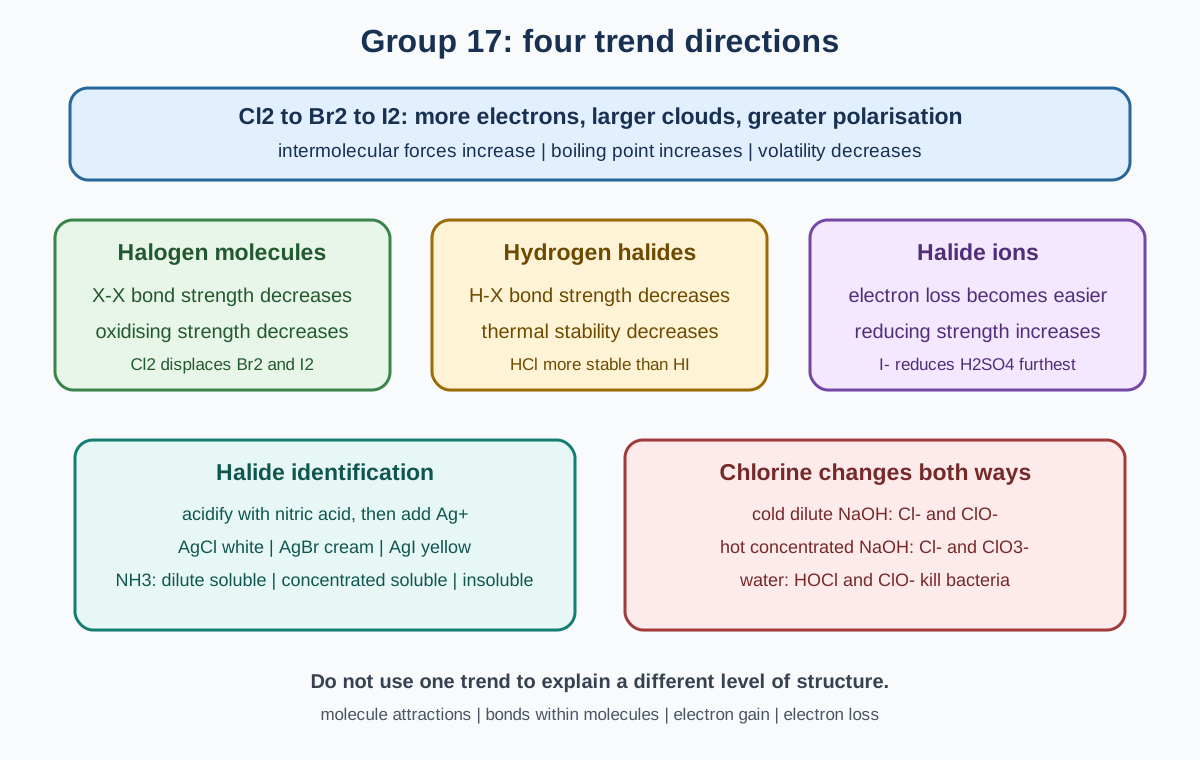
Group 17 is Cambridge International Chemistry 9701 Topic 11. The official AS boundary covers chlorine, bromine and iodine physical trends; their oxidising reactions; hydrogen halides; reducing halide ions; silver-ion and concentrated sulfuric-acid reactions; and chlorine disproportionation and water purification. Practical handling and test execution remain in the practical hub.
1. Appearance and physical state
At room conditions, chlorine is a pale green gas, bromine is a red-brown volatile liquid and iodine is a grey-black solid that forms a purple vapour when heated.
Volatility decreases down the group: chlorine is most volatile and iodine least volatile. Melting and boiling points therefore increase from chlorine to iodine.
Colour becomes darker down the group. State and colour are separate observations, so an answer should not replace one with the other.
2. Volatility and intermolecular forces
The halogens exist as non-polar diatomic molecules, ClX2,
Check this topic from memory
Attempt the matching topic bank before reopening the notes. Use each missed idea to decide what to review next.
. Attractions between their molecules are instantaneous dipole-induced dipole forces.
Down the group, molecules contain more electrons and larger electron clouds. Their electron clouds are more polarisable, so temporary dipoles induce stronger attractions in neighbouring molecules. More energy is needed to separate molecules, raising boiling point and lowering volatility.
Do not explain boiling with the covalent bond inside each molecule. Boiling separates molecules without breaking the halogen-halogen bond.
3. Halogen bond strength
For chlorine, bromine and iodine, the X−X bond becomes longer and weaker down the group. Atomic radius increases, so the shared bonding pair lies farther from both nuclei and orbital overlap becomes less effective.
The order is approximately Cl−Cl>Br−Br>I−I in bond strength. This intramolecular trend is distinct from the increasing intermolecular-force trend. Iodine molecules attract one another most strongly but have the weakest bond within each molecule of this three-element sequence.
4. Halogens as oxidising agents
A halogen acts as an oxidising agent by accepting electrons:
XX2+2eX−2XX−
Oxidising strength decreases down the group: chlorine is stronger than bromine, which is stronger than iodine. Down the group, increased radius and shielding make the incoming electron less strongly attracted to the nucleus.
This trend predicts displacement. A stronger halogen oxidising agent displaces a weaker halogen from its halide ions:
ClX2+2BrX−2ClX−+BrX2
ClX2+2IX−2ClX−+IX2
BrX2+2IX−2BrX−+IX2
Bromine cannot oxidise chloride ions, and iodine cannot oxidise bromide or chloride ions. In each valid reaction, the halogen gains electrons while halide ions lose them.
5. Reactions with hydrogen
The general reaction is:
HX2+XX22HX
Chlorine reacts rapidly or explosively with hydrogen in light. Bromine reacts less readily and normally requires heating. Iodine reacts more slowly, requires stronger heating and establishes an equilibrium because hydrogen iodide decomposes relatively readily.
Relative reactivity decreases from chlorine to iodine. Both breaking the halogen bond and forming hydrogen-halogen bonds matter, but the increasingly weak H−X bond makes hydrogen-halide formation less favourable down the group.
6. Thermal stability of hydrogen halides
Thermal stability decreases from hydrogen chloride to hydrogen iodide:
HCl>HBr>HI
The hydrogen-halogen bond length increases and bond strength decreases down the group because the halogen bonding orbital becomes larger and overlap with hydrogen's small orbital becomes less effective.
Hydrogen iodide therefore decomposes on heating more readily than hydrogen bromide, while hydrogen chloride is the most thermally stable of the three. This is a bond-strength argument, not an intermolecular-force argument.
7. Halide ions as reducing agents
A halide ion acts as a reducing agent by donating an electron:
2XX−XX2+2eX−
Reducing strength increases down the group: iodide is stronger than bromide, which is stronger than chloride. Increased radius and shielding weaken the attraction for an outer electron, so oxidation of the ion becomes easier.
The halogen and halide trends point in opposite directions. Chlorine is the strongest oxidising halogen here, while iodide is the strongest reducing halide ion.
8. Silver-ion test for halides
Acidify the sample with dilute nitric acid, then add aqueous silver nitrate. Nitric acid removes interfering carbonate without adding chloride ions.
The ionic precipitation equation is:
AgX++XX−AgX(s)
Chloride gives white AgCl, bromide gives cream AgBr, and iodide gives yellow AgI.
Follow with aqueous ammonia to distinguish similar precipitates. Silver chloride dissolves in dilute ammonia. Silver bromide does not dissolve in dilute ammonia but dissolves in concentrated ammonia. Silver iodide remains insoluble even in concentrated ammonia. The formula of the silver-ammonia complex is outside the required boundary.
9. Why nitric acid is used
Hydrochloric acid would introduce chloride ions and could generate a false white precipitate. Sulfuric acid can introduce sulfate complications. Dilute nitric acid supplies acidity without adding a halide.
Acidification removes carbonate because carbonate could also form a pale silver precipitate. The sequence is therefore acid first, then silver nitrate, then ammonia. Reversing the order can create evidence that is harder to interpret.
10. Chloride with concentrated sulfuric acid
Solid sodium chloride undergoes an acid-base reaction that releases steamy hydrogen chloride:
NaCl+HX2SOX4NaHSOX4+HCl
There is no redox because chloride is not a sufficiently strong reducing agent to reduce concentrated sulfuric acid under these conditions. Sulfur remains at oxidation number (+6).
This reaction supports the reducing-strength order: chloride produces hydrogen chloride but does not produce chlorine.
11. Bromide with concentrated sulfuric acid
An initial acid-base reaction forms hydrogen bromide. Bromide or hydrogen bromide then reduces sulfuric acid to sulfur dioxide while being oxidised to bromine:
2HBr+HX2SOX4BrX2+SOX2+2HX2O
Expected evidence can include red-brown bromine vapour and colourless, choking sulfur dioxide. Bromine has oxidation number (0), while sulfur falls from (+6) in sulfuric acid to (+4) in sulfur dioxide.
The redox equation should not omit water, and it should not claim hydrogen bromide is the final and only product.
12. Iodide with concentrated sulfuric acid
Iodide is a stronger reducing agent and can reduce sulfuric acid to several sulfur products. Balanced hydrogen-iodide equations include:
2HI+HX2SOX4IX2+SOX2+2HX2O
6HI+HX2SOX43IX2+S+4HX2O
8HI+HX2SOX44IX2+HX2S+4HX2O
Evidence can include purple iodine vapour or dark iodine solid, yellow sulfur and the rotten-egg smell of hydrogen sulfide. Appropriate safety practice means smell is not tested directly.
Sulfur changes from (+6) to (+4), (0) or (-2), while iodide changes from (-1) to (0). The deeper reduction compared with bromide demonstrates the stronger reducing power of iodide.
13. Chlorine with cold sodium hydroxide
Cold, dilute aqueous sodium hydroxide produces chloride and chlorate(I), also called hypochlorite:
ClX2+2NaOHNaCl+NaClO+HX2O
Chlorine begins at oxidation number (0). It is reduced to (-1) in chloride and oxidised to (+1) in chlorate(I). The same element is both oxidised and reduced, so the reaction is disproportionation.
State the conditions because hot alkali gives a different oxidation product.
14. Chlorine with hot sodium hydroxide
Hot, concentrated aqueous sodium hydroxide produces chloride and chlorate(V):
3ClX2+6NaOH5NaCl+NaClOX3+3HX2O
Chlorine changes from (0) to (-1) in chloride and (+5) in chlorate(V), so this is also disproportionation. The coefficients reflect the unequal electron changes: one chlorine atom loses five electrons while five chlorine atoms each gain one.
Do not interchange ClOX− and ClOX3X− between cold and hot conditions.
15. Chlorine in water purification
Chlorine reacts reversibly with water:
ClX2+HX2O⇌HCl+HOCl
Hypochlorous acid partially dissociates:
HOCl⇌HX++ClOX−
The active species HOCl and ClOX− kill bacteria through oxidation of vital cellular components. Their relative proportions depend on pH because HOCl is a weak acid.
The benefit is microbial control. Answers should also recognise that chlorine dosage is controlled because excess chlorine and chlorinated by-products are undesirable. The syllabus focus is the chemistry and antibacterial species, not a blanket claim that more chlorine is always better.
Worked application: identify three unknown halide salts
Solutions A, B and C are acidified with nitric acid and treated with silver nitrate. A gives a white precipitate soluble in dilute ammonia, B gives a cream precipitate soluble only in concentrated ammonia, and C gives a yellow precipitate insoluble in concentrated ammonia. They contain chloride, bromide and iodide respectively. Separate solid samples are treated with concentrated sulfuric acid: A gives steamy hydrogen chloride without redox; B forms bromine and sulfur dioxide; C forms iodine and can reduce sulfuric acid as far as hydrogen sulfide. The paired tests confirm the identities while also demonstrating that halide reducing strength increases from chloride to iodide.
Common misconceptions and corrections
Calling chlorine colourless. It is pale green.
Calling bromine a gas at room conditions. It is a volatile red-brown liquid.
Calling iodine vapour black. The solid is grey-black and the vapour is purple.
Saying volatility increases down the group. It decreases.
Explaining boiling point with covalent bond strength. Boiling overcomes intermolecular attractions.
Calling the intermolecular attraction permanent dipole bonding. The named explanation is instantaneous dipole-induced dipole attraction.
Saying halogen bonds strengthen down the group. The chlorine-to-iodine bond weakens.
Using intermolecular force to explain hydrogen-halide thermal stability. Use H−X bond strength.
Saying halogen oxidising strength increases down the group. It decreases.
Saying chlorine displaces fluoride in this boundary. The assessed displacement set here concerns chloride, bromide and iodide chemistry.
Letting bromine oxidise chloride. Bromine is the weaker oxidising agent.
Letting iodine oxidise bromide. Iodine is weaker still.
Saying halide reducing strength decreases down the group. It increases.
Treating halogen and halide trends as the same direction. They are opposite.
Adding hydrochloric acid before silver nitrate. It contaminates the test with chloride.
Skipping acidification. Carbonate can interfere.
Calling silver chloride cream. It is white.
Calling silver bromide yellow. It is cream.
Saying silver iodide dissolves in concentrated ammonia. It remains insoluble.
Requiring the silver-ammonia complex formula. It is outside this boundary.
Claiming chloride reduces concentrated sulfuric acid. Its reaction is acid-base only.
Stopping the bromide reaction at hydrogen bromide. Redox produces bromine and sulfur dioxide.
Giving only sulfur dioxide for iodide. Stronger iodide can form sulfur and hydrogen sulfide too.
Identifying hydrogen sulfide by deliberately smelling it. Direct smelling is unsafe.
Calling cold-alkali chlorine a simple neutralisation. It is disproportionation.
Putting chlorate(V) in the cold reaction. Cold dilute alkali forms chlorate(I).
Putting chlorate(I) in the hot reaction. Hot concentrated alkali forms chlorate(V).
Omitting oxidation numbers from a disproportionation explanation. Show both increase and decrease.
Saying water purification uses chloride alone. The active species are HOCl and ClOX−.
Claiming unlimited chlorine is beneficial. Dose and by-products must be controlled.
Assessment guidance
Name the trend and the particles before explaining it. Keep intermolecular attractions for volatility separate from covalent bond strengths for halogen and hydrogen-halide stability. In displacement questions, identify both electron donor and acceptor and check that the proposed direction matches chlorine, bromine and iodine oxidising strength. For qualitative tests, give reagent order, precipitate colour and ammonia solubility. Concentrated sulfuric-acid answers need balanced equations and sulfur oxidation-state changes. Chlorine-alkali equations require the stated temperature and concentration, both chlorine oxidation products and explicit disproportionation. Water-purification answers must form and name HOCl and ClOX−.
Retrieval practice
Rebuild a table for chlorine, bromine and iodine containing colour, state, volatility, molecular bond strength and oxidising strength. Write every valid halogen-halide displacement equation. Reconstruct the silver nitrate and ammonia sequence from memory. Balance the chloride, bromide and three iodide reactions with concentrated sulfuric acid. Finish with both chlorine-sodium hydroxide equations, oxidation numbers and the two equilibria that generate antibacterial species in water.