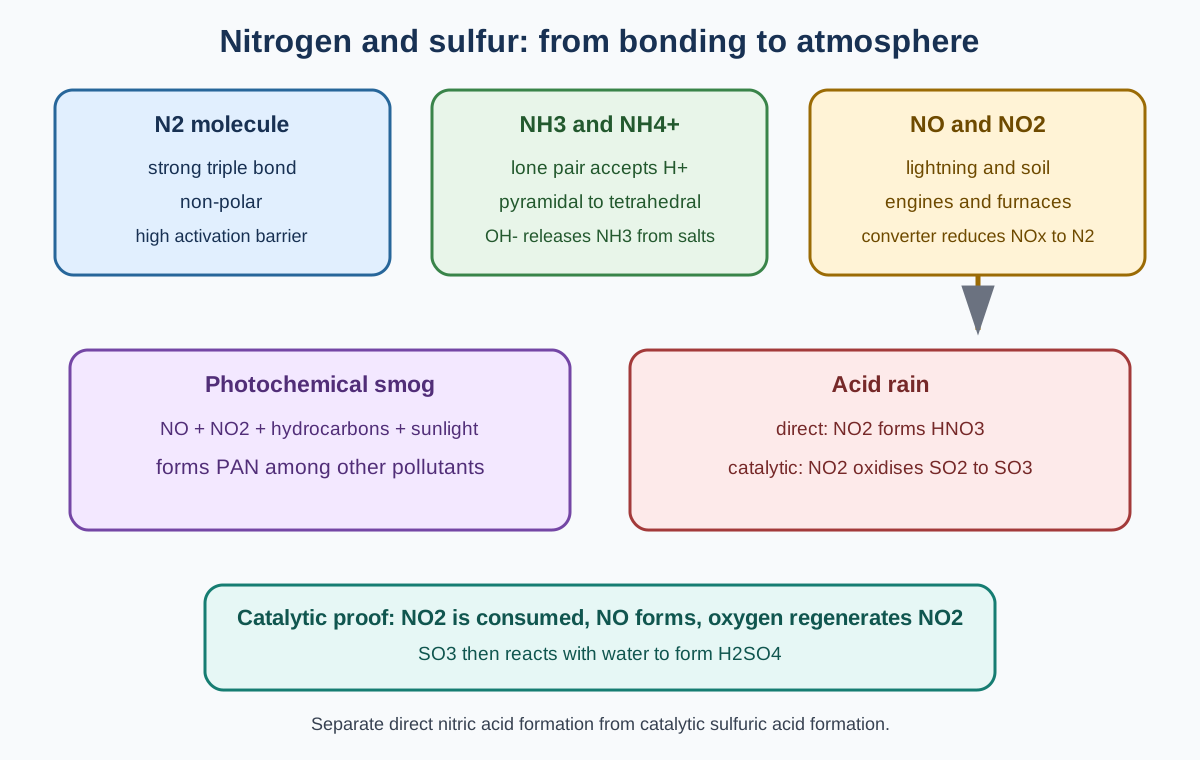
Nitrogen and Sulfur is Cambridge International Chemistry 9701 Topic 12. The official AS boundary links molecular nitrogen and ammonia chemistry to atmospheric nitrogen oxides, photochemical smog and acid rain. This theory note owns structures, equations, oxidation-state reasoning and environmental pathways. Practical test execution remains in the practical hub.
1. Why atmospheric nitrogen is unreactive
A nitrogen molecule contains a strong triple covalent bond, one sigma bond and two pi bonds. Breaking this bond requires a large activation energy. At ordinary temperatures, relatively few collisions have enough energy to initiate reaction.
The molecule is also non-polar because it consists of two identical atoms with the same electronegativity. It therefore lacks a permanent charge separation that might attract polar or charged reactants.
Lack of reactivity is kinetic, not evidence that all possible nitrogen reactions are energetically impossible. High temperature, pressure, catalysts or electrical discharges can create alternative conditions.
2. Ammonia as a Bronsted-Lowry base
A Bronsted-Lowry base accepts a proton. The lone pair on nitrogen allows ammonia to accept HX+. In water:
NHX3+HX2O⇌NHX4X++OHX−
Check this topic from memory
Attempt the matching topic bank before reopening the notes. Use each missed idea to decide what to review next.
Ammonia is the base and water is the acid. The products are ammonium and hydroxide ions. Because the reaction is reversible and incomplete, aqueous ammonia is a weak base.
The presence of three hydrogen atoms does not make ammonia an acid in this reaction. Role is determined by proton transfer, not by simply counting hydrogens in a formula.
3. Structure of ammonia
Ammonia has three bonding pairs and one lone pair around nitrogen. Its electron-pair geometry is tetrahedral, but its molecular shape is trigonal pyramidal because shape names describe atom positions.
Lone-pair to bond-pair repulsion is stronger than bond-pair to bond-pair repulsion, compressing the H−N−H angle below the ideal tetrahedral value.
This lone pair is also the site that accepts a proton. Structure and basic behaviour are therefore two views of the same electron-pair evidence.
4. Formation and structure of the ammonium ion
Ammonia donates its lone pair to a proton:
NHX3+HX+NHX4X+
The new bond is initially described as a coordinate bond because both bonding electrons come from nitrogen. Once the ion has formed, all four nitrogen-hydrogen bonds are equivalent.
Ammonium has four bonding pairs and no lone pair on nitrogen, so it is tetrahedral with bond angles near 109.5 degrees. The overall positive charge belongs to the ion, not to one selected hydrogen atom.
This is an acid-base reaction: ammonia accepts a proton and acts as the base.
5. Displacing ammonia from ammonium salts
A strong base such as aqueous sodium hydroxide removes a proton from an ammonium ion:
NHX4X++OHX−NHX3+HX2O
For ammonium chloride:
NHX4Cl+NaOHNHX3+HX2O+NaCl
Gentle warming releases ammonia gas. The process is another Bronsted-Lowry acid-base reaction: ammonium donates a proton, while hydroxide accepts it.
An ammonium salt does not release ammonia merely because it is warmed in water. A sufficiently strong base is needed to shift the proton-transfer chemistry toward ammonia.
6. Natural formation of nitrogen oxides
Lightning supplies enough energy for nitrogen and oxygen to react:
NX2+OX22NO
Nitrogen monoxide is then oxidised in air:
2NO+OX22NOX2
Natural biological processes in soils, including microbial transformations of nitrogen compounds, can also release nitrogen oxides. Wildfires provide another high-temperature natural source.
The term NOx commonly groups NO and NOX2 in atmospheric discussions. It does not represent a single compound with a fixed formula.
7. Human formation of nitrogen oxides
Internal-combustion engines and high-temperature furnaces provide conditions in which atmospheric nitrogen and oxygen react. The hotter the combustion region and the longer gases remain there, the more thermal nitrogen monoxide can form.
Nitrogen monoxide leaving the engine is oxidised to nitrogen dioxide in air. Power generation, industrial combustion and transport are therefore major human sources.
Fuel does not need to contain nitrogen for thermal NO to form, because the nitrogen can come from the air supplied for combustion.
8. Catalytic removal from exhaust gases
Catalytic converters use a solid catalyst surface to speed oxidation and reduction reactions. Nitrogen oxides are reduced to nitrogen while carbon monoxide or unburned hydrocarbons are oxidised.
A representative equation is:
2CO+2NO2COX2+NX2
Another simplified equation using a hydrocarbon is:
4NO+CHX42NX2+COX2+2HX2O
The catalyst provides an alternative pathway with lower activation energy and is regenerated. It does not change the overall stoichiometry or turn pollutants into harmless material without atom conservation.
Effective control depends on exhaust temperature, gas composition and catalyst condition. Lead compounds and other poisons can block active sites.
9. From nitrogen oxides to photochemical smog
Sunlight drives a network of radical reactions involving NO, NOX2, oxygen and unburned hydrocarbons. One product is peroxyacetyl nitrate, abbreviated PAN.
PAN is a component of photochemical smog and irritates eyes and respiratory tissues. It is not simply another name for nitrogen dioxide, nor is it formed by nitrogen oxides alone. Unburned hydrocarbon-derived species and light-driven chemistry are required.
The official boundary asks for the relationship among atmospheric NO, NOX2, unburned hydrocarbons, PAN and smog rather than a detailed radical mechanism.
10. Direct formation of nitric acid and acid rain
Atmospheric nitrogen dioxide reacts with oxygen and water to form nitric acid. A useful overall equation is:
4NOX2+OX2+2HX2O4HNOX3
Nitric acid dissolves in cloud droplets and lowers precipitation pH. Nitrogen monoxide contributes after oxidation to nitrogen dioxide.
Acid rain is more acidic than natural rainwater, which is already slightly acidic because dissolved carbon dioxide forms carbonic acid. Do not use neutral pH 7 as the only criterion.
11. Sulfur dioxide and sulfuric acid
Combustion of sulfur-containing fuels releases sulfur dioxide. In the atmosphere, oxidation produces sulfur trioxide, which reacts with water to form sulfuric acid:
SOX3+HX2OHX2SOX4
Sulfuric acid in atmospheric droplets contributes to acid deposition. The slow oxidation of sulfur dioxide can be accelerated by atmospheric oxidants, including nitrogen dioxide.
This sulfur pathway is included because nitrogen oxides do more than form nitric acid directly: they can catalyse oxidation of another pollutant.
Nitrogen dioxide oxidises sulfur dioxide to sulfur trioxide and is reduced to nitrogen monoxide:
NOX2+SOX2NO+SOX3
Nitrogen monoxide is reoxidised by atmospheric oxygen:
2NO+OX22NOX2
Because nitrogen dioxide is regenerated, the NOX2/NO pair acts catalytically. Adding the two stages after matching coefficients gives the net oxidation of sulfur dioxide by oxygen. The regenerated species must appear as a reactant in one step and product in another.
Sulfur trioxide then produces sulfuric acid with water. Nitrogen oxides therefore contribute to acid rain both directly through nitric acid and catalytically through sulfuric acid formation.
13. Environmental consequences and control logic
Acid deposition can acidify lakes and soils, mobilise toxic metal ions, damage plant tissues and weather carbonate stone. Photochemical smog can harm respiratory health and reduce visibility.
Control strategies follow the reaction chain: lower peak combustion temperatures or modify combustion to reduce initial NO formation; use catalytic converters to remove nitrogen oxides and oxidisable pollutants; reduce sulfur in fuels; and prevent release of unburned hydrocarbons.
No single measure removes every pollutant. For example, reducing sulfur dioxide does not by itself eliminate PAN, while removing nitrogen oxides can reduce both nitric-acid formation and their catalytic assistance in sulfuric-acid formation.
Worked application: explain two acid-rain roles of nitrogen oxides
An exhaust plume contains nitrogen monoxide and sulfur dioxide. In air, NO is oxidised to NOX2. One portion forms nitric acid through the overall reaction 4NOX2+OX2+2HX2O4HNOX3, so nitrogen oxides contribute directly to acidic droplets. Another portion oxidises SOX2 to SOX3, producing NO; oxygen then converts that NO back to NOX2. Regeneration proves a catalytic cycle. Finally, SOX3+HX2OHX2SOX4. The answer must distinguish consumed nitrogen forming nitric acid from regenerated nitrogen oxide accelerating sulfuric-acid formation.
This distinction also predicts why lowering nitrogen-oxide emissions can weaken both pathways at once.
Common misconceptions and corrections
Calling nitrogen reactive because it has a triple bond. The strong bond creates a high activation barrier.
Explaining nitrogen inertness only by non-polarity. Triple-bond strength is also required.
Saying nitrogen reactions are thermodynamically impossible. Suitable conditions can overcome kinetic barriers.
Defining an ammonia base as an OHX− donor. It accepts a proton.
Calling water the base in ammonia's aqueous equilibrium. Water donates the proton.
Saying ammonia is a strong base. Its reaction with water is incomplete.
Calling ammonia tetrahedral in molecular shape. It is trigonal pyramidal.
Omitting the lone pair from ammonia's structure. It controls shape and basicity.
Calling ammonium trigonal pyramidal. It is tetrahedral.
Keeping one permanent coordinate bond in ammonium. All four bonds are equivalent after formation.
Putting the positive charge on one hydrogen. It belongs to the ion overall.
Displacing ammonia with an acid. A strong base removes the proton from ammonium.
Omitting water from the ammonium-hydroxide ionic equation. Proton transfer forms water.
Saying all nitrogen oxides come from nitrogen-containing fuel. Atmospheric nitrogen reacts at high temperature.
Calling lightning a human source. It is natural.
Treating NOx as one fixed compound. It groups nitrogen oxides such as NO and NOX2.
Saying a catalytic converter stores nitrogen oxides. It converts them through surface reactions.
Saying the catalyst changes the reaction products. It changes pathway and rate.
Omitting oxidation of carbon monoxide or hydrocarbons. Exhaust treatment couples reduction and oxidation.
Calling PAN another formula for nitrogen dioxide. It is a different smog component.
Forming PAN from nitrogen oxides without hydrocarbons. Unburned hydrocarbon-derived species are involved.
Saying all smog is simply smoke. Photochemical smog is a light-driven pollutant mixture.
Defining acid rain as any rain below pH 7. Natural rain is already slightly acidic.
Saying nitrogen monoxide directly forms nitric acid without oxidation. It first contributes through NOX2.
Stopping sulfur chemistry at sulfur dioxide. Oxidation and hydration produce sulfuric acid.
Calling NOX2 a catalyst when it is never regenerated. Show the NO-to-NOX2
Saying catalytic means no net reaction. The catalyst cancels, but reactants still become products.
Combining direct and catalytic acid-rain roles into one vague statement. Explain nitric and sulfuric acid pathways separately.
Assessment guidance
For nitrogen inertness, give both triple-bond strength and non-polarity, then relate the strong bond to activation energy. Acid-base answers must identify proton donor and acceptor and connect ammonia's lone pair to ammonium formation and geometry. Nitrogen-oxide questions should separate natural from human sources and conserve atoms in converter equations. For PAN, include nitrogen oxides, unburned hydrocarbons and photochemical smog without inventing a required radical mechanism. Acid-rain responses need two routes: direct nitric-acid formation and catalytic sulfur-dioxide oxidation, with equations that show nitrogen dioxide consumed and regenerated before sulfur trioxide forms sulfuric acid.
Retrieval practice
Draw ammonia and ammonium with shape, lone pairs, bond angles and proton-transfer equations. List two natural and three human nitrogen-oxide sources, then balance two catalytic-converter equations. Explain PAN formation at the syllabus level. Finally, reconstruct the direct nitric-acid equation and the two-step NOX2/NO catalytic cycle for sulfur dioxide, cancel the regenerated intermediate and state the sulfuric-acid-forming step.