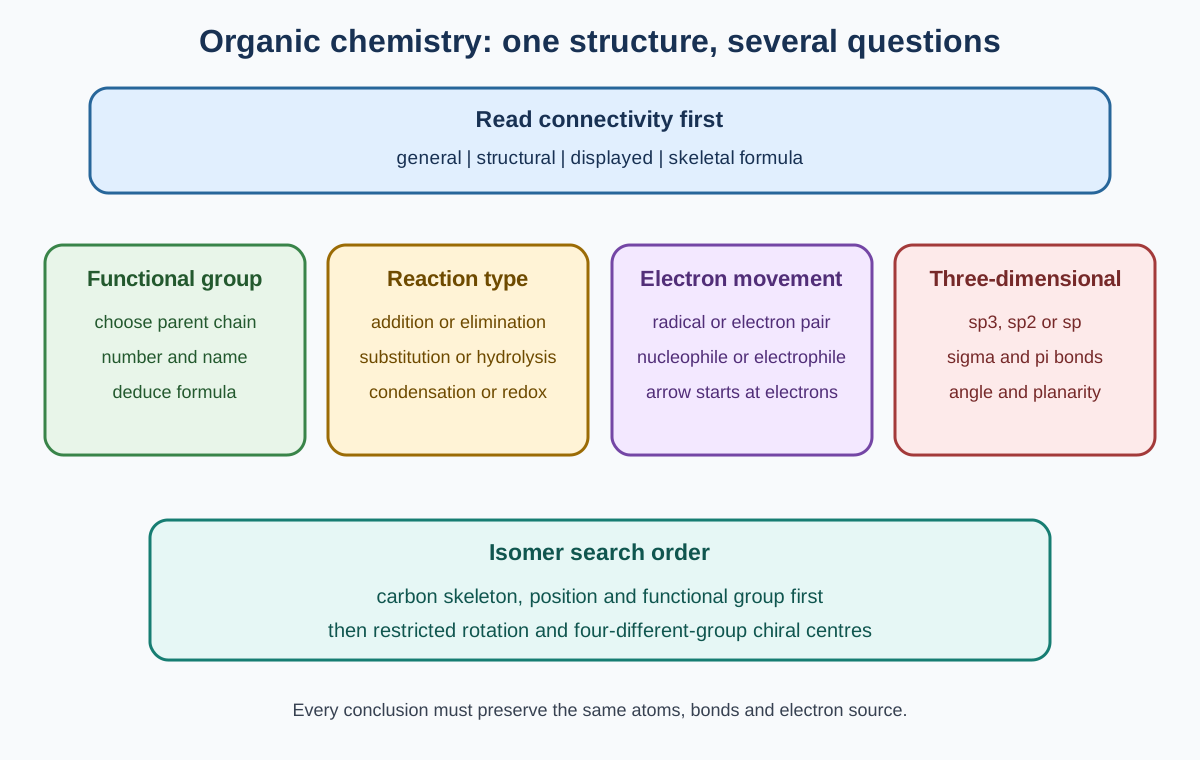
An Introduction to AS Level Organic Chemistry is Cambridge International Chemistry 9701 Topic 13. It establishes the representation, naming, reaction, mechanism, shape and isomerism language used in later organic topics. This note owns conceptual interpretation and deduction; physical model-building and practical reaction execution remain outside this theory hub.
1. Hydrocarbons and functional groups
A hydrocarbon contains carbon and hydrogen atoms only. Alkanes are simple saturated hydrocarbons with no functional group. Their characteristic behaviour arises mainly from carbon-carbon and carbon-hydrogen bonds.
A functional group is an atom or group of atoms that determines characteristic physical and chemical properties. Changing a functional group can change polarity, intermolecular attractions and reaction pathways even when the carbon skeleton remains similar.
The AS set includes alkenes, halogenoalkanes, alcohols, aldehydes, ketones, carboxylic acids, esters, primary amines and nitriles.
2. Four formula representations
A general formula represents every member of a homologous series, such as CnH2n+2 for non-cyclic alkanes.
A structural formula shows the order in which atoms or groups are connected, such as CH3CH2OH. A displayed formula shows every atom and every covalent bond. A skeletal formula shows the carbon framework as lines: each unlabelled line end or vertex is a carbon, and hydrogens attached to carbon are omitted.
Heteroatoms and hydrogens attached to them are shown explicitly in skeletal formulae. A short skeletal line is not a single carbon by itself; its two ends represent two carbons.
3. Reading skeletal formulae accurately
Count every vertex and line end, then supply enough hydrogen atoms to give each neutral carbon four bonds. A double bond counts as two bonds and a triple bond as three.
Do not count a written O, N or halogen label as a carbon vertex. In a terminal aldehyde, the carbonyl carbon is part of the main chain even though one of its attachments is oxygen.
To deduce molecular formula, total each element after completing implied carbon hydrogens. Reduce subscripts to their simplest whole-number ratio for the empirical formula.
4. Alkenes and halogenoalkanes
An alkene contains a carbon-carbon double bond. The longest chain containing the double bond supplies the stem, and numbering gives the double bond the lowest possible locant. For example, CH3CH=CHCH3 is but-2-ene.
A halogenoalkane contains a carbon-halogen bond. Halogens are named as prefixes such as chloro or bromo, with locants. A halogenoalkane is primary, secondary or tertiary according to how many carbon atoms are directly attached to the carbon bearing the halogen.
Check this topic from memory
Attempt the matching topic bank before reopening the notes. Use each missed idea to decide what to review next.
The classification concerns that carbon, not the total number of carbon atoms in the molecule.
5. Alcohols, aldehydes and ketones
An alcohol contains a hydroxyl group attached to carbon. Choose the longest chain containing that carbon and use the suffix -ol, giving the hydroxyl the lowest locant. Alcohols are primary, secondary or tertiary according to the number of carbon groups attached to the hydroxyl-bearing carbon.
An aldehyde contains a terminal carbonyl group and uses the suffix -al. Its carbonyl carbon is carbon 1 and normally needs no written locant. A ketone contains a carbonyl group within a chain and uses -one with the lowest possible locant, as in pentan-2-one.
Both aldehydes and ketones contain carbonyl groups, but their positions and oxidation behaviour differ.
6. Carboxylic acids and esters
A carboxylic acid contains the carboxyl group and uses the suffix -oic acid. The carboxyl carbon belongs to the parent chain and is carbon 1.
An ester has the linkage RCOOR'. Its name has two parts. The alkyl group attached to oxygen is named first; the acid-derived part is named second with the ending -oate. CH3CH2COOCH3 is methyl propanoate.
For this syllabus boundary, ester naming uses straight chains and may involve up to six carbons on each side. Do not reverse the two name parts by starting with the carbonyl side.
7. Primary amines and nitriles
A primary amine contains the group RNH2. Simple compounds may be named using an alkylamine form, such as propylamine, following the syllabus table.
A nitrile contains RCN. The carbon of the nitrile group counts as part of the main carbon chain, so CH3CH2CN is propanenitrile, not ethanenitrile. Straight-chain nitriles up to the stated boundary are required.
The nitrogen in a nitrile is triple-bonded to carbon, whereas the nitrogen in a primary amine has single bonds and a lone pair. The shared presence of nitrogen does not make them one homologous series.
8. Systematic naming workflow
First identify the principal functional group. Next select the longest permitted parent chain containing it and any required multiple bond. Number the chain from the end that gives the principal group the lowest locant. Then identify substituents, assign locants and arrange prefixes consistently before the parent name and suffix.
Check that the written name reconstructs one unambiguous structure. For simple aliphatic molecules, the Cambridge boundary extends to six carbon atoms, with the stated six-plus-six allowance for straight-chain esters.
Naming is not visual pattern matching. Reversing a drawing does not create a new compound if connectivity remains unchanged.
9. Homologous series, saturation and reaction classes
A homologous series is a family with the same functional group and general formula, similar chemical properties and a gradual trend in physical properties. Adjacent members differ by CH2.
A saturated compound contains only single carbon-carbon bonds. An unsaturated compound contains at least one carbon-carbon multiple bond.
Addition combines reactants into one main product, usually across a multiple bond. Substitution replaces one atom or group with another. Elimination removes atoms or groups to form a multiple bond. Hydrolysis breaks a bond using water. Condensation joins molecules with loss of a small molecule such as water.
Oxidation in organic chemistry can involve gain of oxygen or loss of hydrogen; reduction can involve gain of hydrogen or loss of oxygen. Cambridge equations may use [O] and [H] as bookkeeping symbols.
10. Homolytic and heterolytic fission
In homolytic fission, each atom receives one electron from the broken bond, forming two radicals. Use single-headed fish-hook arrows when explicitly representing single-electron movement.
In heterolytic fission, both bonding electrons move to one atom, forming ions. A full curly arrow represents movement of an electron pair and must begin at the bond or lone pair that supplies those electrons.
An arrow beginning at a positive charge has no electron source. An arrow ending vaguely between atoms fails to identify the new bond or receiving atom.
11. Radicals and chain reactions
A free radical is a species with an unpaired electron. Free-radical substitution has three stages.
Initiation creates radicals, usually by homolytic bond breaking. Propagation consumes a radical and forms another radical, allowing the chain to continue. Termination removes radicals when two combine to form a non-radical product.
An equation is classified by its role in the chain, not by its position on a memorised page. A propagation step must have a radical on both sides; a termination step has radicals as reactants but none as products.
12. Nucleophiles, electrophiles and mechanisms
A nucleophile donates an electron pair. It may carry a negative charge or have an available lone pair. An electrophile accepts an electron pair and is electron-deficient.
Electrophilic addition commonly begins when an electrophile attacks electron density in a pi bond. Nucleophilic substitution replaces a leaving group after a nucleophile donates a pair to carbon. Nucleophilic addition occurs when a nucleophile attacks an electron-deficient atom in a multiple bond such as a carbonyl group.
Mechanism names combine the attacking species with the overall change. A nucleophile participating does not make every reaction nucleophilic substitution.
13. Curly-arrow discipline
A full curly arrow shows movement of an electron pair. It begins at a lone pair or a bond and points toward the atom or bond that receives the pair.
When a bond breaks heterolytically, the arrow begins on that bond and ends on the atom that takes both electrons. When a new bond forms, the arrow begins at the donor lone pair or electron-rich bond and ends at the atom being attacked.
Charges after each step must match electron movement. Curly arrows describe electron movement, not the physical flight path of atoms.
14. Straight, branched and cyclic molecules
A straight-chained molecule has an unbranched carbon sequence. A branched molecule has one or more carbon substituents attached to the main chain. A cyclic molecule contains a ring.
These descriptions concern carbon connectivity. A zigzag skeletal drawing can still represent a straight chain, because the drawing angle is not a branch unless a carbon connects to three or more carbon neighbours.
Ring structures can also show geometrical isomerism because the ring restricts rotation.
15. Hybridisation, shape and bonding
An sp3-hybridised carbon has four sigma bonds arranged tetrahedrally at about 109.5 degrees. An sp2-hybridised carbon has three regions of sigma bonding in a trigonal planar arrangement at about 120 degrees, plus one unhybridised p orbital. Sideways overlap of p orbitals forms a pi bond.
An sp-hybridised carbon has two sigma-bonding directions arranged linearly at 180 degrees and two unhybridised p orbitals capable of forming two pi bonds.
A single bond is one sigma bond. A double bond contains one sigma and one pi bond. A triple bond contains one sigma and two pi bonds.
16. Planarity and restricted rotation
Ethene is planar around its double bond. Each carbon is sp2 hybridised, and the parallel p orbitals must remain aligned for sideways overlap.
Rotation about the carbon-carbon double bond would disrupt the pi overlap, so it is restricted. Rotation about an isolated carbon-carbon sigma bond is much easier because head-on overlap remains while the groups rotate.
Restricted rotation is the structural origin of geometrical isomerism when each double-bonded carbon carries two different groups.
17. Structural isomerism
Structural isomers have the same molecular formula but different connectivity.
Chain isomers differ in carbon skeleton, such as butane and 2-methylpropane. Positional isomers have the same skeleton and functional group at different positions, such as propan-1-ol and propan-2-ol. Functional-group isomers have different functional groups, such as an aldehyde and ketone with formula C3H6O.
Different conformations produced by rotation about a single bond are not structural isomers because connectivity has not changed.
18. Geometrical isomerism
Geometrical stereoisomers have the same connectivity but different spatial arrangements caused by restricted rotation. For an alkene to show cis-trans isomerism, each carbon of the double bond must be attached to two different groups.
If one double-bonded carbon has two identical groups, no geometrical pair exists. Cis describes the relevant matching groups on the same side; trans places them on opposite sides. E and Z nomenclature is acceptable but not required here.
Cyclic compounds can also show cis-trans isomerism because ring bonds restrict relative orientation.
19. Optical isomerism and chiral centres
A chiral centre is commonly a tetrahedral carbon bonded to four different atoms or groups. It gives two non-superimposable mirror images called enantiomers.
To test a carbon, trace whole attached groups until a difference appears. Labels that both begin with carbon may still represent different groups. A carbon with two methyl groups is not chiral.
A molecule can contain more than one chiral centre. Detailed meso-compound and diastereoisomer terminology is outside this boundary, so identify the centres without applying an automatic two-to-the-power-n count in every case.
20. Systematically deducing isomers
Start from the molecular formula and any stated compound class. Enumerate distinct carbon skeletons, then place the functional group or multiple bond at non-equivalent positions. Check functional-group alternatives if the prompt allows them. Finally, test each connectivity for geometrical and optical stereoisomerism.
Remove duplicates by renumbering or rotating drawings mentally. Confirm carbon valency, formula and functional-group requirement for every candidate.
This layered process is safer than sketching randomly because it separates connectivity choices from spatial-isomer checks.
Worked application: analyse CH3CH(OH)CH=CH2
The longest chain has four carbons and contains both the hydroxyl group and double bond. Number from the end giving the hydroxyl the lower locant, so the name is but-3-en-2-ol. Its molecular formula is C4H8O and its empirical formula is also C4H8O because the subscripts share no common factor. Carbon 2 is sp3 hybridised and attached to H, OH, CH3 and CH=CH2, four different groups, so it is chiral and gives two enantiomers. The terminal double-bond carbon is CH2 with two identical hydrogen substituents, so the molecule does not show geometrical isomerism despite containing a carbon-carbon double bond.
Common misconceptions and corrections
Calling any carbon compound a hydrocarbon. It must contain only carbon and hydrogen.
Giving alkanes a functional group. They have no functional group in this treatment.
Treating every skeletal line as one carbon. Ends and vertices are carbons.
Showing carbon-bound hydrogens in every skeletal formula. They are normally omitted.
Omitting a heteroatom from a skeletal formula. Heteroatoms are explicit.
Excluding the aldehyde carbon from the chain. The carbonyl carbon is carbon 1.
Naming the acid side first in an ester. Name the oxygen-side alkyl group first.
Excluding the nitrile carbon from the chain. It counts in the parent name.
Classifying an alcohol by total carbon count. Inspect the hydroxyl-bearing carbon.
Calling compounds homologues merely because they react similarly. They need the same functional group and general formula.
Calling an alkane unsaturated because it has carbon-hydrogen bonds. Saturation concerns carbon-carbon multiple bonds.
Calling hydrolysis any reaction involving water. Water must break a bond in the substrate.
Calling condensation simple addition. A small molecule is eliminated.
Giving both homolytic electrons to one atom. Homolysis divides them one each.
Drawing a full curly arrow for one electron. Full arrows represent pairs.
Starting a curly arrow at a positive charge. Start at an electron source.
Calling radical creation propagation. Initial radical formation is initiation.
Calling radical-radical combination propagation. It is termination.
Defining a nucleophile as any negative ion. Electron-pair donation is decisive.
Defining an electrophile as a proton donor. It accepts an electron pair.
Calling every nucleophile reaction substitution. Addition is also possible.
Calling a zigzag chain branched. Connectivity, not drawing shape, defines branching.
Giving sp3 carbon a planar 120-degree geometry. It is tetrahedral near 109.5 degrees.
Saying a double bond has two sigma bonds. It has one sigma and one pi bond.
Saying a triple bond has three sigma bonds. It has one sigma and two pi bonds.
Allowing free rotation around a double bond. Rotation disrupts pi overlap.
Calling rotated conformations structural isomers. Connectivity is unchanged.
Claiming every alkene has cis-trans forms. Each double-bonded carbon needs two different groups.
Requiring a double bond for all geometrical isomerism. Rings can restrict rotation too.
Calling any carbon bearing four bonds chiral. The four attached groups must differ.
Assuming two carbon-starting groups are identical. Trace their connectivity.
Using two-to-the-power-n blindly for multiple chiral centres. Excluded symmetry cases can change the count.
Assessment guidance
Translate carefully among molecular, structural, displayed and skeletal formulae before naming. Identify the principal functional group, parent chain and numbering direction explicitly, then verify carbon count and valency. Mechanism answers require accurate terminology and curly arrows that start at a bond or lone pair and end at a defined electron-pair destination. Shape explanations should state hybridisation, sigma and pi composition, angle and planarity where relevant. For isomer questions, separate structural enumeration from stereochemical tests, remove equivalent duplicates and justify geometrical or optical isomerism from substituent identity rather than from the mere presence of a double bond or tetrahedral carbon.
Retrieval practice
Translate ten compounds through all four formula representations and name every official functional-group class. Sort reaction descriptions into addition, substitution, elimination, hydrolysis, condensation, oxidation and reduction. Draw one valid electron-flow step for each named AS mechanism. Rebuild the sp3, sp2 and sp shape table, then enumerate chain, positional, functional-group, geometrical and optical isomers for progressively constrained molecular formulae while explaining why rejected drawings are duplicates or invalid.