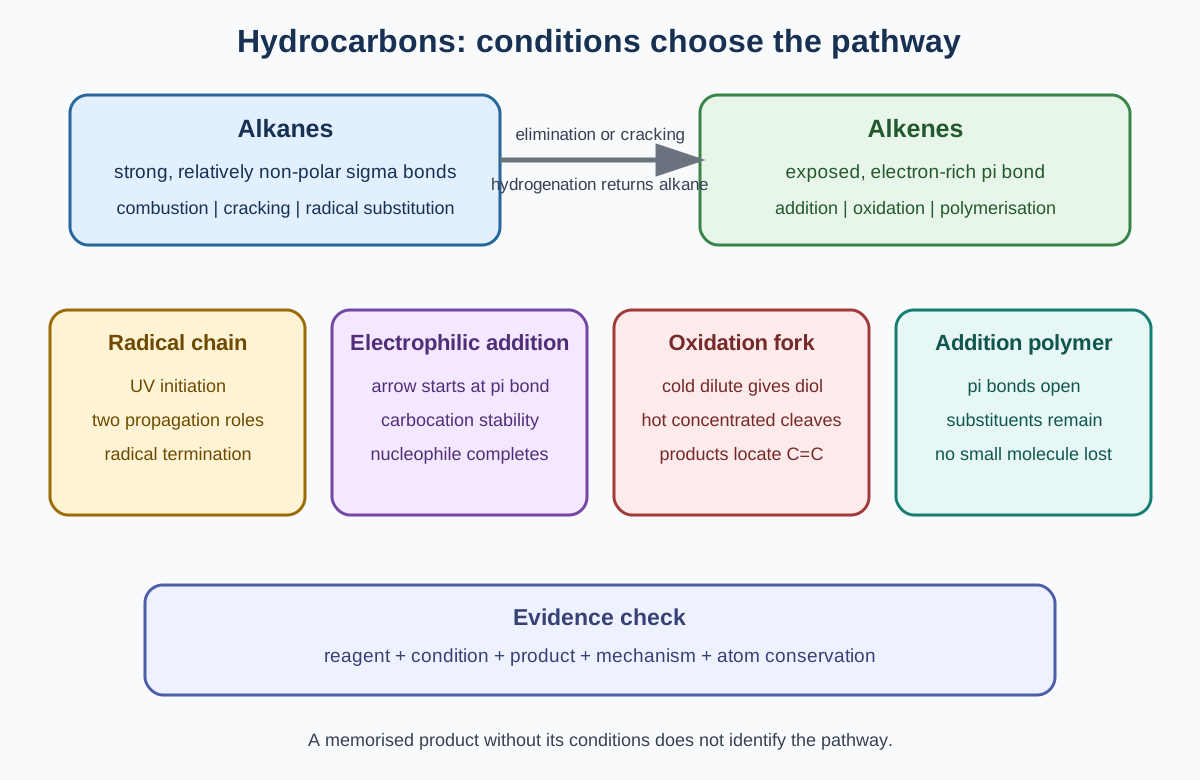
Hydrocarbons is Cambridge International Chemistry 9701 Topic 14. It develops alkane and alkene preparation, reactions and mechanisms, then uses these patterns to explain fuel pollution, cracking, alkene tests, oxidative cleavage and polymer formation. Practical execution and risk controls remain in the practical hub; this theory note owns reagents, conditions, equations and deductions.
1. Alkane structure and unreactivity
Alkanes are saturated hydrocarbons containing only carbon-carbon and carbon-hydrogen single bonds. Their carbon atoms are sp3 hybridised and their bonds are sigma bonds.
Carbon-hydrogen bonds are strong and relatively non-polar because carbon and hydrogen have similar electronegativities. Alkanes therefore offer no strongly electron-rich or electron-poor site for attack by many polar reagents.
This is general unreactivity, not complete inertness. Combustion, cracking and radical substitution occur when suitable energy and reagents are supplied.
2. Producing alkanes by hydrogenation
Adding hydrogen across an alkene double bond produces an alkane. The required conditions are hydrogen gas, a platinum or nickel catalyst and heat.
For example, ethene plus hydrogen forms ethane. The carbon-carbon pi bond and hydrogen-hydrogen bond are replaced by two new carbon-hydrogen sigma bonds.
The catalyst lowers activation energy without changing the product formula or equilibrium thermodynamics. Hydrogenation is an addition reaction and a reduction of the organic molecule.
3. Producing smaller alkanes by cracking
Cracking heats a longer-chain alkane over aluminium oxide to form smaller molecules, including a shorter alkane and an alkene. The exact products depend on which carbon-carbon bonds break, so more than one valid balanced product set may exist.
For example, decane can crack to octane and ethene. Atom totals must be conserved.
Cracking converts less useful heavy crude-oil fractions into lower-relative-mass alkanes used as fuels and alkenes used as chemical feedstocks. It responds to demand; it does not create additional carbon atoms or guarantee one pure product.
4. Complete combustion
With excess oxygen, an alkane burns completely to carbon dioxide and water. Balance carbon first, hydrogen second and oxygen last.
For propane, the balanced relationship is propane plus five oxygen molecules forming three carbon dioxide and four water molecules.
Complete combustion is exothermic. Carbon reaches oxidation number (+4) in carbon dioxide, and hydrogen forms water. A clean-looking flame is not by itself proof of exact stoichiometric completion.
Check this topic from memory
Attempt the matching topic bank before reopening the notes. Use each missed idea to decide what to review next.
Limited oxygen can produce carbon monoxide and water, or carbon soot and water. Product mixtures are possible.
Carbon monoxide is toxic because it binds strongly to haemoglobin and reduces oxygen transport. Particulate carbon contributes to respiratory and visibility problems and can absorb light.
Incomplete combustion still releases energy, but less chemical energy is extracted than when carbon is fully oxidised to carbon dioxide.
6. Pollutants from internal-combustion engines
Carbon monoxide arises from incomplete combustion. High engine temperatures allow atmospheric nitrogen and oxygen to form nitrogen monoxide, which can become nitrogen dioxide. Unburned hydrocarbons escape when fuel does not burn completely.
Nitrogen oxides contribute to acid rain and photochemical smog. Unburned hydrocarbons participate in smog chemistry, and carbon monoxide is directly toxic.
Catalytic converters reduce nitrogen oxides to nitrogen while oxidising carbon monoxide and hydrocarbons to carbon dioxide and water. A catalyst accelerates these reactions but cannot compensate for absent reactants, low operating temperature or poisoned active sites.
7. Free-radical substitution of alkanes
Chlorine or bromine substitutes for hydrogen in an alkane under ultraviolet light. Ethane with chlorine first forms chloroethane and hydrogen chloride, but further substitution can occur because the product still contains carbon-hydrogen bonds.
The overall first-substitution equation is ethane plus chlorine forming chloroethane plus hydrogen chloride.
This is not an electrophilic substitution. The ultraviolet condition signals a radical chain process initiated by homolytic halogen-bond fission.
8. Initiation
Ultraviolet light supplies energy for homolytic fission of chlorine or bromine. One halogen molecule forms two halogen radicals.
Use fish-hook arrows if showing single-electron movement: each atom receives one electron from the original bond.
Initiation creates radicals but does not itself form the substituted organic product.
9. Propagation
For chlorination of ethane, a chlorine radical abstracts hydrogen from ethane, forming hydrogen chloride and an ethyl radical. The ethyl radical then reacts with chlorine, forming chloroethane and regenerating a chlorine radical.
These two steps repeat. Each propagation step consumes one radical and produces another, maintaining the chain.
Adding the propagation equations cancels the radical intermediate and gives the overall substitution. A step with no radical product cannot propagate the chain.
10. Termination and product mixtures
Termination occurs when two radicals collide and form a stable molecule. Possible combinations include two chlorine radicals, a chlorine radical with an ethyl radical, or two ethyl radicals.
Radical substitution is difficult to stop after one substitution and can produce positional and multiple-substitution mixtures in larger alkanes. It is therefore often less selective than a simple overall equation suggests.
The rarity of radical-radical collisions compared with radical-molecule collisions explains why a small radical population can sustain many propagation cycles.
11. Producing alkenes by elimination
Heating a halogenoalkane with sodium hydroxide in ethanol removes hydrogen halide and forms an alkene. The solvent and condition matter: aqueous hydroxide favours substitution, while ethanolic hydroxide and heat favour elimination.
An unsymmetrical halogenoalkane may produce more than one positional alkene if hydrogen can be removed from different adjacent carbons.
The atoms removed must come from neighbouring carbons so that the new carbon-carbon double bond can form.
12. Producing alkenes from alcohols
Dehydration removes water from an alcohol. Required alternatives are a heated aluminium oxide catalyst or a concentrated acid such as concentrated sulfuric acid.
The hydroxyl group and a hydrogen on an adjacent carbon are lost, and a carbon-carbon double bond forms. This is an elimination reaction.
As with halogenoalkane elimination, different adjacent hydrogens can produce positional isomers. Conditions should be written with the reaction, not supplied as an afterthought.
13. Alkene bonding and reactivity
An alkene double bond contains one sigma bond and one pi bond. The pi electrons lie above and below the internuclear axis and are more exposed than sigma electrons.
The electron-rich pi region attracts electrophiles. Electrophilic addition breaks the pi component and forms two new sigma bonds, leaving the carbon-carbon sigma framework intact.
This explains why alkenes are generally more reactive than alkanes toward polar reagents.
14. Hydrogenation of alkenes
Hydrogen gas with platinum or nickel catalyst and heat adds across the double bond to form an alkane. Each alkene carbon gains one hydrogen.
This is both electrophilic-addition content in the reaction map and an organic reduction. In mechanism questions, however, catalytic surface hydrogenation is not normally represented as the simple carbocation pathway used for hydrogen halides.
The same reaction connects Topic 14.2 alkene consumption with Topic 14.1 alkane production.
15. Hydration with steam
Steam adds across an alkene double bond in the presence of a phosphoric acid catalyst to form an alcohol.
For ethene, the product is ethanol. For an unsymmetrical alkene, structural possibilities depend on which carbon receives hydrogen and which receives hydroxyl.
This is hydration and addition, not hydrolysis: no bond is being split by water in an existing substrate functional group.
16. Addition of hydrogen halides
Hydrogen chloride, bromide or iodide gas adds at room temperature across an alkene double bond to form a halogenoalkane.
With an unsymmetrical alkene, protonation may generate alternative carbocation intermediates. The pathway through the more stable carbocation normally gives the major product.
For propene with hydrogen bromide, proton addition at the terminal carbon forms a secondary carbocation at carbon 2. Bromide attack then gives 2-bromopropane as the major product.
17. Addition of halogens and the bromine-water test
A halogen adds across the double bond to form a dihalogenoalkane. Bromine changes from orange or red-brown to colourless when it reacts with an alkene under the aqueous test conditions.
Decolourisation indicates a reactive carbon-carbon double bond in this syllabus context. It does not identify the alkene's exact position or prove that every unsaturated functional group is present.
State aqueous bromine when describing the test rather than using an unspecified bromine reagent.
18. Bromine and ethene mechanism
The ethene pi bond polarises an approaching bromine molecule. A full curly arrow begins at the pi bond and points toward the electron-deficient bromine atom, while another arrow shows heterolytic bromine-bromine bond breaking toward the departing bromide.
The resulting positive organic intermediate is attacked by a bromide lone pair to form 1,2-dibromoethane.
Every curly arrow begins at an electron pair. Charges and atom totals after the first step must be consistent with the arrows.
19. Hydrogen bromide and propene mechanism
The propene pi bond attacks hydrogen in hydrogen bromide, while the hydrogen-bromine bond electrons move to bromine. Two carbocation pathways are conceivable.
The major pathway places positive charge on the secondary carbon because two alkyl groups stabilise it by positive inductive electron donation. Bromide then attacks the carbocation to form 2-bromopropane.
The minor pathway passes through a less stable primary carbocation and forms 1-bromopropane. Markovnikov orientation is an outcome of relative intermediate stability, not a rule that replaces mechanism reasoning.
20. Carbocation stability and inductive effects
Alkyl groups push electron density toward a positively charged carbon through sigma bonds. This positive inductive effect disperses the electron deficiency.
Carbocation stability increases from primary to secondary to tertiary for the required comparison. A more stable intermediate has a lower-energy formation pathway and is produced more readily.
Count the carbon groups directly attached to the positively charged carbon. Do not classify the carbocation from the original alkene's total carbon count.
21. Cold dilute acidified manganate(VII)
Cold, dilute acidified potassium manganate(VII) oxidises an alkene to a vicinal diol, adding a hydroxyl group to each former double-bond carbon.
The purple oxidising solution is decolourised as it reacts. The carbon-carbon bond remains, but the pi bond is replaced.
The product is a diol, not a pair of carbonyl compounds. Temperature and concentration distinguish this mild oxidation from oxidative cleavage.
22. Hot concentrated acidified manganate(VII)
Hot, concentrated acidified potassium manganate(VII) ruptures the carbon-carbon double bond. Examine each original alkene carbon separately.
If that carbon carried no hydrogen, it forms a ketone. If it carried one hydrogen, it forms a carboxylic acid. A terminal CH2 end is oxidised fully to carbon dioxide under these strong conditions.
The products reveal what groups were attached to the original double-bond carbons. Deduction works in reverse by replacing carbonyl or carboxyl product carbons with the original alkene carbons and reconnecting them with a double bond.
23. Oxidative-cleavage deductions
Two identical ketone products suggest a symmetrical alkene whose double-bond carbons each lacked hydrogen. A ketone plus a carboxylic acid indicates one original alkene carbon had no hydrogen and the other had one.
A carboxylic acid plus carbon dioxide indicates a terminal alkene with one substituted double-bond carbon bearing hydrogen. Product mole ratios matter if the molecule has more than one double bond.
Check carbon conservation before accepting a proposed original structure.
24. Addition polymerisation
Many alkene molecules join when their pi bonds open to form a long saturated carbon backbone. No small molecule is eliminated.
Poly(ethene) has the repeat unit derived from CH2=CH2. Poly(propene) has a two-carbon repeat unit with a methyl substituent on every second backbone carbon.
Draw repeat units with continuation bonds crossing brackets and place the subscript outside. The repeat unit must retain every substituent from the monomer and use single carbon-carbon bonds in the backbone.
Worked application: reconstruct an alkene from oxidation products
An alkene gives propanone and ethanoic acid as its only organic products when heated with concentrated acidified potassium manganate(VII). The propanone carbonyl carbon must come from a double-bond carbon attached to two methyl groups and no hydrogen. The ethanoic-acid carboxyl carbon must come from a double-bond carbon attached to one methyl group and one hydrogen. Reconnect those two carbon atoms with a double bond to obtain (CH3)2C=CHCH3, named 2-methylbut-2-ene. The five-carbon alkene conserves all carbons in three-carbon propanone plus two-carbon ethanoic acid, and both predicted product types match the original hydrogen attachments.
Common misconceptions and corrections
Calling alkanes completely inert. They react under suitable combustion, cracking or radical conditions.
Explaining alkane unreactivity only by saturation. Strong, relatively non-polar bonds matter.
Hydrogenating without a catalyst. Platinum or nickel and heat are required.
Saying cracking produces only alkenes. Smaller alkanes also form.
Treating cracking as one fixed equation. Several balanced product sets are possible.
Saying bromine decolourisation locates the double bond. It only supports its presence.
Using bromine test evidence to identify any unsaturation. The syllabus inference is a carbon-carbon double bond.
Making a ketone from a cleavage carbon bearing hydrogen. It forms a carboxylic acid.
Stopping terminal CH2 oxidation at methanoic acid. Strong conditions give carbon dioxide.
Using cold dilute oxidant for cleavage. It gives a diol.
Breaking the carbon-carbon sigma bond during ordinary electrophilic addition. Only the pi component is lost.
Drawing polymer repeat units with a double bond. The backbone bond is single.
Losing the methyl substituent from propene during polymerisation. It remains on the repeat unit.
Calling addition polymerisation condensation. No small molecule is lost.
Accepting an oxidation reconstruction without carbon counting. Products and alkene must conserve every carbon.
Assessment guidance
Reaction answers must pair the correct substrate with reagent, conditions, product class and reaction type. Radical mechanisms need initiation, both propagation roles and plausible termination, with single-electron accounting. Electrophilic-addition mechanisms need arrows from electron sources, valid intermediate charges and a carbocation-stability explanation for major products. Keep cold dilute manganate(VII) diol formation separate from hot concentrated oxidative cleavage. In cleavage deductions, analyse each alkene carbon, rebuild the double bond and verify carbon conservation. Polymer drawings need the correct saturated repeat unit, continuation bonds and retained substituents. Environmental answers should connect each pollutant to its formation and catalytic conversion.
Retrieval practice
Build a complete alkane and alkene reaction map with every official reagent and condition. Write the ethane-halogen radical mechanism and the ethene-bromine and propene-hydrogen bromide electron-pair mechanisms. Predict major products from primary, secondary and tertiary carbocation alternatives. Work forward and backward through ten hot manganate(VII) cleavage problems, then draw monomers and repeat units for ethene and propene while auditing every atom and bond.