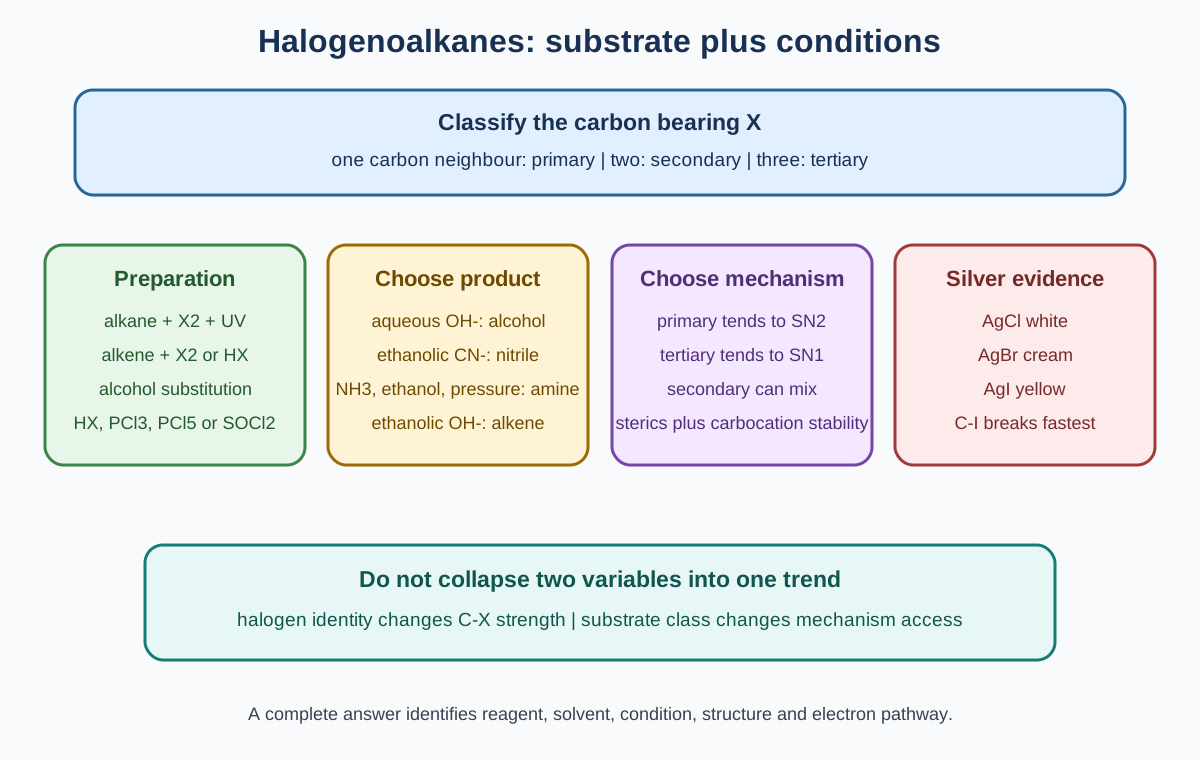
Halogen Compounds is Cambridge International Chemistry 9701 Topic 15. The AS boundary covers preparation and classification of halogenoalkanes, three product-forming nucleophilic substitutions, silver-ion identification, elimination, SN1 and SN2 mechanisms and carbon-halogen bond control of reactivity. Practical execution remains in the practical hub.
1. Structure, polarity and classification
A halogenoalkane contains a halogen bonded to an sp3-hybridised carbon. Because halogens are more electronegative than carbon, the carbon-halogen bond is polar: carbon is electron-deficient and the halogen end is electron-rich.
Classify the molecule by the number of carbon atoms directly attached to the carbon bearing the halogen. One carbon neighbour makes it primary, two secondary and three tertiary. Count neither the total carbon atoms nor the groups attached to another carbon.
This classification helps predict SN1 and SN2 mechanism preference, while halogen identity helps predict carbon-halogen bond strength.
2. Preparation from alkanes
Chlorine or bromine substitutes into an alkane under ultraviolet light by a free-radical chain mechanism. Ethane with chlorine can form chloroethane and hydrogen chloride.
Initiation homolytically splits the halogen molecule. Propagation abstracts hydrogen and then forms the carbon-halogen bond while regenerating a halogen radical. Termination combines radicals.
The method can give positional and multiple-substitution mixtures. It is a valid preparation route but is not necessarily selective.
3. Preparation from alkenes
Electrophilic addition of a halogen at room temperature gives a dihalogenoalkane. Addition of a gaseous hydrogen halide gives a monohalogenoalkane.
For an unsymmetrical alkene with hydrogen halide, the major product normally forms through the more stable carbocation intermediate. Alkyl positive inductive effects stabilise secondary and tertiary carbocations relative to primary ones.
The pi bond is lost and two sigma bonds form. This route is addition, not substitution.
4. Preparation from alcohols using hydrogen halides
An alcohol can undergo substitution with gaseous hydrogen halide, replacing hydroxyl with halogen and forming water.
The hydroxyl group is a poor leaving group by itself. Acidic conditions protonate it so that water can leave more readily.
Reaction outcome and rate depend on alcohol structure and hydrogen-halide reactivity, but the required preparation claim is reagent, substitution and halogenoalkane product.
5. Preparation from alcohols using halide salts and acid
Check this topic from memory
Attempt the matching topic bank before reopening the notes. Use each missed idea to decide what to review next.
Potassium chloride with concentrated sulfuric acid or concentrated phosphoric acid generates acidic chlorinating conditions for alcohol substitution.
The acid supplies protons and helps produce the effective hydrogen-halide reagent. Concentrated phosphoric acid may be chosen to avoid unwanted oxidation of some halide ions by concentrated sulfuric acid.
State the actual halide salt and acid rather than writing only “acidified halide”.
6. Preparation using phosphorus or sulfur reagents
Phosphorus trichloride with heat, phosphorus pentachloride, or thionyl chloride can replace an alcohol hydroxyl group with chlorine.
Thionyl chloride is especially useful because sulfur dioxide and hydrogen chloride by-products are gases, helping leave the organic chloride product behind.
Each route belongs to substitution of an alcohol. Do not present these reagents as catalysts for the unchanged alcohol.
7. Nucleophilic substitution with aqueous hydroxide
Heating a halogenoalkane with aqueous sodium hydroxide produces an alcohol. Hydroxide donates a lone pair to the electron-deficient carbon, and halide leaves.
For bromoethane, the products are ethanol and bromide ion. The carbon skeleton is unchanged.
The aqueous solvent and heat distinguish this from ethanolic hydroxide elimination. Writing NaOH without its solvent leaves the intended pathway ambiguous.
8. Nucleophilic substitution with cyanide
Heating a halogenoalkane with potassium cyanide in ethanol produces a nitrile. Cyanide attacks through carbon so a new carbon-carbon bond forms.
The nitrile product has one more carbon atom than the original halogenoalkane. Bromoethane therefore produces propanenitrile, not ethanenitrile.
This carbon-chain extension is an important synthesis tool. Include ethanol and heat with the reagent.
9. Nucleophilic substitution with ammonia
Heating a halogenoalkane with ammonia in ethanol under pressure produces a primary amine. Ammonia attacks through its nitrogen lone pair; proton transfer then gives the neutral amine.
Excess ammonia favours the primary amine by reducing the chance that the amine product undergoes further alkylation.
Pressure keeps volatile ammonia in the reaction mixture at elevated temperature. It is a condition with a physical purpose, not a reaction product.
10. Elimination with ethanolic hydroxide
Heating a halogenoalkane with sodium hydroxide in ethanol removes hydrogen halide and forms an alkene.
Hydrogen is removed from a carbon adjacent to the carbon bearing halogen. The electrons form a carbon-carbon double bond while halide leaves.
Unsymmetrical substrates may produce more than one positional alkene. The ethanolic solvent and heat favour elimination; aqueous hydroxide favours substitution to alcohol.
11. Silver nitrate identification
Warm the halogenoalkane with aqueous silver nitrate in ethanol. Ethanol helps the organic compound mix with the aqueous reagent. Hydrolysis releases halide ions, which precipitate with silver ions.
Chloroalkanes give white silver chloride, bromoalkanes give cream silver bromide and iodoalkanes give yellow silver iodide.
The time taken for precipitate appearance provides rate evidence. It is not simply a direct precipitation from an intact covalent carbon-halogen bond.
12. Carbon-halogen bond strengths and rates
Carbon-halogen bond strength decreases from carbon-chlorine to carbon-bromine to carbon-iodine because bond length increases and orbital overlap becomes less effective.
Iodoalkanes therefore hydrolyse fastest, bromoalkanes more slowly and chloroalkanes slowest in a controlled comparison. Fluoroalkanes would be especially unreactive because the carbon-fluorine bond is very strong, though the named silver-nitrate examples focus on the other halogens.
Bond polarity alone gives the wrong prediction: carbon-chlorine is more polar than carbon-iodine, but carbon-iodine breaks more readily.
13. The SN2 mechanism
SN2 means bimolecular nucleophilic substitution. It occurs in one concerted step: the nucleophile attacks as the carbon-halogen bond breaks.
A full curly arrow begins at the nucleophile lone pair and points to the carbon bearing halogen. A second arrow begins at the carbon-halogen bond and points to the leaving halogen.
The nucleophile approaches from the side opposite the leaving group because electron density and attached groups obstruct the front. The transition state has partial bonds to both nucleophile and leaving group, but no carbocation intermediate.
14. Why primary substrates favour SN2
Primary halogenoalkanes have relatively little steric crowding around the reacting carbon, so backside nucleophilic approach is accessible.
Their corresponding primary carbocations would be poorly stabilised, making an SN1 ionisation pathway unfavourable.
The SN2 rate depends on both halogenoalkane and nucleophile concentrations because both participate in the single rate-determining collision.
15. The SN1 mechanism
SN1 means unimolecular nucleophilic substitution. The first and slow step is heterolytic carbon-halogen bond breaking to form a carbocation and halide ion.
The nucleophile then attacks the planar carbocation in a faster step. The first step contains only the halogenoalkane, so the rate depends primarily on its concentration rather than nucleophile concentration.
Curly arrows must show electron-pair movement from the carbon-halogen bond to halogen during ionisation and from the nucleophile lone pair to the carbocation during attack.
16. Why tertiary substrates favour SN1
Three alkyl groups donate electron density through positive inductive effects and stabilise a tertiary carbocation. Steric crowding also hinders backside SN2 attack at a tertiary carbon.
Tertiary halogenoalkanes therefore tend to react by SN1. Primary halogenoalkanes tend to use SN2. Secondary halogenoalkanes can use a mixture depending on detailed structure and conditions.
These are tendencies, not labels that make reagent and solvent irrelevant.
17. Competing effects in a reactivity comparison
Two variables may change at once. Changing chlorine to iodine weakens the carbon-halogen bond. Changing a primary substrate to tertiary stabilises a possible carbocation but increases steric hindrance.
An exam comparison should state which factor is held constant. Within one structural class under the same conditions, carbon-halogen bond strength gives a clear iodide faster than bromide faster than chloride trend.
Across different structures, mechanism and conditions must also be considered before predicting rate.
18. Synthesis planning
Use aqueous hydroxide to convert halogenoalkane to alcohol, ethanolic cyanide to extend the carbon chain as a nitrile, ethanolic ammonia under pressure to form an amine, and ethanolic hydroxide with heat to form an alkene.
Work backward from the target functional group, then check carbon count. A nitrile route adds one carbon; hydroxide, ammonia and elimination preserve the original carbon count.
Finally attach reagent, solvent, temperature or pressure to the arrow and verify whether substitution or elimination is intended.
Worked application: distinguish structure and halogen effects
Samples A and B are primary chloroethane and primary iodoethane; sample C is tertiary 2-chloro-2-methylpropane. With warm aqueous silver nitrate in ethanol, B should form a yellow precipitate faster than A forms a white one because the carbon-iodine bond is weaker than the carbon-chlorine bond while structure is held primary. Comparing A with C is different: C can ionise through a stabilised tertiary carbocation and favour SN1, whereas A favours one-step SN2. A claim that every chloroalkane reacts more slowly than every iodoalkane would ignore structure, mechanism and conditions. Precipitate colour identifies halide, while appearance time supplies reactivity evidence.
Common misconceptions and corrections
Classifying from total carbon count. Count carbon neighbours of the halogen-bearing carbon.
Calling the carbon-halogen bond non-polar. Carbon is electron-deficient.
Including nucleophile concentration in the ideal SN1 rate-determining step. It is absent from that step.
Saying primary carbocations are strongly stabilised. They have little alkyl donation.
Saying tertiary substrates favour SN2 because they have more carbons. Steric crowding hinders attack.
Forcing secondary substrates into one mechanism. They can use a mixture.
Treating mechanism preference as independent of conditions. Solvent and nucleophile also matter.
Comparing halogen effects while changing substrate class silently. Control or discuss both variables.
Assessment guidance
For every synthetic route, state substrate class, reagent, solvent, condition, product and reaction type. Classification must inspect the halogen-bearing carbon. Nucleophilic-substitution mechanisms need arrows from electron sources, correct charges and an explicit distinction between concerted SN2 and carbocation-forming SN1. Explain primary and tertiary preferences using both steric access and alkyl positive inductive stabilisation, while describing secondary behaviour as conditional. Silver-nitrate questions require the hydrolysis context, precipitate colour and timing evidence. When comparing reactivity, separate carbon-halogen bond-strength effects from structural and mechanistic effects instead of using one universal ordering.
Retrieval practice
Build a route map for every official halogenoalkane preparation and reaction, including solvent, heat and pressure. Classify twenty structures by the carbon bearing halogen. Draw complete SN1 and SN2 electron-flow mechanisms and predict which pathway primary, secondary and tertiary examples favour. Reconstruct the silver-nitrate colours and carbon-halogen rate order, then solve multistep syntheses in which cyanide changes carbon count while hydroxide, ammonia and elimination do not.