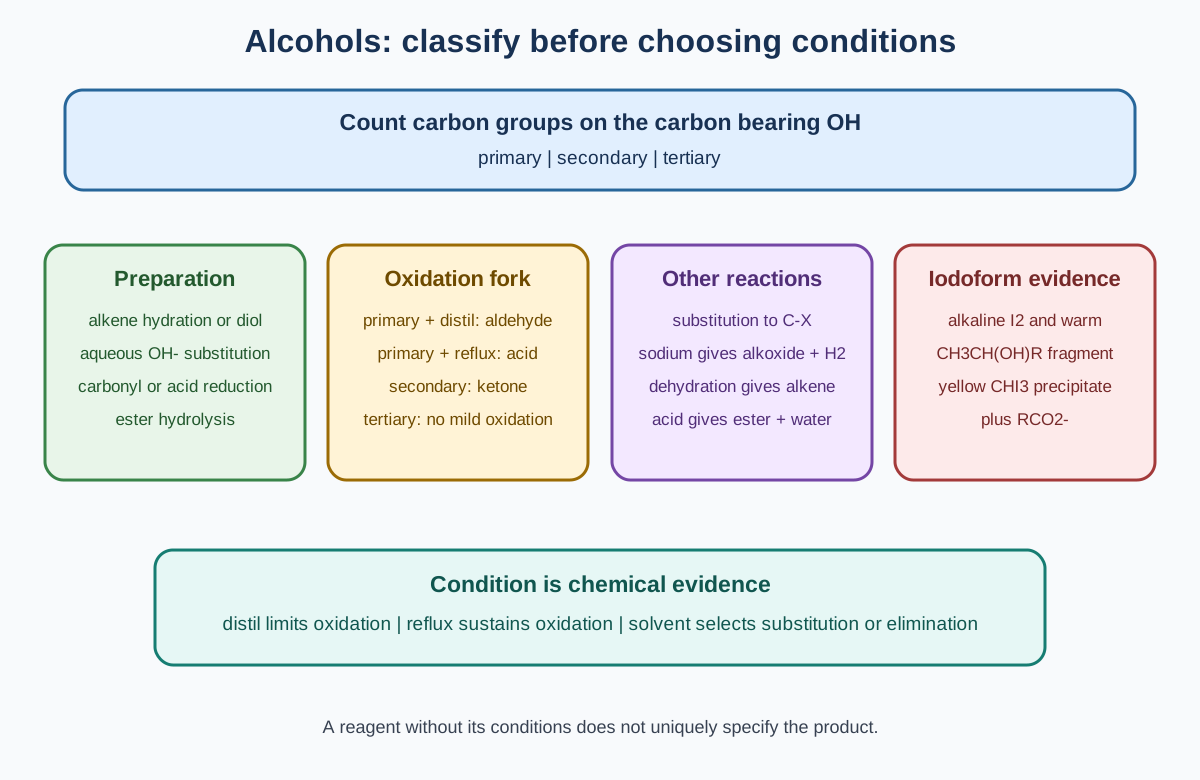
Hydroxy Compounds is Cambridge International Chemistry 9701 Topic 16. The AS boundary covers six alcohol preparation routes, combustion, substitution, sodium, controlled oxidation, dehydration, esterification, classification, the iodoform inference and acidity relative to water. Practical execution remains in the practical hub.
1. The hydroxyl group and alcohol classification
An alcohol contains a hydroxyl group bonded to a saturated carbon. Classify an alcohol by counting the carbon groups directly attached to the carbon bearing hydroxyl.
A primary alcohol has one carbon group on that carbon, a secondary alcohol has two and a tertiary alcohol has three. Methanol is handled separately because its hydroxyl-bearing carbon has no carbon neighbour.
Molecules with more than one hydroxyl group require each relevant carbon environment to be inspected. The whole molecule is not automatically assigned one class from its total number of hydroxyl groups.
2. Preparation by alkene hydration
Steam adds across an alkene double bond using phosphoric acid as catalyst. Ethene gives ethanol; unsymmetrical alkenes can give positional alternatives according to the electrophilic-addition pathway.
The carbon-carbon pi bond is replaced by carbon-hydrogen and carbon-hydroxyl bonds. This is addition and hydration, not hydrolysis.
State steam and phosphoric acid catalyst rather than writing water alone.
3. Preparation of diols from alkenes
Cold, dilute acidified potassium manganate(VII) oxidises an alkene to a diol. One hydroxyl group forms on each former double-bond carbon.
The carbon-carbon bond remains; only the pi component is lost. Purple manganate(VII) is decolourised as oxidation occurs.
Hot, concentrated conditions must not be substituted because they cleave the carbon-carbon double bond instead of giving the diol.
4. Preparation from halogenoalkanes
Heating a halogenoalkane with aqueous sodium hydroxide substitutes hydroxyl for halogen and forms an alcohol.
Hydroxide acts as a nucleophile, donating a lone pair to the electron-deficient carbon while halide leaves through an SN1, SN2 or mixed pathway depending on substrate and conditions.
Aqueous solvent favours substitution. Ethanolic hydroxide and heat favour elimination to an alkene.
5. Reduction of aldehydes and ketones
Sodium borohydride or lithium aluminium hydride reduces a carbonyl group to an alcohol. An aldehyde gives a primary alcohol; a ketone gives a secondary alcohol.
The carbonyl carbon gains hydrogen and the carbonyl oxygen becomes hydroxyl. Organic equations may represent the reducing input using [H].
Check this topic from memory
Attempt the matching topic bank before reopening the notes. Use each missed idea to decide what to review next.
Sodium borohydride is the milder named reagent. Lithium aluminium hydride is more reactive and requires appropriate dry handling in practical work.
6. Reduction of carboxylic acids
Lithium aluminium hydride reduces a carboxylic acid to a primary alcohol. Sodium borohydride is not the required reagent for this conversion.
The carboxyl carbon remains in the skeleton and becomes the carbon bearing hydroxyl in the product.
This route illustrates selectivity: a reagent sufficient for aldehydes and ketones is not automatically sufficient for the more resistant carboxylic-acid group.
7. Alcohols from ester hydrolysis
Heating an ester with dilute acid hydrolyses it reversibly to a carboxylic acid and alcohol. Heating with dilute alkali gives a carboxylate salt and alcohol and is effectively driven forward by carboxylate formation.
The alcohol comes from the ester group originally attached through oxygen. The carbonyl-side fragment becomes acid or carboxylate.
Do not reverse these origins when predicting products from an ester structure.
8. Combustion
Alcohols undergo complete combustion in excess oxygen to form carbon dioxide and water. Balance carbon, hydrogen and oxygen after including the oxygen already present in the alcohol.
Limited oxygen can give carbon monoxide or soot as well as water. The presence of oxygen in the alcohol molecule does not guarantee complete combustion.
Combustion is oxidation of the organic compound but is distinct from the controlled laboratory oxidations used to identify alcohol class.
9. Substitution to halogenoalkanes
The hydroxyl group can be replaced by halogen using gaseous hydrogen halide; potassium chloride with concentrated sulfuric or phosphoric acid; phosphorus trichloride with heat; phosphorus pentachloride; or thionyl chloride.
Acidic conditions convert hydroxyl into a better leaving group. Phosphorus and sulfur chlorinating reagents provide alternative routes.
With thionyl chloride, gaseous sulfur dioxide and hydrogen chloride by-products help separate from the organic chloride. Each reagent should be attached to the actual product conversion.
10. Reaction with sodium
Sodium metal reacts with an alcohol to form a sodium alkoxide and hydrogen gas. Two alcohol molecules release one hydrogen molecule because one hydroxyl hydrogen is removed from each.
The reaction is acid-base and redox in character: the alcohol supplies a proton and sodium is oxidised. Carbon-hydrogen bonds are not the source of the gas.
Observation of effervescence alone does not distinguish an alcohol from water because both can release hydrogen with sodium.
11. Oxidation reagents and observations
Acidified potassium dichromate(VI) or acidified potassium manganate(VII) can oxidise suitable alcohols.
Dichromate(VI) changes from orange to green as chromium(VI) is reduced to chromium(III). Manganate(VII) loses its purple colour under the relevant acidic reaction conditions.
The colour change supports oxidation but the organic product depends on whether the alcohol is primary, secondary or tertiary and on distillation versus reflux.
12. Primary alcohol oxidation by distillation
Gentle oxidation of a primary alcohol first forms an aldehyde and water. Distil the aldehyde as it forms to remove it from the oxidising mixture and limit further oxidation.
Ethanol therefore gives ethanal when heated with acidified dichromate and distilled.
Distillation is not a reagent. It is a separation condition that changes product exposure and therefore the isolated oxidation level.
13. Primary alcohol oxidation under reflux
Heating a primary alcohol under reflux with excess acidified oxidising agent allows the intermediate aldehyde to remain in contact and oxidise further to a carboxylic acid.
Ethanol gives ethanoic acid. Reflux condenses vapour and returns it to the reaction vessel, enabling prolonged heating without losing volatile material.
An answer that gives carboxylic acid but specifies immediate distillation has mismatched condition and product.
14. Secondary and tertiary alcohol oxidation
A secondary alcohol oxidises to a ketone. The hydroxyl-bearing carbon loses hydrogen while retaining its two carbon groups.
A tertiary alcohol cannot be oxidised by these mild reagents because the hydroxyl-bearing carbon has no hydrogen. Oxidation without breaking a carbon-carbon bond is therefore unavailable.
“Cannot be oxidised” is bounded to the stated mild conditions. It does not mean a tertiary alcohol can never burn.
15. Distinguishing alcohol classes
Warm the alcohol with acidified potassium dichromate(VI). Primary and secondary alcohols change the reagent from orange to green; tertiary alcohols show no change under these conditions.
This separates tertiary from oxidisable alcohols but does not by colour alone distinguish primary from secondary. Product identification is needed: aldehyde or acid evidence indicates primary, while ketone indicates secondary.
For molecules with several hydroxyl groups, consider each oxidisable site and the combined product.
16. Dehydration to alkenes
Heat an alcohol over aluminium oxide or with a concentrated acid such as concentrated sulfuric acid to eliminate water and form an alkene.
Hydroxyl leaves from one carbon and hydrogen from an adjacent carbon. Unsymmetrical structures may form more than one positional alkene.
Dehydration is elimination. It is the reverse functional-group direction of alkene hydration, though the operational conditions differ.
17. Esterification
An alcohol reacts reversibly with a carboxylic acid using concentrated sulfuric acid as catalyst to form an ester and water.
The alcohol supplies the alkyl group attached to ester oxygen. Ethanol with ethanoic acid forms ethyl ethanoate.
Concentrated sulfuric acid catalyses the equilibrium and helps remove water, but it is not written as a stoichiometric reactant in the ester product.
18. Iodoform reaction
Warm an appropriate alcohol with aqueous iodine in alkaline conditions. A pale yellow precipitate of triiodomethane, CHI3, forms when the alcohol contains the CH3CH(OH)- group represented as CH3CH(OH)R.
The alcohol is first oxidised to a methyl carbonyl compound, which then undergoes iodination and cleavage. The organic co-product is a carboxylate ion, RCO2-.
Ethanol is the special case with R as hydrogen and also gives the positive result. The test identifies a structural fragment, not every secondary alcohol.
19. Interpreting iodoform evidence
A yellow precipitate supports the presence of CH3CH(OH)R in an alcohol or a methyl carbonyl precursor in broader organic analysis. Within this alcohol topic, draw candidate structures and inspect the hydroxyl-bearing carbon.
Propan-2-ol is positive. Propan-1-ol is negative. Butan-2-ol is positive because it contains CH3CH(OH)-, while butan-1-ol is negative.
Do not infer the complete molecule from a positive result alone; several structures share the required fragment.
20. Alcohol acidity compared with water
Both water and an alcohol can donate the proton bonded to oxygen, forming hydroxide or alkoxide respectively. Alcohols are generally less acidic than water.
An alkyl group has a positive inductive effect, pushing electron density toward oxygen. This destabilises the negatively charged alkoxide ion relative to hydroxide and makes proton loss less favourable.
The difference is small, and alcohols remain much weaker acids than carboxylic acids. Their reaction with sodium does not make them strong acids in aqueous solution.
21. Route planning and condition control
To make an alcohol, choose hydration, mild alkene oxidation, aqueous halogenoalkane substitution, carbonyl reduction, carboxylic-acid reduction or ester hydrolysis. Carbon count and functional-group compatibility identify the best route.
To react an alcohol, first classify it, then choose oxidation level, substitution, sodium, dehydration or esterification. Attach distillation, reflux, catalyst, solvent and heat to the arrow.
Finally use product evidence to check the route rather than relying on reagent recall alone.
Worked application: identify an unknown C4H10O alcohol
An unknown alcohol with molecular formula C4H10O turns acidified dichromate from orange to green. Oxidation under distillation gives a carbonyl compound that reacts positively in the iodoform test. The alcohol is not tertiary because it is oxidised. A ketone product means it is secondary, leaving butan-2-ol as the four-carbon candidate. Its oxidation product is butanone, which contains the CH3CO- group and gives triiodomethane. Butan-1-ol would give butanal and no iodoform precipitate, while 2-methylpropan-2-ol would not undergo mild oxidation. The combined formula, oxidation class and structural-fragment evidence identify one structure.
Each observation removes a different isomer, so no single test carries the whole conclusion.
Common misconceptions and corrections
Classifying by the molecule's total carbon count. Inspect the hydroxyl-bearing carbon.
Calling every multi-hydroxyl molecule secondary. Classify each site.
Calling steam hydration hydrolysis. It is addition across an alkene.
Omitting phosphoric acid from alkene hydration. It is the catalyst.
Using hot concentrated manganate(VII) to make a diol. It cleaves the double bond.
Using ethanolic hydroxide to make an alcohol. Aqueous hydroxide favours substitution.
Saying aldehyde reduction gives a secondary alcohol. It gives a primary alcohol.
Saying ketone reduction gives a primary alcohol. It gives a secondary alcohol.
Using sodium borohydride for the named carboxylic-acid reduction. Use lithium aluminium hydride.
Reversing ester hydrolysis fragments. The oxygen-side group becomes alcohol.
Assuming an alcohol's own oxygen ensures complete combustion. Oxygen supply still controls products.
Treating chlorinating reagents as catalysts. They replace hydroxyl.
Taking hydrogen gas from a carbon-hydrogen bond in the sodium reaction. It comes from hydroxyl hydrogen.
Using colour change alone to distinguish primary from secondary. Both reduce dichromate.
Giving an aldehyde under reflux with excess oxidant. It continues to acid.
Giving a carboxylic acid while distilling immediately. Distillation isolates aldehyde.
Calling reflux a reagent. It is a heating and condensation setup.
Saying secondary alcohols oxidise to aldehydes. They form ketones.
Saying tertiary alcohols never react with oxygen. They still combust.
Explaining tertiary resistance with steric hindrance only. The required carbon has no hydrogen.
Removing water from non-adjacent atoms in dehydration. Hydrogen comes from an adjacent carbon.
Calling dehydration substitution. It is elimination.
Naming the ester alkyl group from the acid. It comes from the alcohol.
Writing sulfuric acid as part of the ester product. It is catalyst.
Calling triiodomethane white. It is pale yellow.
Saying every secondary alcohol gives iodoform. It needs CH3CH(OH)R.
Excluding ethanol from the iodoform reaction. It is a positive special case.
Using one positive iodoform result to identify a whole molecule. It identifies a fragment.
Saying alcohols are more acidic than water because alkyl groups release electrons. That donation destabilises alkoxide.
Calling alcohols strong acids because they react with sodium. Their aqueous acidity remains weak.
Assessment guidance
Start by classifying every hydroxyl-bearing carbon and tracking carbon count through the route. Preparation and reaction answers must include the exact reagent, solvent or catalyst and condition. For oxidation, pair primary, secondary or tertiary structure with product and distinguish distillation from reflux. Use reagent colour only as supporting evidence, not a complete structural identification. Iodoform deductions require the CH3CH(OH)R fragment, yellow triiodomethane and carboxylate outcome, with ethanol treated as a special positive case. Acidity explanations should compare conjugate-base stability and the alkyl positive inductive effect rather than merely stating an order.
Retrieval practice
Construct the six-route alcohol preparation map and every official alcohol reaction with conditions. Classify twenty mono- and polyhydroxy structures. Predict products under distillation and reflux for primary, secondary and tertiary alcohols, then design evidence that separates their classes. Test candidate structures for the iodoform fragment and reconstruct the carboxylate co-product. Finish by explaining alcohol versus water acidity through alkoxide and hydroxide stability.