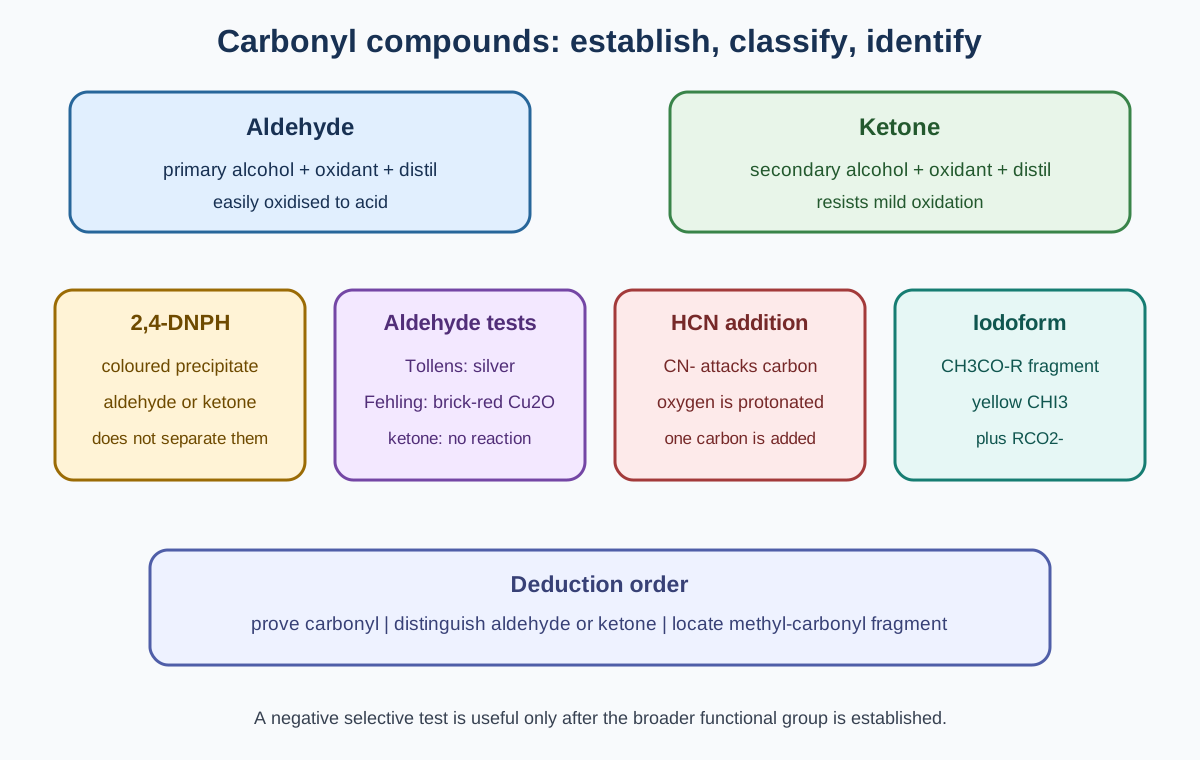
Carbonyl Compounds is Cambridge International Chemistry 9701 Topic 17. The AS boundary covers aldehyde and ketone production, reduction, hydrogen-cyanide addition and mechanism, 2,4-DNPH detection, aldehyde-versus-ketone tests and iodoform evidence for a methyl carbonyl group. Practical execution and reagent hazards remain in the practical hub.
1. Carbonyl structure and polarity
A carbonyl group contains a carbon-oxygen double bond. It consists of one sigma and one pi bond and is planar around the sp2-hybridised carbonyl carbon.
Oxygen is more electronegative than carbon, so electron density is pulled toward oxygen. The carbonyl carbon is electron-deficient and susceptible to nucleophilic attack, while oxygen carries partial negative character.
Aldehydes have at least one hydrogen attached to the carbonyl carbon. Ketones have two carbon groups attached to it. This structural distinction controls oxidation and identification.
2. Producing aldehydes
Oxidise a primary alcohol using acidified potassium dichromate(VI) or acidified potassium manganate(VII), heat gently and distil the aldehyde as it forms.
Removing the volatile aldehyde limits its contact with oxidising agent and helps prevent further oxidation to carboxylic acid.
Ethanol gives ethanal. Refluxing with excess oxidant would instead favour ethanoic acid, so the separation condition is part of the synthesis.
3. Producing ketones
Oxidise a secondary alcohol using acidified dichromate(VI) or acidified manganate(VII) and distil the ketone product.
Propan-2-ol gives propanone. The carbon bearing hydroxyl loses hydrogen, and the carbon-oxygen single bond becomes a double bond.
Ketones do not undergo the easy further oxidation shown by aldehydes under the named mild conditions, so distillation is less about preventing a direct ketone-to-acid continuation, but it remains the stated product-isolation condition.
4. Reduction to alcohols
Sodium borohydride or lithium aluminium hydride reduces carbonyl compounds. An aldehyde gives a primary alcohol and a ketone gives a secondary alcohol.
The carbonyl carbon gains hydrogen and oxygen becomes hydroxyl. Organic equations may show the input as two [H] equivalents.
Reduction preserves carbon count. A ketone cannot give a tertiary alcohol by simple reduction because the carbonyl carbon already has only two carbon substituents.
5. Addition of hydrogen cyanide
Aldehydes and ketones react with hydrogen cyanide using potassium cyanide as catalyst and heat to form hydroxynitriles, also called cyanohydrins.
Hydrogen cyanide adds across the carbon-oxygen double bond: cyanide attaches to carbon and hydrogen ultimately attaches to oxygen. The product contains hydroxyl and nitrile on the same former carbonyl carbon.
Check this topic from memory
Attempt the matching topic bank before reopening the notes. Use each missed idea to decide what to review next.
The nitrile carbon adds one carbon to the product skeleton. Ethanal therefore gives 2-hydroxypropanenitrile, while propanone gives 2-hydroxy-2-methylpropanenitrile.
6. First mechanism step: cyanide attack
Cyanide ion is the nucleophile. A full curly arrow begins at its carbon lone pair and points to the electron-deficient carbonyl carbon.
At the same time, a second curly arrow moves the carbonyl pi electron pair to oxygen. This preserves carbon valency and forms a negatively charged oxygen intermediate.
Attack through cyanide carbon forms a carbon-carbon bond and nitrile. Attack through nitrogen would give the wrong connectivity.
7. Second mechanism step: protonation
The negatively charged oxygen intermediate removes a proton from hydrogen cyanide. A curly arrow starts at the oxygen lone pair and points to hydrogen, while the hydrogen-cyanide bond electrons return to carbon.
This forms the hydroxynitrile and regenerates cyanide ion, explaining why potassium cyanide is catalytic.
The two-step cycle must show charges, electron sources and catalyst regeneration. Writing HCN as the first strong nucleophile ignores that it is only weakly ionised.
8. Shape and stereochemical consequence
The carbonyl carbon is planar, so cyanide can approach from either face. If attack creates a carbon bonded to four different groups, two enantiomers form in equal amounts in an achiral environment.
Ethanal produces a chiral hydroxynitrile because the new centre is attached to hydroxyl, nitrile, hydrogen and methyl. Propanone's product is not chiral because the new centre has two identical methyl groups.
This stereochemical result follows from structure; it should not be asserted for every carbonyl addition.
9. Detecting a carbonyl with 2,4-DNPH
2,4-Dinitrophenylhydrazine reagent detects aldehydes and ketones. A positive result is a yellow, orange or orange-red precipitate of a 2,4-dinitrophenylhydrazone derivative.
The test establishes the presence of a reactive aldehyde or ketone carbonyl but does not by itself distinguish those two classes.
In broader analytical work, derivative melting point can help identify a specific compound, but the core syllabus outcome is carbonyl detection.
10. Tollens' reagent
Warm an aldehyde with Tollens' reagent. The aldehyde is oxidised while silver(I) is reduced to silver metal, producing a silver mirror or grey silver deposit.
Ketones normally show no reaction under these conditions because they lack the hydrogen attached to the carbonyl carbon needed for easy oxidation without carbon-carbon bond breaking.
A positive Tollens result supports an aldehyde after carbonyl presence is established. Clean glassware is important to the mirror observation in practical work.
11. Fehling's solution
Warm an aliphatic aldehyde with Fehling's solution. The blue copper(II) reagent is reduced to a brick-red precipitate of copper(I) oxide.
Ketones normally give no change. The aldehyde is oxidised to a carboxylate under alkaline test conditions.
State both the initial blue solution and brick-red precipitate. “Turns red” alone can obscure that a solid forms.
12. Ease of oxidation
Aldehydes oxidise readily to carboxylic acids because the carbonyl carbon has a hydrogen. Ketones resist mild oxidation because equivalent oxidation would require carbon-carbon bond cleavage.
Acidified dichromate changes from orange to green with an aldehyde but not an ordinary ketone under the stated conditions. Acidified manganate(VII) is decolourised by the aldehyde.
This chemical contrast complements Tollens and Fehling evidence rather than replacing a complete test description.
13. A logical identification sequence
First use 2,4-DNPH to test for aldehyde or ketone carbonyl. If positive, use Tollens or Fehling reagent to decide whether the compound is an aldehyde. A negative aldehyde-selective test supports ketone only after carbonyl presence is established.
Then use formula, oxidation products, iodoform evidence or derivative data to narrow the exact structure.
A negative Tollens test on an unknown that never gave a positive carbonyl test does not prove it is a ketone.
14. The iodoform reaction
A carbonyl compound containing the CH3CO- group reacts with aqueous iodine under alkaline conditions to form a pale yellow precipitate of triiodomethane, CHI3, and a carboxylate ion, RCO2-.
The methyl group next to carbonyl is repeatedly iodinated before carbon-carbon bond cleavage. The one-carbon CHI3 product contains the original methyl carbon.
Ethanal is the special aldehyde case and gives a positive result. Other positive examples include propanone and butan-2-one.
15. Using iodoform products
For a methyl ketone written CH3COR, the carboxylate co-product is RCO2-. This can help reconstruct the group on the other side of the original carbonyl.
Propanone gives ethanoate because R is methyl. Butan-2-one gives propanoate because R is ethyl. Ethanal gives methanoate because R is hydrogen.
A positive result identifies a structural fragment, not a unique molecule. Combine it with molecular formula and other tests.
16. Differentiating aldehyde, ketone and alcohol evidence
2,4-DNPH detects aldehyde or ketone directly but not a simple alcohol. Tollens and Fehling identify oxidisable aldehydes. Iodoform can be positive for methyl ketones, ethanal and alcohols that oxidise to methyl carbonyl compounds.
Therefore the same yellow iodoform precipitate does not prove the starting compound was a ketone unless carbonyl presence has already been shown.
Test order and the structural scope of each observation are part of the deduction.
17. Synthetic connections
Primary alcohol under distillation gives aldehyde, and aldehyde reduction returns primary alcohol. Secondary alcohol oxidation gives ketone, and ketone reduction returns secondary alcohol.
Hydrogen-cyanide addition extends the carbon chain by one and adds both hydroxyl and nitrile functionality. That product can support later synthesis routes.
Use these paired transformations to plan forward and backward while tracking oxidation level and carbon count.
Worked application: distinguish three C3 oxygen compounds
Unknowns A, B and C all contain three carbons. A and B give orange precipitates with 2,4-DNPH, while C does not. A gives a silver mirror with Tollens' reagent; B does not, so A is propanal and B is propanone. C turns acidified dichromate from orange to green and gives a yellow iodoform precipitate, identifying propan-2-ol rather than propan-1-ol. B also gives iodoform because it contains CH3CO-. The conclusions use 2,4-DNPH to establish carbonyl presence, Tollens to separate aldehyde from ketone, and oxidation plus iodoform to identify the alcohol fragment without treating any single result as unique.
Common misconceptions and corrections
Calling every C=O compound a ketone. Aldehydes also contain carbonyl.
Calling an aldehyde carbonyl internal. It has at least one hydrogen attached.
Refluxing a primary alcohol to prepare aldehyde. Distil it as it forms.
Saying secondary alcohol oxidation gives aldehyde. It gives ketone.
Saying ketone reduction gives tertiary alcohol. It gives secondary alcohol.
Changing carbon count during simple reduction. It is preserved.
Omitting heat from hydroxynitrile production. It is a named condition.
Attacking carbonyl through cyanide nitrogen. Carbon attack forms nitrile connectivity.
Starting a curly arrow at carbonyl carbon. Start at the nucleophile lone pair.
Leaving the carbonyl pi bond intact during attack. Its electrons move to oxygen.
Forgetting the negative oxygen intermediate. It precedes protonation.
Consuming cyanide permanently. Protonation regenerates it.
Saying every hydroxynitrile is chiral. Four different groups are required.
Calling propanone's hydroxynitrile chiral. It has two methyl groups.
Saying 2,4-DNPH distinguishes aldehyde from ketone. Both precipitate.
Calling the 2,4-DNPH result a colour change only. A precipitate forms.
Giving ketones a silver mirror. Ordinary ketones are negative.
Calling Tollens' silver product silver oxide. Silver metal deposits.
Saying Fehling changes from blue solution to red solution. Brick-red solid forms.
Giving aldehydes no oxidation reaction. They oxidise readily to acids or carboxylates.
Saying ketone oxidation is impossible under all conditions. It resists the named mild tests.
Inferring ketone from a negative Tollens result alone. Establish carbonyl first.
Calling triiodomethane white. It is pale yellow.
Saying every ketone gives iodoform. It needs CH3CO-R.
Excluding ethanal from iodoform positives. It is the aldehyde special case.
Making CHI3 from the non-methyl side. Its carbon comes from the methyl group.
Treating iodoform as unique identification. It identifies a fragment.
Saying simple alcohols give 2,4-DNPH. They lack carbonyl.
Forgetting carbon-chain extension in HCN addition. Nitrile contributes one carbon.
Assessment guidance
Pair alcohol class with oxidant, distillation and the correct carbonyl product. In hydrogen-cyanide mechanisms, show cyanide attack through carbon, movement of the pi pair to oxygen, protonation and catalyst regeneration; then test whether a chiral centre actually forms. Use 2,4-DNPH only to establish aldehyde or ketone carbonyl and follow with Tollens, Fehling or controlled oxidation to separate classes. Iodoform answers need the CH3CO-R fragment, yellow CHI3 and RCO2- co-product, including ethanal as the special aldehyde case. Structural conclusions should combine independent observations and conserve carbon count.
Retrieval practice
Build the primary-alcohol-to-aldehyde and secondary-alcohol-to-ketone preparation routes with conditions, then reverse each by reduction. Draw the complete cyanide-catalysed mechanism for ethanal and propanone and decide whether each product is chiral. Reconstruct the 2,4-DNPH, Tollens, Fehling and oxidation decision tree. Finish with ten iodoform deductions that identify both the required methyl-carbonyl fragment and the carboxylate co-product.