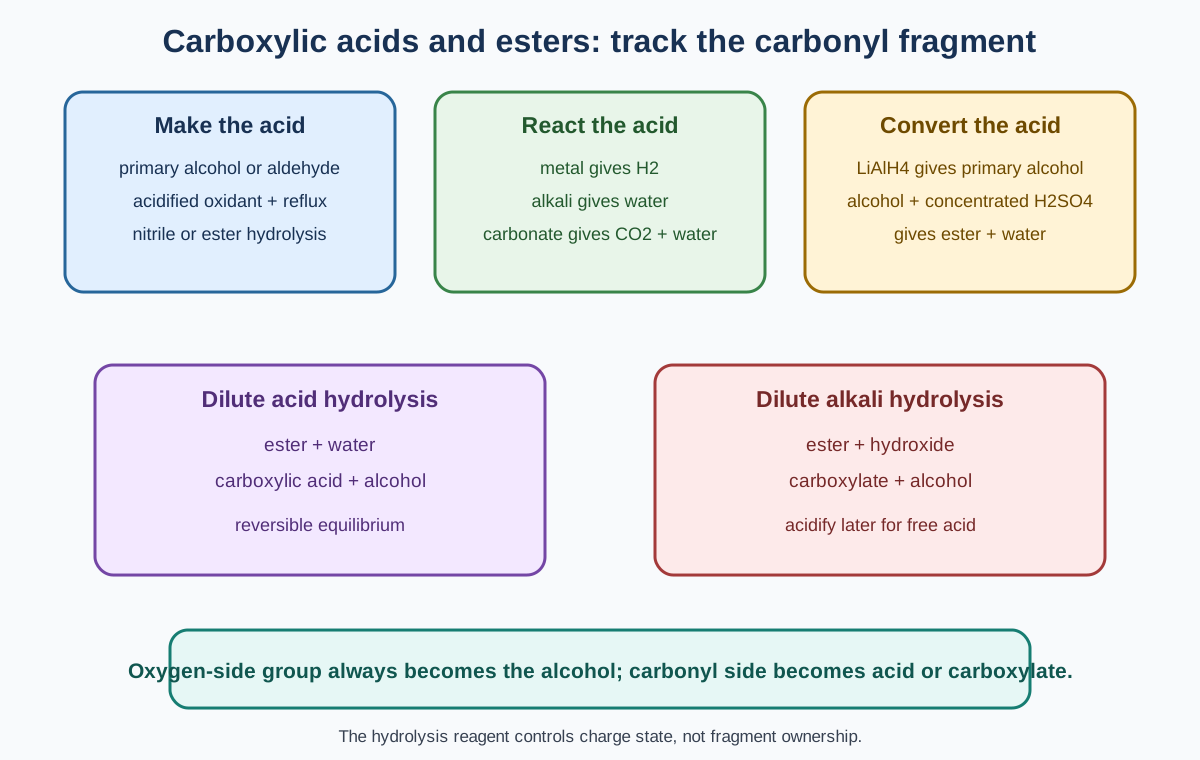
Carboxylic Acids and Derivatives is Cambridge International Chemistry 9701 Topic 18. At AS Level, the official boundary covers carboxylic-acid preparation and reactions plus ester formation and acid or alkaline hydrolysis. Acyl chlorides belong to later content and are not imported into this note. Practical execution remains in the practical hub.
1. The carboxyl group
A carboxylic acid contains the carboxyl group, in which carbonyl and hydroxyl are attached to the same carbon. The carboxyl carbon is carbon 1 in systematic naming.
Carboxylic acids donate the hydroxyl proton to bases and form resonance-stabilised carboxylate ions. This makes them more acidic than alcohols, whose alkoxide conjugate bases lack equivalent charge delocalisation.
The carbonyl oxygen is not the site from which the acidic proton is removed.
2. Preparation from primary alcohols
Heat a primary alcohol under reflux with acidified potassium dichromate(VI) or acidified potassium manganate(VII). The alcohol first forms an aldehyde and then a carboxylic acid.
Reflux keeps the volatile intermediate in contact with excess oxidising agent, allowing complete oxidation.
Distillation would favour removal of aldehyde and is therefore the wrong condition when carboxylic acid is the target.
3. Preparation from aldehydes
An aldehyde is oxidised by acidified dichromate(VI) or acidified manganate(VII) under reflux to a carboxylic acid with the same carbon count.
Ethanal gives ethanoic acid. Dichromate changes from orange to green; manganate(VII) loses its purple colour under the relevant acidic conditions.
The aldehyde carbon already belongs to the chain and becomes the carboxyl carbon.
4. Preparation by nitrile hydrolysis
Heat a nitrile with dilute acid to form the carboxylic acid and an ammonium salt. Alternatively, heat with dilute alkali to form a carboxylate salt, then acidify to obtain the carboxylic acid.
The nitrile carbon becomes the carboxyl carbon. Hydrolysing propanenitrile therefore gives propanoic acid.
This route is valuable in synthesis because cyanide substitution earlier added one carbon before hydrolysis.
5. Preparation by ester hydrolysis
Heating an ester with dilute acid gives a carboxylic acid and alcohol in a reversible hydrolysis. Heating with dilute alkali gives a carboxylate salt and alcohol; acidification then gives the carboxylic acid.
The ester carbonyl-side fragment becomes acid or carboxylate. The group attached through ester oxygen becomes the alcohol.
Do not reverse the two fragments when reading an ester structural formula.
Check this topic from memory
Attempt the matching topic bank before reopening the notes. Use each missed idea to decide what to review next.
A reactive metal such as sodium reacts with a carboxylic acid to form a carboxylate salt and hydrogen gas.
Two acid molecules provide the two protons needed to form one hydrogen molecule. The metal is oxidised while hydrogen ions are reduced.
Effervescence is expected, but hydrogen identification requires an appropriate test rather than appearance alone.
7. Neutralisation with alkalis
A carboxylic acid reacts with an alkali such as sodium hydroxide to form a carboxylate salt and water.
The net proton-transfer relationship is acid plus hydroxide forming carboxylate plus water. No carbon dioxide or hydrogen gas forms in simple neutralisation.
Salt names use the carboxylate ending, such as sodium ethanoate from ethanoic acid.
8. Reaction with carbonates
Carboxylic acids react with carbonates to form a carboxylate salt, water and carbon dioxide. Effervescence provides a useful distinction from many alcohols.
Two acid molecules are needed per carbonate ion because carbonate accepts two protons overall.
Hydrogencarbonates also release carbon dioxide, but their stoichiometry differs because only one proton is required per hydrogencarbonate ion.
9. Esterification
A carboxylic acid reacts reversibly with an alcohol using concentrated sulfuric acid as catalyst to form an ester and water.
The alcohol supplies the alkyl group attached to ester oxygen. The acid supplies the carbonyl-containing alkanoate part. Ethanoic acid and propan-1-ol form propyl ethanoate.
Concentrated sulfuric acid catalyses the equilibrium and helps remove water. It is not consumed into the ester structure.
10. Naming and reading esters
Name the oxygen-side alkyl group first and the acid-derived alkanoate group second. CH3CH2COOCH3 is methyl propanoate.
To hydrolyse an ester on paper, cut the acyl-oxygen bond conceptually into the acid-derived carbonyl fragment and the oxygen-side alkyl fragment, then add the appropriate hydroxyl and hydrogen through the reaction process.
Formula order in a condensed drawing does not always match the spoken name order, so identify connectivity rather than reading left to right.
11. Reduction to primary alcohols
Lithium aluminium hydride reduces a carboxylic acid to a primary alcohol. The carboxyl carbon remains and becomes the carbon bearing hydroxyl.
Sodium borohydride is not the named reagent for carboxylic-acid reduction. It is sufficient for aldehydes and ketones but not this less reactive derivative under the syllabus treatment.
Reduction changes oxidation level without changing carbon count.
12. Acid hydrolysis of esters
Heat an ester with dilute acid. Water splits the ester into a carboxylic acid and alcohol.
The reaction is reversible because the products can esterify again. Using excess water helps shift equilibrium toward hydrolysis.
The acid acts as catalyst and is not the source of the carbon skeleton in either organic product.
13. Alkaline hydrolysis of esters
Heat an ester with dilute alkali. Products are a carboxylate salt and alcohol.
Carboxylate formation makes this hydrolysis effectively irreversible under the alkaline conditions because the negatively charged carboxylate does not readily esterify with the alcohol.
If the target is the free carboxylic acid, acidify the carboxylate after hydrolysis. Omitting acidification leaves the salt.
14. Comparing acid and alkaline hydrolysis
Both routes cleave the ester and produce the same oxygen-side alcohol. Acid hydrolysis gives carboxylic acid directly and is reversible. Alkaline hydrolysis gives carboxylate and is driven forward.
The reagent and final work-up determine whether the named product is acid or salt.
An answer that gives carboxylic acid directly from alkaline hydrolysis without acidification has skipped a chemically distinct step.
15. Interconverting the functional groups
Primary alcohol oxidises through aldehyde to acid. Acid reduces to primary alcohol with lithium aluminium hydride. Acid plus alcohol forms ester, and ester hydrolysis returns acid or carboxylate plus alcohol.
Nitrile hydrolysis provides another acid route and preserves the nitrile carbon as carboxyl carbon.
This network supports multistep synthesis. Track carbon count and the origin of each ester fragment at every arrow.
16. Acid-base evidence and comparative acidity
Carboxylic acids neutralise hydroxide and carbonate, whereas ordinary alcohols do not react appreciably with carbonate. Carbon dioxide effervescence therefore supports a carboxylic-acid group.
The carboxylate conjugate base is stabilised by delocalising negative charge over two oxygen atoms. Alkoxide charge is more localised, and an alkyl positive inductive effect further destabilises it.
This conjugate-base comparison explains the acidity order rather than merely restating observations.
17. Planning a synthesis
To create a carboxylic acid, choose oxidation if the carbon skeleton already exists as a primary alcohol or aldehyde, nitrile hydrolysis if a one-carbon extension was introduced earlier, or ester hydrolysis if the acid is protected in derivative form.
To create an ester, identify the required oxygen-side alkyl group and acid-derived carbonyl group, then choose the corresponding alcohol and carboxylic acid.
Check whether the target after hydrolysis is acid or salt and include acidification when required.
Worked application: trace both ester fragments
An ester has formula CH3CH2COOCH2CH3. The group attached through oxygen is ethyl, while the carbonyl fragment derives from propanoic acid, so the ester is ethyl propanoate. Dilute acid and heat give propanoic acid plus ethanol. Dilute sodium hydroxide and heat give sodium propanoate plus ethanol; subsequent acidification converts propanoate to propanoic acid. Lithium aluminium hydride reduction of that acid gives propan-1-ol without changing its three-carbon chain. The analysis preserves fragment ownership and distinguishes the direct acid-hydrolysis product from the alkaline salt before work-up.
Drawing the ester linkage before naming prevents both a reversed name and reversed hydrolysis products.
Common misconceptions and corrections
Removing the carbonyl oxygen proton. The acidic proton is on hydroxyl.
Calling alcohols more acidic than carboxylic acids. Carboxylate is resonance-stabilised.
Distilling a primary alcohol to prepare acid. Reflux with excess oxidant.
Changing carbon count in aldehyde oxidation. It is preserved.
Excluding nitrile carbon from the acid chain. It becomes the carboxyl carbon.
Stopping alkaline nitrile hydrolysis at free acid. It first gives carboxylate; acidify.
Reversing ester hydrolysis fragments. The oxygen-side group becomes alcohol.
Saying acid plus metal gives carbon dioxide. It gives hydrogen.
Saying acid plus alkali gives hydrogen. It gives water.
Omitting water from carbonate reaction. Salt, water and carbon dioxide form.
Using one acid molecule per carbonate without checking charge. Carbonate accepts two protons.
Naming the acid side first in an ester. Oxygen-side alkyl comes first.
Calling concentrated sulfuric acid an ester reactant. It is catalyst.
Saying esterification is irreversible. It is an equilibrium.
Using sodium borohydride for the named acid reduction. Use lithium aluminium hydride.
Losing the carboxyl carbon during reduction. It remains in the primary alcohol.
Calling ester hydrolysis condensation. Hydrolysis uses water to split.
Giving carboxylate in acid hydrolysis as final organic acid product. It gives carboxylic acid.
Giving carboxylic acid directly in alkaline hydrolysis. It gives carboxylate before acidification.
Calling alkaline hydrolysis reversible to the same extent. Carboxylate formation drives it forward.
Changing the alcohol product between acid and alkaline routes. Fragment ownership is unchanged.
Using acid catalyst as a carbon source. It contributes no organic skeleton.
Saying ordinary alcohols effervesce with carbonate. Carboxylic acids do.
Explaining acidity only by oxygen electronegativity. Compare conjugate-base stabilisation.
Importing acyl chloride reactions into this AS topic. They are outside the official boundary here.
Planning an ester from name order without drawing connectivity. Identify both fragments structurally.
Assessment guidance
For each preparation, state starting functional group, reagent, heat or reflux and final oxidation level. Track the nitrile carbon into the acid and the two ester fragments into their hydrolysis products. Acid-base equations must give the correct gas or water and balanced proton stoichiometry. Esterification answers require the correct alcohol-side alkyl name, acid-derived alkanoate name and concentrated sulfuric-acid catalyst. Hydrolysis questions must distinguish reversible dilute-acid production of carboxylic acid from dilute-alkali production of carboxylate and include acidification when free acid is required. Acidity explanations should compare delocalised carboxylate with localised alkoxide charge.
Retrieval practice
Build every official carboxylic-acid preparation route and track carbon count. Write the metal, alkali, carbonate, esterification and reduction outcomes. Name and dissect twenty esters into oxygen-side alcohol and carbonyl-side acid fragments. Predict products under dilute acid and dilute alkali, including final acidification. Finish by explaining carboxylic-acid versus alcohol acidity from the structures of their conjugate bases rather than from reaction observations alone.