

Cambridge International AS and A Level Chemistry 19: Nitrogen compounds
Cambridge International Chemistry 9701 notes on primary amine preparation, nitrile chain extension, hydroxynitrile formation and nitrile hydrolysis.
Nitrogen Compounds is Cambridge International Chemistry 9701 Topic 19. The official AS boundary covers preparation of primary amines, nitriles and hydroxynitriles plus nitrile hydrolysis to carboxylic acids. Classification of amines is explicitly not tested at AS Level. Practical execution and hazards remain in the practical hub.
1. Primary amines in this boundary
A primary amine has the structural pattern RNH2 and a lone pair on nitrogen. The lone pair allows nitrogen to act as a nucleophile and base.
At AS Level, the required focus is preparation from a halogenoalkane. Formal classification of amines is not tested, so the note does not expand into secondary, tertiary or quaternary naming systems.
Do not confuse a primary amine with a nitrile. An amine nitrogen has single bonds, whereas nitrile contains a carbon-nitrogen triple bond.
2. Preparing a primary amine
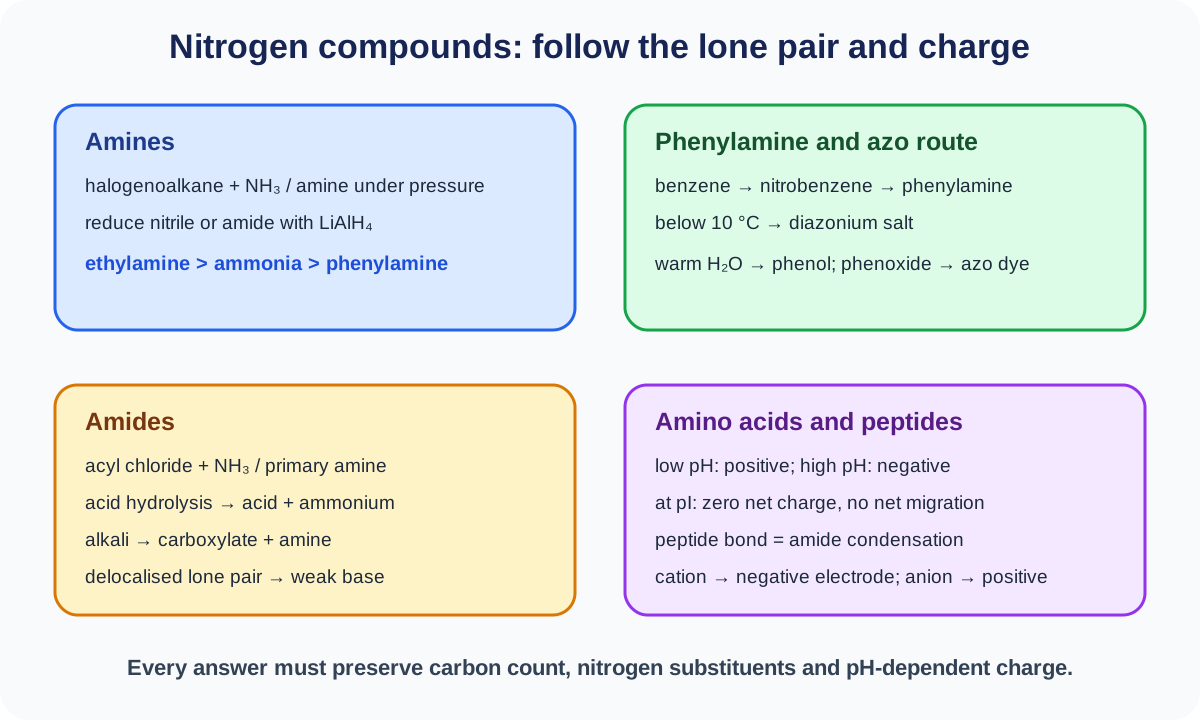
React a halogenoalkane with ammonia in ethanol and heat under pressure. Ammonia attacks the electron-deficient carbon and replaces halogen.
For bromoethane, the carbon skeleton remains two carbons and the organic product is ethylamine.
Ethanol provides a suitable solvent, heat increases rate and pressure keeps volatile ammonia in the reaction mixture.
3. Substitution reasoning
Ammonia donates its nitrogen lone pair to the carbon bearing halogen. The carbon-halogen bond breaks and halide leaves. Proton transfer then produces the neutral primary amine.
This is nucleophilic substitution. Depending on the halogenoalkane structure and conditions, the detailed substitution may follow SN1, SN2 or mixed behaviour developed in Topic 15.
Curly arrows must begin at the ammonia lone pair or carbon-halogen bond, never at the electron-deficient carbon by itself.
4. Why excess ammonia is useful
The primary amine product also has a nitrogen lone pair and can attack more halogenoalkane, giving further substitution products.
Using excess ammonia makes collision with ammonia more likely than collision with the amine product and therefore favours primary amine yield.
The reaction is not inherently guaranteed to stop after one substitution; reagent proportions help control selectivity.
5. Producing nitriles from halogenoalkanes
Heat a halogenoalkane with potassium cyanide in ethanol. Cyanide ion acts as a nucleophile and replaces halide.
Attack occurs through cyanide carbon, forming a new carbon-carbon bond and the nitrile group. Bromoethane gives propanenitrile.
The nitrile has one more carbon than the starting halogenoalkane. This makes the reaction a standard one-carbon chain-extension method.
Check this topic from memory
Attempt the matching topic bank before reopening the notes. Use each missed idea to decide what to review next.
Start the topic quiz