

Cambridge International AS and A Level Chemistry 20: Polymerisation
Cambridge International Chemistry 9701 notes on addition polymerisation, poly(ethene), PVC, repeat-unit deduction, monomer reconstruction and disposal.
Polymerisation is Cambridge International Chemistry 9701 Topic 20. The AS boundary covers addition polymerisation using poly(ethene) and poly(chloroethene), repeat-unit and monomer deduction, and disposal problems of poly(alkenes). Condensation polymerisation belongs to later content and is not imported here.
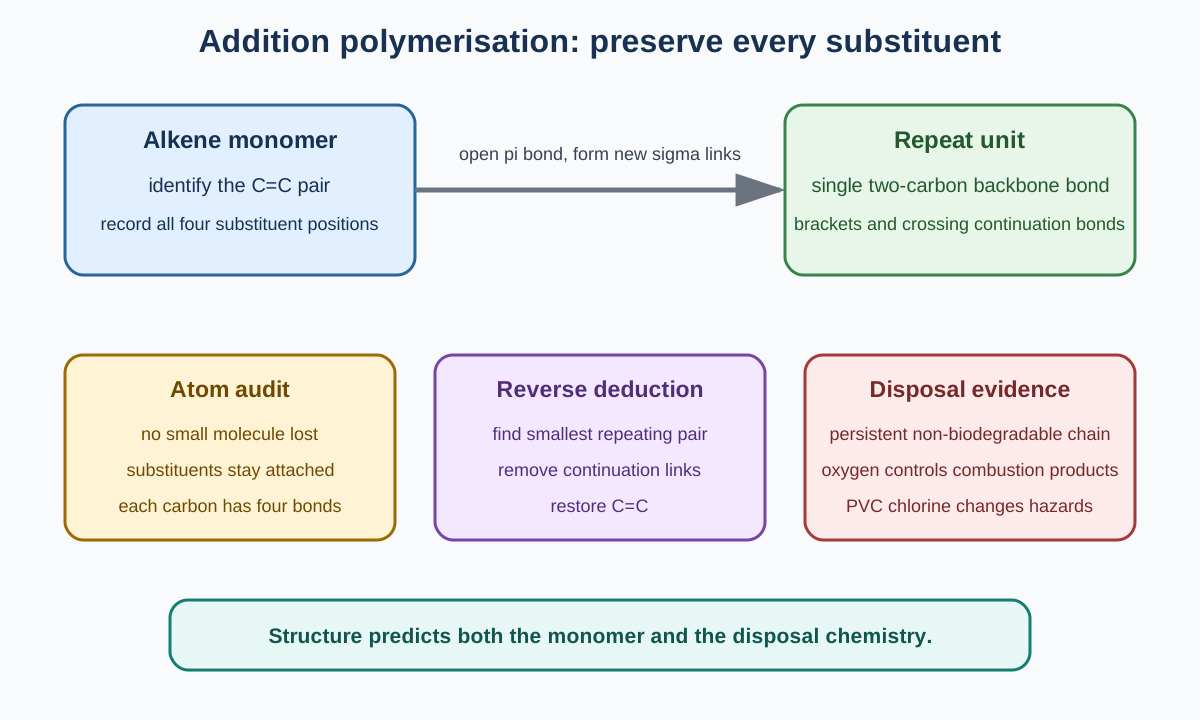
1. Monomer, polymer and repeat unit
A monomer is a small molecule capable of joining repeatedly. A polymer is a long-chain molecule made from many monomer units. The repeat unit is the smallest structural section that repeats along the polymer chain.
For addition polymerisation at this level, the monomer is an alkene. Its carbon-carbon pi bond opens and the two alkene carbons become part of a saturated carbon backbone.
No atoms are removed and no small molecule is formed.
2. What changes during addition polymerisation
Each carbon-carbon double bond contains one sigma and one pi bond. Polymerisation replaces the pi component with new carbon-carbon sigma bonds to neighbouring monomer units.
The original two alkene carbons remain adjacent in the repeat unit. Every substituent attached to them remains on the same carbon.
The repeat unit therefore has a single bond between its two backbone carbons and continuation bonds extending through the brackets.
3. Poly(ethene)
Ethene has formula CH2=CH2. Opening the double bond produces the repeat unit with two CH2 backbone groups.
Poly(ethene) contains only carbon and hydrogen. The name is written with the monomer name in parentheses.
A correct displayed repeat unit shows the two carbon atoms, four hydrogen atoms, single backbone bonds, brackets and continuation bonds crossing the brackets.
4. Poly(chloroethene), PVC
Chloroethene has structure CH2=CHCl. Addition polymerisation gives a repeat unit containing CH2 and CHCl groups. The chlorine substituent remains attached to the same backbone carbon.
Poly(chloroethene) is commonly called PVC. The abbreviation comes from the older name vinyl chloride.
Do not lose chlorine, move it to every carbon or write hydrogen chloride as a polymerisation by-product. Addition preserves all monomer atoms.
5. Deducing a repeat unit from a monomer
First identify the carbon-carbon double bond. Replace it with a single bond. Preserve every group attached to each alkene carbon. Extend a single continuation bond from each end of the two-carbon backbone, place the structure in brackets and write a subscript (n) outside.
Check that each carbon has four bonds. Check that the repeat unit contains exactly the atoms of one monomer for a simple alkene example.
Check this topic from memory
Attempt the matching topic bank before reopening the notes. Use each missed idea to decide what to review next.
Start the topic quiz