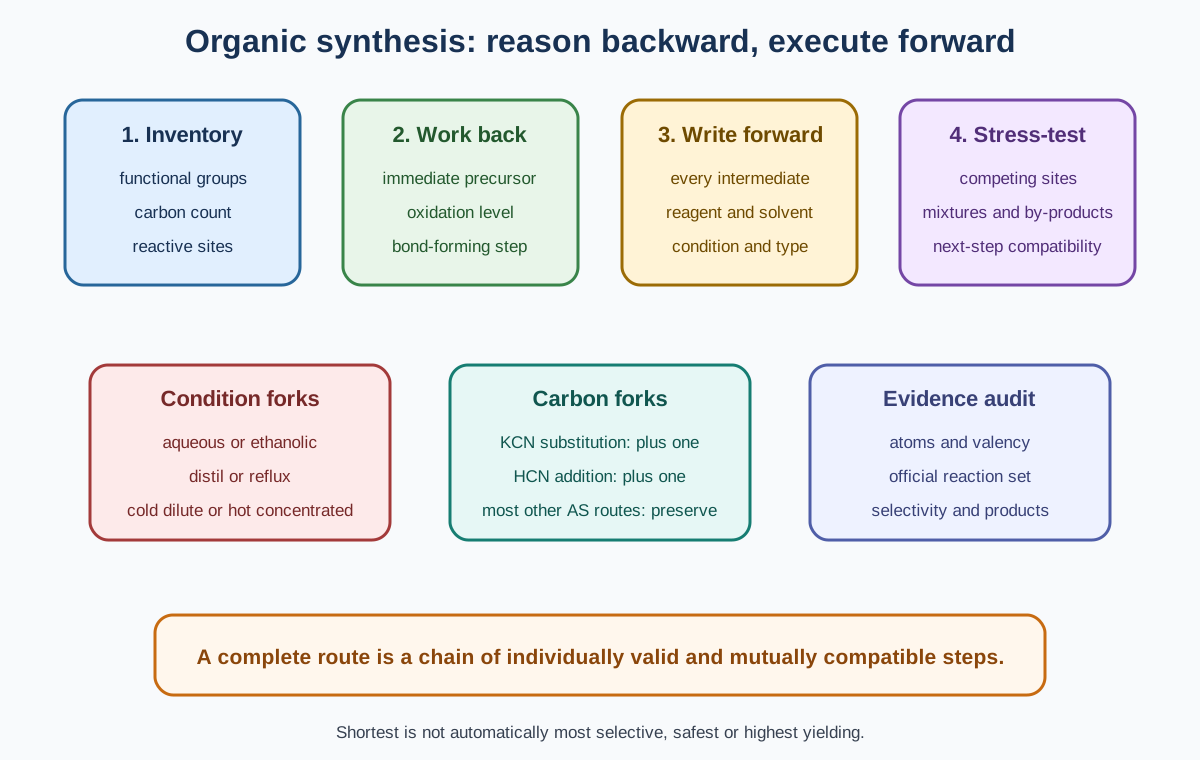
Organic Synthesis is Cambridge International Chemistry 9701 Topic 21. It integrates the AS reaction set: identify functional groups in multifunctional molecules, predict their properties and reactions, devise multistep routes, and analyse every step by reaction type, reagent and possible by-product. It does not introduce unlisted transformations.
1. Begin with a functional-group inventory
Mark every carbon-carbon double bond, halogenoalkane carbon, hydroxyl, aldehyde, ketone, carboxyl group, ester linkage, amine and nitrile.
One molecule can contain several reactive sites. A reagent may react with more than one, so predicting one familiar change while ignoring another can produce the wrong route.
Record carbon count, branching and any stereochemical features before proposing reactions.
2. Predict properties from structure
Functional groups influence polarity, hydrogen bonding, boiling point, solubility and acidity. Carbon skeleton length and branching also matter.
A carboxylic acid can neutralise carbonate; an alcohol generally cannot. Aldehydes oxidise readily; ketones resist mild oxidation. Alkenes undergo electrophilic addition, while halogenoalkanes undergo substitution or elimination.
Predictions should connect structure to particles, bonding or reaction mechanism rather than rely only on names.
3. Use diagnostic reactions with scope limits
Aqueous bromine supports a carbon-carbon double bond. 2,4-DNPH detects aldehyde or ketone carbonyl. Tollens or Fehling reagent identifies an aldehyde after carbonyl is established. Iodoform supports CH3CO-R or an alcohol oxidisable to it. Carbonate effervescence supports carboxylic acid.
Each result has a bounded inference. A negative Tollens result alone does not prove ketone, and a positive iodoform result does not identify a complete molecule.
Combine independent evidence.
4. Work backward from the target
Retrosynthesis asks which immediate precursor can give the target by a known syllabus reaction. Replace the target functional group mentally with a plausible precursor.
An alcohol may come from alkene hydration, halogenoalkane substitution, carbonyl reduction, carboxylic-acid reduction or ester hydrolysis. A carboxylic acid may come from oxidation, nitrile hydrolysis or ester hydrolysis.
Continue backward until reaching the stated starting material, then write the executable route forward.
5. Audit carbon count first
Most AS transformations preserve carbon count. Cyanide substitution and hydrogen-cyanide addition add one carbon. Cracking changes molecular sizes by splitting a skeleton. Polymerisation joins many monomers.
Check this topic from memory
Attempt the matching topic bank before reopening the notes. Use each missed idea to decide what to review next.
If target and starting material differ by one carbon, a cyanide route is often relevant. If carbon count should remain unchanged, ammonia, hydroxide, oxidation, reduction or elimination may be more suitable.
Count carbon after every proposed step before checking finer details.
6. Choose conditions, not just reagents
Aqueous sodium hydroxide with heat converts halogenoalkane to alcohol; ethanolic sodium hydroxide with heat favours alkene. Primary-alcohol oxidation with distillation gives aldehyde; reflux with excess oxidant gives carboxylic acid.
Steam with phosphoric acid hydrates an alkene, while cold dilute acidified manganate(VII) forms a diol and hot concentrated reagent cleaves the double bond.
The same reagent name under different conditions can own a different product.
7. Plan oxidation level deliberately
Arrange common oxygenated states from alcohol to carbonyl to carboxylic acid. Primary alcohol can stop at aldehyde under distillation or continue to acid under reflux. Secondary alcohol gives ketone. Tertiary alcohol does not undergo the named mild oxidation.
Sodium borohydride or lithium aluminium hydride reduces aldehydes and ketones; only lithium aluminium hydride is named for carboxylic-acid reduction.
Do not use a stronger transformation than the target requires.
8. Plan carbon-carbon bond formation
Potassium cyanide in ethanol substitutes halide and adds one carbon as nitrile. Hydrogen cyanide with potassium cyanide catalyst adds to aldehyde or ketone and adds one carbon while producing hydroxynitrile.
These are the main AS carbon-extension tools. One is nucleophilic substitution; the other is nucleophilic addition.
Choose according to the starting functional group and whether hydroxyl is required in the product.
9. Use elimination and addition as paired routes
Halogenoalkane with ethanolic hydroxide and heat or alcohol dehydration produces alkene. Alkene can then add hydrogen, steam, halogen or hydrogen halide.
This creates route flexibility, but unsymmetrical intermediates can give positional mixtures. Carbocation stability predicts major hydrogen-halide addition products.
A theoretically valid route may be poor if it produces difficult mixtures.
10. Protect carbon skeleton logic
Reversing a displayed formula does not change connectivity. Choosing a new parent name does not change atoms. Every step must conserve atoms except for named reagents added or leaving groups and small molecules removed.
For ester formation and hydrolysis, keep the oxygen-side alcohol fragment distinct from the acid-derived carbonyl fragment.
For nitriles, include nitrile carbon in the product chain.
11. Label reaction type
Classify each step as addition, substitution, elimination, oxidation, reduction, hydrolysis, condensation or polymerisation, with mechanism subtype where required.
Reaction type checks the structural change. If a proposed “substitution” increases the number of groups across a double bond without a leaving group, it is actually addition.
The label should follow electron and atom changes, not the reagent's usual reputation.
12. Anticipate by-products and competing pathways
Radical halogenation can give multiple substitutions and positional mixtures. Unsymmetrical elimination can give more than one alkene. Hydrogen-halide addition can give major and minor regioisomers. Amine preparation can continue to further alkylation.
Esterification is reversible. Oxidation can continue beyond aldehyde if the product remains with oxidant. Strong alkene oxidation cleaves rather than stops at diol.
Naming possible by-products demonstrates route realism and can justify a more selective alternative.
13. Functional-group compatibility
Before selecting a reagent, inspect every functional group in the molecule. Acidified oxidant may attack an aldehyde and an oxidisable alcohol. Hydrogenation targets carbon-carbon double bonds. Strong reduction may affect more than one reducible group.
At AS Level, answer using the reaction set in the syllabus and the expected selectivity implied by the question, but flag obvious competing sites.
Do not invent protecting-group chemistry that has not been supplied.
14. Forward-route presentation
Draw each intermediate explicitly. Above or beside each arrow, write reagent and solvent; add temperature, catalyst, pressure, distillation, reflux or acidification as required.
Below the arrow, label reaction type if requested. After the structure, note significant by-products or mixtures.
Avoid compressing several transformations onto one arrow unless the question explicitly permits a one-pot sequence.
15. Route validation
For every step ask: Is the functional-group change in the syllabus? Is carbon count correct? Are reagent and conditions complete? Does the product preserve valency? Are competing products plausible? Can the next step use the proposed intermediate?
Then validate the full route from start to target without silently changing structure.
A locally correct step can still lead to a globally impossible sequence if its product is not the next required precursor.
16. Analysing a supplied route
Do not merely identify compounds. For each arrow, compare starting and product structures, name the reaction type, infer reagent and conditions and explain any selectivity.
If a route shows an unexpected carbon increase, look for cyanide incorporation. If it changes primary alcohol directly to acid, look for reflux oxidation. If an alkene becomes alcohol, distinguish steam hydration from diol oxidation by product structure.
Use products as evidence for conditions.
17. Efficiency and evidence
A shorter route is not automatically better. Selectivity, yield, separation, hazardous reagents and by-product load also matter.
Within examination constraints, prefer a route with known syllabus steps and unambiguous products. If two routes are valid, compare them using chemical reasons such as mixture formation or carbon-count control.
Do not claim a precise yield or safety ranking without supplied data.
Worked application: ethanal to 2-hydroxypropanoic acid
Ethanal has two carbons, while the target has three and contains both hydroxyl and carboxylic acid. Hydrogen cyanide with potassium cyanide catalyst and heat adds one carbon by nucleophilic addition, forming 2-hydroxypropanenitrile. Cyanide attacks the planar carbonyl carbon, oxygen is protonated and cyanide catalyst is regenerated. Heating the nitrile with dilute acid hydrolyses its nitrile carbon into the carboxyl group, giving 2-hydroxypropanoic acid while retaining hydroxyl. An alkaline route would first give carboxylate and would need acidification. The route is superior to simple ethanal oxidation because oxidation preserves two carbons and cannot reach the target skeleton.
Common misconceptions and corrections
Starting with reagents before reading all functional groups. Inventory structure first.
Using one positive test as unique identification. Most tests identify a class or fragment.
Inferring ketone from negative Tollens alone. Establish carbonyl first.
Ignoring carbon count. Audit it at every arrow.
Saying every reaction preserves carbon count. Cyanide routes add one.
Forgetting nitrile carbon in the chain. It becomes carboxyl carbon on hydrolysis.
Treating retrosynthesis as the executable direction. Rewrite the route forward.
Writing NaOH without solvent. Aqueous and ethanolic outcomes differ.
Writing oxidant without distillation or reflux. Product oxidation level remains ambiguous.
Using hot concentrated manganate(VII) to make a diol. It cleaves the double bond.
Using sodium borohydride for carboxylic-acid reduction. Use lithium aluminium hydride.
Reversing ester fragment origins. Track the oxygen-side group.
Calling esterification irreversible. It is an equilibrium.
Naming reaction type from reagent alone. Inspect structural change.
Omitting a required catalyst, heat or pressure. Conditions are part of the step.
Skipping acidification after alkaline nitrile hydrolysis. Carboxylate forms first.
Drawing an intermediate that cannot undergo the next step. Validate globally.
Compressing unrelated reactions onto one arrow. Show intermediates.
Claiming the shortest route has highest yield. No such data are implied.
Inventing protecting-group steps outside the syllabus. Use supplied chemistry.
Ignoring possible by-products when explicitly asked. Name mechanistically plausible ones.
Assessment guidance
Begin with functional groups, carbon count and target oxidation level. Work backward through only syllabus transformations, then present the route forward with every intermediate, reagent, solvent and condition. Separate aqueous from ethanolic hydroxide, distillation from reflux, mild alkene oxidation from cleavage and stoichiometric cyanide substitution from catalytic HCN addition. Label reaction types from structural changes and identify credible by-products such as regioisomers, multiple radical substitutions or further amine alkylation. Validate every step for atom conservation, valency and compatibility with the next step. When analysing an existing route, use the product structure to infer conditions rather than reciting an unrelated reagent list.
Retrieval practice
Build a one-page AS reaction network linking alkanes, alkenes, halogenoalkanes, alcohols, carbonyls, carboxylic acids, esters, amines and nitriles. For twenty targets, mark carbon-count changes before choosing steps. Write full forward routes with conditions and reaction types, then annotate by-products. Reverse-audit supplied routes by inferring missing reagents from structural changes and rejecting any step that violates valency, carbon conservation or the official reaction set.