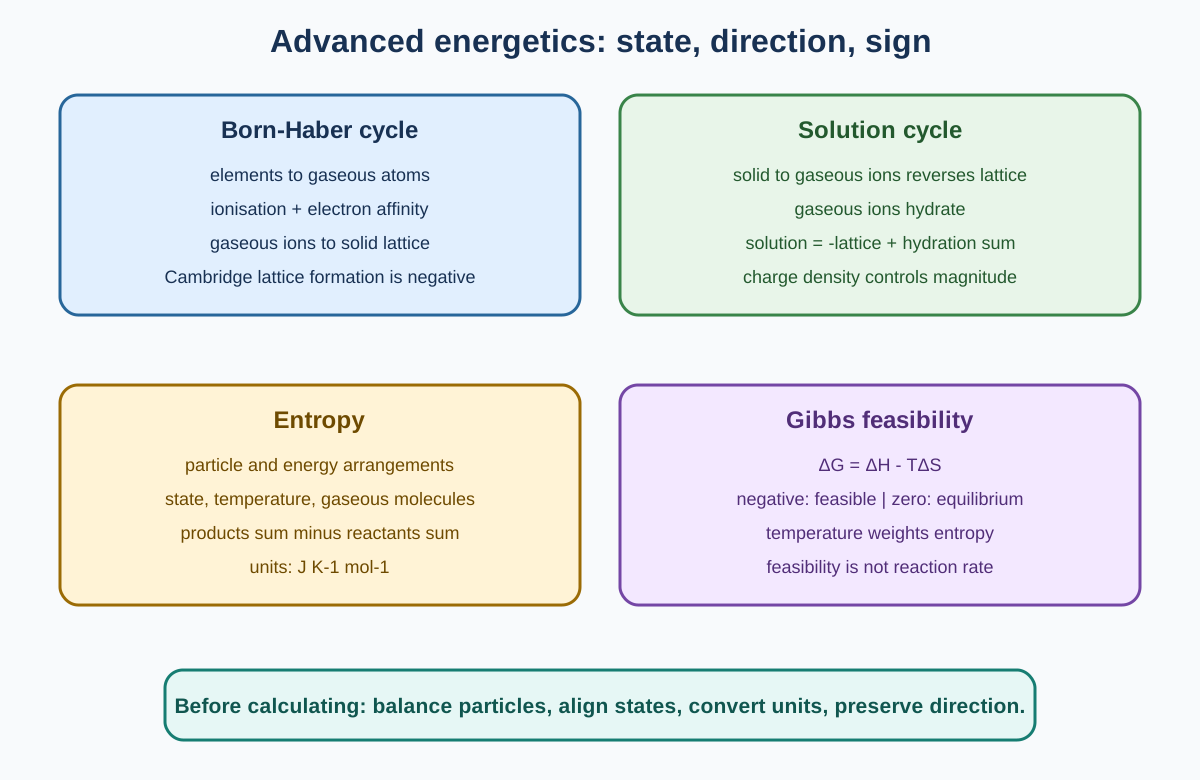
Chemical Energetics is Cambridge International Chemistry 9701 Topic 23. The A Level boundary covers lattice energy and Born-Haber cycles, solution and hydration cycles, entropy and Gibbs free energy. This theory note owns definitions, sign conventions, cycles, calculations and feasibility deductions; calorimetry execution remains in the practical hub.
1. One sign convention throughout
Cambridge defines lattice energy as the enthalpy change when one mole of solid ionic lattice forms from its gaseous ions. It is exothermic and normally negative.
Some external sources quote lattice dissociation enthalpy, the opposite process and sign. Do not mix that convention into a Cambridge cycle.
Write the defining particles and states before substituting numbers. Direction determines sign.
2. Enthalpy change of atomisation
Atomisation enthalpy is the enthalpy change when one mole of gaseous atoms forms from the element in its standard state under standard conditions.
For a solid metal, atomisation converts solid atoms to gaseous atoms. For a diatomic non-metal, forming one mole of gaseous atoms requires half a mole of molecules, so the value is half the bond dissociation enthalpy for that molecular step.
Atomisation is endothermic because attractions or bonds are overcome.
3. First electron affinity
First electron affinity is the enthalpy change when one mole of gaseous atoms each gains one electron to form one mole of gaseous singly negative ions.
It is usually exothermic because the incoming electron is attracted to the nucleus. Its numerical sign is therefore commonly negative.
Electron affinity concerns gaseous atoms and ions. It is not the same as electronegativity or ionisation energy.
4. Factors affecting first electron affinity
Greater nuclear charge strengthens attraction for an incoming electron. Greater atomic radius and shielding weaken it. Repulsion within a compact or already occupied subshell can make electron gain less exothermic than a simple nuclear-charge prediction.
Down a group, increasing distance and shielding usually make first electron affinity less exothermic. Small-atom crowding creates important top-of-group exceptions.
Always explain the balance of attraction and electron-electron repulsion.
5. Group 17 electron affinities
Group 17 atoms need one electron to complete the outer p subshell, so their first electron affinities are strongly exothermic.
Chlorine is more exothermic than fluorine because fluorine's very compact 2p subshell creates greater repulsion for the incoming electron. Below chlorine, increasing size and shielding make electron affinity progressively less exothermic.
Check this topic from memory
Attempt the matching topic bank before reopening the notes. Use each missed idea to decide what to review next.
The trend should therefore include the fluorine-chlorine exception rather than forcing a smooth order.
6. Group 16 electron affinities
Group 16 atoms add an electron to an already occupied p orbital, creating additional pairing repulsion. Their first electron affinities are generally less exothermic than neighbouring Group 17 values.
Oxygen is less exothermic than sulfur because oxygen's compact 2p orbitals create substantial repulsion. Below sulfur, increasing size and shielding reduce the attraction and make values less exothermic.
Subshell occupancy explains the group comparison, while size and repulsion explain the internal exception.
7. Building a Born-Haber cycle
A Born-Haber cycle connects standard enthalpy of formation of an ionic solid with atomisation, ionisation energies, electron affinities and lattice energy.
Begin with elements in standard states. Convert them to gaseous atoms, form gaseous cations by ionisation, form gaseous anions by electron gain, then form the solid lattice.
Hess's law makes the direct formation enthalpy equal to the sum of these alternative steps.
8. Stoichiometric coefficients in cycles
Every quantity must match the formula unit. Magnesium chloride requires one magnesium atom, two chlorine atoms, two ionisation steps for magnesium and two first electron-affinity events for chlorine.
If the element is diatomic, atomising two chlorine atoms requires one chlorine molecule. If only one chloride ion is needed, half a chlorine molecule is used.
Coefficient errors often survive sign checking, so audit particle count independently.
9. Successive ionisation energies
A (2+) cation requires both first and second ionisation energies. These are separate positive enthalpy inputs.
Do not double the first ionisation energy. The second electron is removed from a positively charged gaseous ion and normally requires more energy.
The syllabus limits cycles to (+1) and (+2) cations and (-1) and (-2) anions, so respect that boundary.
10. Electron affinities for divalent anions
Forming a (2-) anion requires first and second electron affinities. The second electron affinity is endothermic because an electron is forced onto an already negative gaseous ion.
This positive term can be large. The ionic solid can still form because sufficiently exothermic lattice energy offsets other endothermic steps.
Do not treat both electron affinities as equally exothermic.
11. Solving for lattice energy
Write the full Hess relation with signs, insert all known terms and isolate lattice energy algebraically.
With Cambridge's formation convention, a plausible lattice energy is negative. A positive answer usually signals reversed direction, missed coefficient or algebra error.
Check magnitude against ionic charge and radius comparisons rather than accepting arithmetic blindly.
12. Charge and radius effects on lattice energy
Higher ionic charges create stronger electrostatic attraction and a more negative lattice energy. Smaller ionic radii bring charge centres closer and also strengthen attraction.
Compare charge product and ion separation. Magnesium oxide has much greater charge attraction than sodium chloride because it contains (2+) and (2-) ions rather than (1+) and (1-).
Structure can also affect measured values, but the required qualitative variables are charge and radius.
13. Hydration enthalpy
Hydration enthalpy is the enthalpy change when one mole of gaseous ions becomes one mole of aqueous ions under standard conditions.
Ion-dipole attractions form between ions and water, so hydration is exothermic. Smaller ions and more highly charged ions have greater charge density, attract water more strongly and have more negative hydration enthalpies.
Specify whether the value belongs to cation or anion; total salt hydration sums both contributions with stoichiometric coefficients.
14. Enthalpy change of solution
Solution enthalpy is the enthalpy change when one mole of solute dissolves in enough solvent to form an infinitely dilute solution under standard conditions.
For an ionic solid, the lattice must first be separated into gaseous ions, then those ions hydrate.
Solution can be endothermic or exothermic depending on the competition between lattice separation and hydration.
15. The solution cycle
Because lattice energy here describes gaseous ions forming solid, reversing it to separate the solid costs the negative of lattice energy.
Therefore solution enthalpy equals negative lattice energy plus the sum of hydration enthalpies.
Use formula coefficients. For calcium chloride, include one calcium-ion hydration term and two chloride-ion hydration terms.
16. Solubility caution
An exothermic solution enthalpy does not by itself guarantee high solubility, and an endothermic value does not prove insolubility. Entropy also contributes to Gibbs feasibility.
Solution cycles explain enthalpy, not the complete equilibrium position.
Use hydration and lattice comparisons qualitatively, then avoid making an unsupported absolute solubility claim.
17. Entropy
Entropy is the number of possible arrangements of particles and their energy in a given system. More accessible arrangements correspond to greater entropy.
Gases usually have higher entropy than liquids, and liquids higher than solids, because particles have more positional freedom. Higher temperature also increases energy arrangements.
Entropy is not simply “disorder”; arrangement count gives a more precise explanation.
18. State and temperature changes
Melting, boiling and sublimation have positive entropy changes. Freezing, condensation and deposition have negative changes.
Heating a substance increases entropy because more energy levels and arrangements become accessible. Cooling decreases it.
Dissolving often increases entropy by dispersing particles, but strong ordering of solvent around ions can compete, so use supplied context rather than treating every dissolution as automatically positive.
19. Reaction entropy and gas molecules
If a reaction increases the number of gaseous molecules, entropy usually increases. If it decreases gaseous molecules, entropy usually decreases.
Count gaseous coefficients only for this quick prediction. Solids and liquids still have entropy, but gas-number change often dominates.
If gas moles are unchanged, inspect states, molecular complexity and data rather than claiming zero entropy change.
20. Calculating reaction entropy
Standard reaction entropy equals the stoichiometric sum of standard molar entropies of products minus that of reactants.
Multiply each tabulated value by its balanced-equation coefficient. Units are joules per kelvin per mole of reaction.
A negative result means products have fewer accessible arrangements overall under the stated standard conditions.
21. Gibbs free energy
The Gibbs relationship is free-energy change equals enthalpy change minus temperature times entropy change.
Use absolute temperature in kelvin. Convert entropy from joules per kelvin per mole to kilojoules per kelvin per mole if enthalpy is in kilojoules.
At fixed temperature, a negative Gibbs change indicates thermodynamic feasibility under the stated conditions; zero indicates equilibrium; positive indicates non-feasibility in the forward direction.
22. Feasibility is not rate
A negative Gibbs change does not mean a reaction is fast. A large activation-energy barrier can make a feasible process kinetically slow.
A catalyst changes the pathway and rate but not standard enthalpy, entropy or Gibbs change between the same initial and final states.
Keep thermodynamic feasibility separate from kinetic accessibility.
23. Temperature and sign combinations
If enthalpy and entropy changes are both negative, low temperature favours feasibility because the positive contribution from subtracting a negative temperature-entropy term grows with temperature.
If both are positive, sufficiently high temperature can make the negative entropy term dominate. Negative enthalpy with positive entropy is feasible at all temperatures in the simple standard model; positive enthalpy with negative entropy is not feasible at any positive temperature.
State assumptions that enthalpy and entropy are treated as temperature-independent over the range.
24. Threshold temperature
At the boundary of feasibility, Gibbs change is zero, so threshold temperature equals enthalpy change divided by entropy change when units are consistent.
The algebraic result only has the expected physical interpretation when the sign combination permits a crossing at positive temperature.
After calculating, test one temperature above and below rather than relying on a memorised “higher” or “lower” statement.
Worked application: temperature makes an endothermic process feasible
A process has standard enthalpy change (+92.0) kilojoules per mole and standard entropy change (+198) joules per kelvin per mole. Convert entropy to (0.198) kilojoules per kelvin per mole. At 500 kelvin, the temperature-entropy term is 99.0 kilojoules per mole, so Gibbs change is 92.0 minus 99.0, or -7.0 kilojoules per mole, and the process is feasible under the standard model. The threshold is 92.0 divided by 0.198, or 465 kelvin. Below that temperature, the positive enthalpy term dominates; above it, the favourable positive entropy term dominates. This conclusion says nothing about reaction speed.
Common misconceptions and corrections
Using lattice dissociation sign in a formation convention. Cambridge lattice energy is formation from gaseous ions.
Defining atomisation as one mole of molecules. It forms one mole of gaseous atoms.
Using a full diatomic bond enthalpy for one mole of atoms. Apply the half coefficient.
Calling electron affinity ionisation energy. It concerns electron gain.
Saying all first electron affinities are endothermic. They are usually exothermic.
Forcing fluorine above chlorine in exothermic magnitude. Compact fluorine has greater repulsion.
Ignoring oxygen's compact-orbital exception. Sulfur is more exothermic.
Using one ionisation energy for a (2+) ion. Include first and second.
Doubling the first ionisation energy. Use successive values.
Making second electron affinity exothermic automatically. Adding to an anion is endothermic.
Forgetting formula coefficients in a Born-Haber cycle. Match the formula unit.
Accepting positive lattice formation energy. Recheck direction and algebra.
Saying larger ions have more negative lattice energy. Greater separation weakens attraction.
Saying lower charge strengthens hydration. Higher charge density strengthens it.
Defining hydration from solid to aqueous ions. It begins with gaseous ions.
Using lattice formation directly as lattice separation. Reverse its sign.
Forgetting two hydration terms for two anions. Use stoichiometry.
Equating exothermic solution with guaranteed solubility. Gibbs change also includes entropy.
Defining entropy only as disorder. Use possible particle and energy arrangements.
Saying every dissolution increases entropy. Solvent ordering can compete.
Counting all molecules in the gas-mole shortcut. Count gaseous coefficients.
Omitting coefficients in entropy sums. Multiply each molar entropy.
Adding reactant entropies after products. Use products minus reactants.
Mixing joule entropy with kilojoule enthalpy. Convert units.
Using Celsius in the Gibbs equation. Use kelvin.
Saying negative Gibbs means fast. It indicates feasibility, not rate.
Saying a catalyst makes Gibbs more negative. It does not change state-function difference.
Applying one temperature rule to every sign pair. Analyse enthalpy and entropy signs.
Calculating a threshold without checking sign or positive temperature. Verify physical meaning.
Assessment guidance
Write every definition with amount, particles and states, then maintain Cambridge's lattice-formation sign convention. Born-Haber and solution cycles need formula coefficients, successive ionisation or electron-affinity terms and algebraic sign checks. Explain lattice and hydration magnitudes through charge and radius without converting enthalpy into an absolute solubility claim. Entropy predictions should name the change in particle or energy arrangements and use balanced gaseous coefficients where relevant. Gibbs calculations require kelvin and consistent kilojoule units. Feasibility conclusions must state temperature and remain separate from rate, while temperature trends should follow the actual signs of enthalpy and entropy.
Retrieval practice
Construct Born-Haber cycles for (1+/1-), (2+/1-), (1+/2-) and (2+/2-) salts, auditing every coefficient and sign. Build solution cycles and compare charge-density effects on hydration. Predict entropy signs for state, temperature and gas-mole changes, then calculate reaction entropies from tables. Complete Gibbs calculations for all four enthalpy and entropy sign combinations, find threshold temperatures where meaningful and explicitly separate feasibility from kinetic rate.