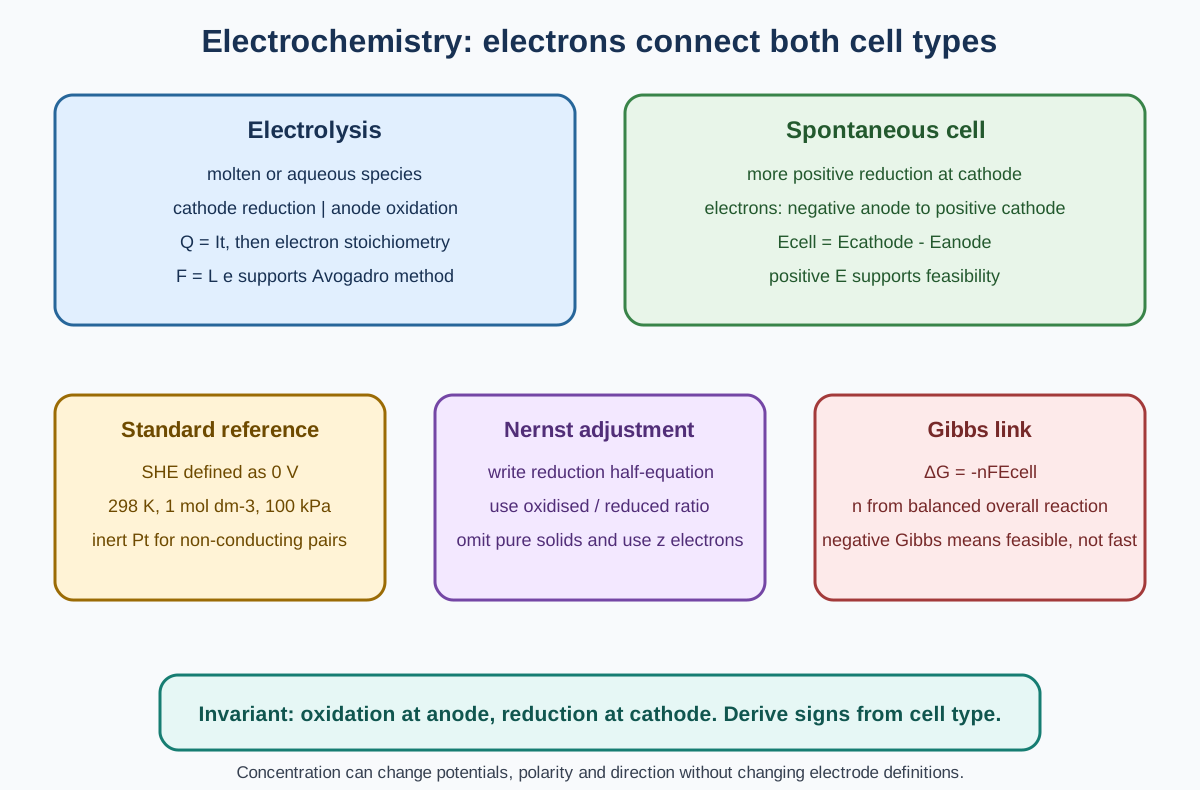
Electrochemistry is Cambridge International Chemistry 9701 Topic 24. The A Level boundary covers product prediction and quantitative electrolysis, an electrolytic Avogadro determination, standard hydrogen and other half-cells, standard cell potentials, redox feasibility, concentration effects through the Nernst equation and the Gibbs-cell relationship. Practical construction remains in the practical hub.
1. Invariant electrode definitions
Oxidation occurs at the anode. Reduction occurs at the cathode. These definitions do not change between electrolytic and spontaneous cells.
In electrolysis, the power supply makes the anode positive and cathode negative. In a spontaneous galvanic cell, the anode is negative because it releases electrons and the cathode is positive because it receives them.
Memorise reaction type first, then derive sign from cell type.
2. Molten electrolysis
A molten ionic compound contains only its own mobile ions. Cations migrate to the cathode and gain electrons; anions migrate to the anode and lose electrons.
Molten sodium chloride gives sodium at the cathode and chlorine at the anode. There is no water to compete.
Use ion charges to balance half-equations and combine them to conserve electrons.
3. Aqueous cathode products
An aqueous electrolyte contains solute ions and water-derived hydrogen species. At the cathode, either a cation is reduced or hydrogen is produced.
Use electrode-potential position and conditions to judge the favoured reduction. Ions of less reactive metals such as copper are readily deposited, while very reactive metal ions remain in solution and water or hydrogen ions form hydrogen.
Concentration can shift which process is observed when alternatives are competitive.
4. Aqueous anode products
At an inert anode, anions or water-derived hydroxide can be oxidised. Halide ions can form halogens, while oxygen commonly forms when other anions are difficult to oxidise.
Concentration matters. Concentrated chloride can favour chlorine, whereas dilute conditions can favour oxygen more strongly.
An active electrode can itself react, so specify inert platinum or carbon when applying the simple competing-ion rules.
5. Product-prediction workflow
First decide molten or aqueous. List all species actually present. At the cathode compare possible reductions; at the anode compare possible oxidations. Include concentration and electrode material.
Write both half-equations and verify charge. Then describe state or gas identity.
A redox-series rule without the electrolyte state is incomplete.
Check this topic from memory
Attempt the matching topic bank before reopening the notes. Use each missed idea to decide what to review next.
Electrical charge equals current multiplied by time. Use current in amperes and time in seconds to obtain coulombs.
If current changes, divide the run into intervals and add charge or use the supplied current-time information. Do not use minutes directly.
Charge measures electron flow; product amount then follows from electron stoichiometry.
7. Faraday constant and electron moles
The Faraday constant is charge per mole of electrons. Moles of electrons equal charge divided by Faraday constant.
Use the half-equation to convert electron moles to product moles. Copper deposition requires two electrons per copper ion, while silver deposition requires one per silver ion.
Do not equate electron moles directly with product moles unless the coefficient is one.
8. Mass and gas-volume calculations
After obtaining product moles, multiply by molar mass for deposited mass. For a gas, use the molar volume supplied or an appropriate gas equation at the stated conditions.
For chlorine formation, two chloride ions lose two electrons to form one chlorine molecule, so product moles are half electron moles.
Carry units and significant figures through the chain: current, time, charge, electron moles, product moles, requested amount.
9. Faraday, Avogadro and electron charge
The relationship is Faraday constant equals Avogadro constant multiplied by the charge on one electron.
In symbols, F=Le. The electron charge is a positive magnitude in this relationship even though an electron's signed charge is negative.
If two quantities are known, rearrange algebraically and preserve units.
10. Electrolytic determination of Avogadro constant
Pass a measured current for a measured time through an electrolyte and determine the mass change of a suitable electrode, such as copper.
Calculate charge, then use electrode mass change and molar mass to obtain moles of deposited or dissolved atoms. The half-equation gives electron moles and hence an experimental Faraday constant.
Divide Faraday constant by the measured elementary charge to obtain Avogadro constant. Accurate drying, current measurement, timing and electrode handling matter.
11. Standard electrode potential
A standard electrode reduction potential is the potential of a half-cell measured relative to the standard hydrogen electrode under standard conditions, with the half-equation written as reduction.
Standard conditions include 298 kelvin, aqueous species at 1 mol per cubic decimetre and gases at 100 kilopascals.
An isolated half-cell potential cannot be measured absolutely; it is a potential difference against a reference.
12. Standard hydrogen electrode
The standard hydrogen electrode has platinum in contact with hydrogen gas and aqueous hydrogen ions under standard conditions. Platinum is inert and provides a conducting catalytic surface.
Its standard potential is defined as zero volts. The reversible half-equation is two hydrogen ions plus two electrons forming hydrogen gas.
The platinum is not consumed and is not a source of hydrogen ions.
13. Measuring a metal half-cell
Place the metal in a standard solution of its ions and connect it to the standard hydrogen electrode through a high-resistance voltmeter and salt bridge.
The measured polarity and voltage determine the half-cell potential relative to zero. The salt bridge completes the ionic circuit while limiting bulk mixing.
All standard concentrations, pressure and temperature must be maintained for a standard potential.
14. Non-metal and same-element ion half-cells
A non-metal in contact with aqueous ions may need an inert platinum electrode when no conducting solid participates.
For two ions of the same element in different oxidation states, such as iron(III) and iron(II), platinum supplies a surface and electrical contact but does not appear in the redox equation.
Both ion concentrations are standard when measuring the standard potential.
15. Standard cell potential
Combine two reduction potentials using standard cell potential equals cathode reduction potential minus anode reduction potential.
The more positive reduction potential runs as reduction at the cathode in the feasible spontaneous direction. The other half-equation is reversed to oxidation at the anode.
Do not reverse the sign of a table value and then subtract it again; use one consistent formula.
16. Electrode polarity and electron flow
In a spontaneous cell, oxidation at the negative anode releases electrons. They travel through the external circuit to the positive cathode, where reduction consumes them.
Conventional current is opposite to electron flow. The salt bridge carries ions, not electrons, to maintain electrical neutrality.
Label half-cells only after deciding which reduction potential is higher under the relevant conditions.
17. Feasibility from cell potential
A positive standard cell potential indicates that the written overall reaction is thermodynamically feasible under standard conditions. A negative value indicates the reverse direction is feasible.
Zero corresponds to equilibrium under those conditions.
Feasibility does not guarantee an observable fast reaction; activation barriers can make a positive-potential reaction slow.
18. Oxidising and reducing strength
A more positive reduction potential indicates a stronger tendency for the oxidised species on the left of the reduction half-equation to gain electrons. It is therefore a stronger oxidising agent.
A more negative reduction potential means the reduced species on the right more readily runs the half-equation backward and acts as a stronger reducing agent.
Identify the actual species, not just the element name, because oxidation state matters.
19. Constructing the redox equation
Select the half-equation with more positive potential as reduction. Reverse the other. Multiply half-equations so electron numbers match, then add and cancel electrons.
Multiplying a half-equation does not multiply its electrode potential because potential is intensive.
Check atoms, charge and physical species in the final equation.
20. Qualitative concentration effects
For a reduction half-equation, increasing the concentration of the oxidised species generally shifts reduction tendency upward and makes potential more positive. Increasing reduced-species concentration shifts it downward.
Pure solids and liquids have constant activity and are omitted from simple concentration expressions.
Use Le Chatelier reasoning as a sign check, then apply the Nernst expression quantitatively.
21. Nernst equation
At 298 kelvin, Cambridge gives electrode potential equals standard potential plus (0.059/z) times the logarithm of oxidised-species concentration divided by reduced-species concentration for the stated reduction form.
Here (z) is the number of electrons in the half-equation. Raise concentrations to stoichiometric powers where the reaction expression requires them.
Use base-10 logarithms and do not insert pure solid concentration.
22. Copper and iron examples
For copper(II) plus two electrons forming solid copper, increasing copper(II) concentration increases potential. Solid copper is omitted and z=2.
For iron(III) plus one electron forming iron(II), potential depends on the ratio of iron(III) to iron(II). Raising iron(III) or lowering iron(II) makes potential more positive.
The ratio must match the half-equation as written as reduction.
23. Non-standard cell potentials
Calculate each half-cell potential under its actual concentrations, then subtract anode value from cathode value.
Concentration changes can reduce, increase or even reverse cell polarity if large enough. A standard potential ranking is not immutable outside standard conditions.
After calculation, relabel electrodes and electron direction from the actual potentials.
24. Gibbs energy and cell potential
Standard Gibbs change equals negative (nFE) for the cell, where (n) is moles of electrons transferred in the balanced overall reaction.
With Faraday constant in coulombs per mole and potential in volts, the result is joules per mole. Divide by 1000 for kilojoules per mole.
A positive cell potential gives negative Gibbs change, matching the feasibility criteria.
Worked application: zinc-copper cell and Gibbs energy
The standard reduction potentials are -0.76 volts for zinc(II)/zinc and +0.34 volts for copper(II)/copper. Copper has the more positive value and is reduced at the positive cathode; zinc is oxidised at the negative anode. Electrons flow externally from zinc to copper. Standard cell potential is 0.34 minus -0.76, or 1.10 volts. The balanced reaction transfers two moles of electrons, so standard Gibbs change is negative two times 96485 times 1.10, or -212267 joules per mole, which is about -212 kilojoules per mole. The positive potential and negative Gibbs change show standard feasibility, not reaction speed.
Common misconceptions and corrections
Saying oxidation is at the cathode in electrolysis. Oxidation is always at the anode.
Using one electrode-sign rule for both cell types. Signs depend on power-driven or spontaneous operation.
Predicting aqueous products from solute ions only. Water-derived species compete.
Ignoring electrolyte concentration. It can change anode products.
Ignoring active electrode material. It can participate.
Using minutes directly in charge calculation. Convert to seconds.
Equating charge with product moles. Convert through electron moles and stoichiometry.
Using one electron per copper atom. Copper(II) requires two.
Using one chlorine molecule per electron. Two electrons correspond to one chlorine molecule.
Giving signed negative electron charge in F=Le. Use its magnitude.
Calculating Avogadro constant directly from deposited mass without charge. Determine Faraday first.
Defining a half-cell potential absolutely. It is measured against a reference.
Omitting standard conditions from the definition. Concentration, pressure and temperature matter.
Saying platinum supplies hydrogen in the SHE. It is inert.
Using a reactive metal for an ion-ion half-cell. Use inert platinum.
Adding two reduction potentials blindly. Use cathode minus anode.
Reversing a potential and subtracting twice. Choose one sign method.
Multiplying potential with half-equation coefficients. Potential is intensive.
Sending electrons through the salt bridge. They use the external wire.
Calling the more negative left-hand species the stronger oxidant. More positive reduction means stronger oxidant.
Calling positive cell potential proof of fast reaction. It only supports feasibility.
Putting solid concentration into Nernst expressions. Pure solids are omitted.
Using (z) as ionic charge automatically. It is electrons transferred.
Using natural logarithm with the supplied 0.059 form. Use base 10.
Reversing oxidised and reduced concentration ratio. Match the reduction half-equation.
Assuming standard polarity persists at all concentrations. Non-standard potentials can reorder.
Using unbalanced electron number in Gibbs calculation. Take (n) from the overall equation.
Reporting Gibbs in kilojoules without converting joules. Divide by 1000.
Assessment guidance
Product predictions must state molten or aqueous conditions, competing species, electrode material and concentration before writing half-equations. Electrolysis calculations should show current-time charge, electron moles and product stoichiometry. Standard-potential answers require standard conditions, the hydrogen reference, cathode-minus-anode arithmetic and a balanced redox equation without scaling potentials. For non-standard systems, write the reduction form, omit pure solids, use the correct electron number and concentration ratio, then recalculate electrode identity. Gibbs calculations use the electron count from the balanced reaction and consistent joule units. Always separate thermodynamic feasibility from kinetic rate.
Retrieval practice
Predict products for molten and aqueous electrolytes while varying concentration and electrode material. Complete charge-to-mass and charge-to-gas calculations plus an Avogadro-constant determination. Draw the standard hydrogen, metal and ion-ion half-cells. Build cells from reduction tables, label polarity and electron flow, balance equations and rank oxidants and reductants. Apply the Nernst equation to copper and iron ratios, test for polarity reversal and convert each cell potential into Gibbs energy with the correct electron stoichiometry.