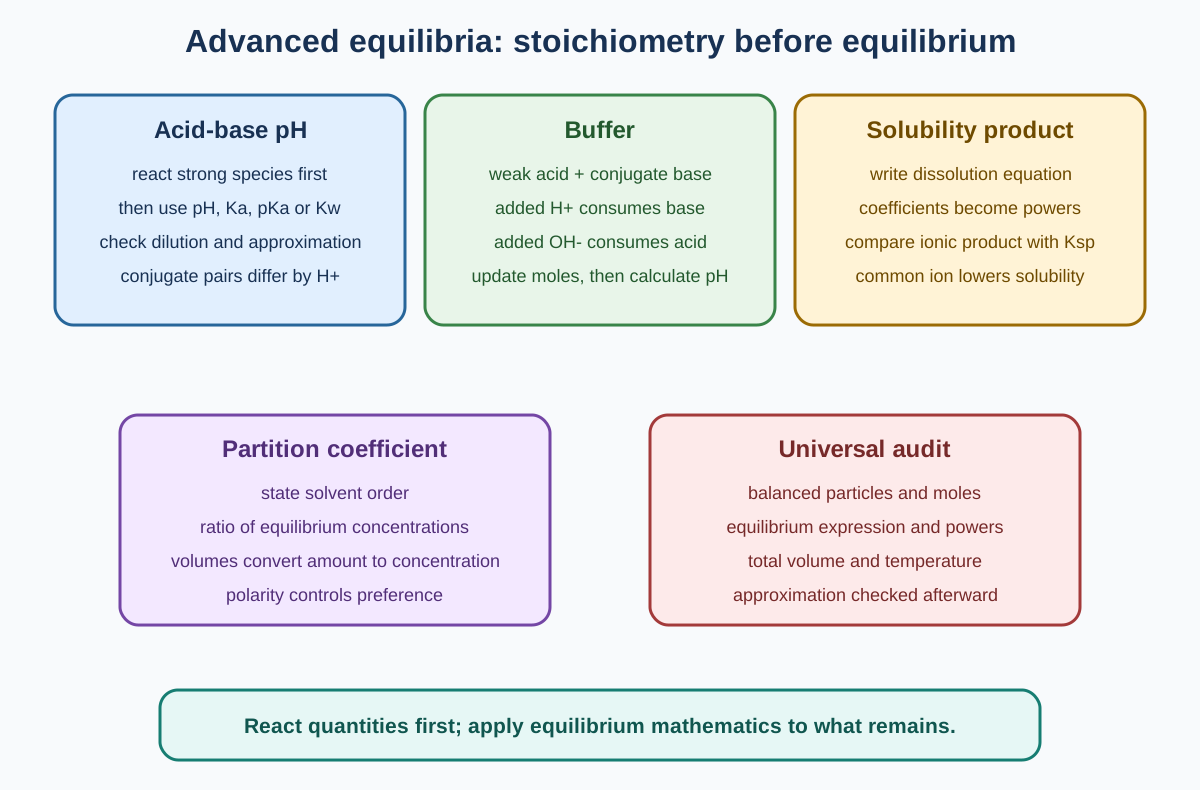
Equilibria is Cambridge International Chemistry 9701 Topic 25. The A Level boundary covers conjugate acid-base pairs, pH, Ka, pKa and Kw calculations, buffer preparation and action, solubility products, common ions and partition coefficients. General Kc and Kp work belongs to Topic 7 rather than this note.
1. Conjugate acid-base pairs
A conjugate acid forms when a base gains a proton. A conjugate base forms when an acid loses a proton. Members of a pair differ by exactly one proton.
In ammonia plus water forming ammonium and hydroxide, ammonia and ammonium are one pair; water and hydroxide are the other.
Identify pairs by formula difference and proton transfer, not by placing any acid beside any base in the equation.
2. Amphiprotic species
Some species can donate or accept a proton depending on reaction partner. Water can act as acid with ammonia or base with hydrogen chloride.
Hydrogencarbonate can accept a proton to form carbonic acid or donate one to form carbonate.
Role is reaction-specific. The same formula is not permanently labelled acid or base without context.
3. pH definition
pH is negative base-10 logarithm of aqueous hydrogen-ion concentration. Conversely, hydrogen-ion concentration is ten raised to negative pH.
Concentration is in moles per cubic decimetre. The logarithm acts on the numerical concentration relative to the standard state.
Do not use total acid concentration as hydrogen-ion concentration until dissociation and stoichiometry have been considered.
4. Strong acids
A strong acid is treated as fully dissociated in dilute aqueous solution. For a monoprotic strong acid, hydrogen-ion concentration equals analytical acid concentration after dilution.
For acids supplying more than one proton, use the dissociation assumptions stated or justified by the syllabus problem rather than multiplying automatically.
If solutions are mixed, calculate moles first, account for neutralisation, then divide excess hydrogen-ion moles by total volume.
5. Strong alkalis
A strong alkali dissociates fully. Hydroxide concentration follows formula stoichiometry: sodium hydroxide gives one hydroxide per formula unit, while barium hydroxide gives two.
Find pOH from hydroxide concentration if useful, then use pH plus pOH equals pKw. At 298 kelvin, pKw is approximately 14.
Do not calculate pH directly as negative log of hydroxide concentration.
6. Ionic product of water
Kw is hydrogen-ion concentration multiplied by hydroxide-ion concentration. At 298 kelvin its numerical value is approximately 1.0 multiplied by ten to the power negative fourteen when concentrations are expressed in moles per cubic decimetre.
Check this topic from memory
Attempt the matching topic bank before reopening the notes. Use each missed idea to decide what to review next.
Pure water has equal hydrogen and hydroxide concentrations, giving pH 7 at 298 kelvin.
Kw varies with temperature, so neutral does not universally mean pH 7 at every temperature; neutrality means equal hydrogen and hydroxide concentrations.
7. Acid dissociation constant
For weak acid HA in equilibrium with hydrogen ions and A-, Ka equals hydrogen-ion concentration times A- concentration divided by undissociated HA concentration.
Pure liquids are omitted where appropriate. Use equilibrium rather than initial concentrations in the expression.
A larger Ka means greater dissociation and stronger acid within a comparable set.
8. pKa
pKa is negative base-10 logarithm of Ka. Conversely, Ka is ten raised to negative pKa.
Because of the negative logarithm, a smaller pKa indicates a stronger acid. A difference of one pKa unit corresponds to a tenfold Ka difference.
Keep strength, which depends on equilibrium position, separate from concentration, which states amount per volume.
9. Weak-acid pH
For initial weak-acid concentration (c) and dissociated amount (x), equilibrium concentrations are (x), (x) and (c-x). Thus Ka equals (x^2/(c-x)).
If dissociation is small, approximate (c-x) by (c), giving hydrogen-ion concentration approximately the square root of Ka times (c).
Check the approximation after calculation. If (x/c) is not small, solve the quadratic relation.
10. Dilution and neutralisation before pH
Concentration after dilution equals moles divided by total volume. When acid and alkali mix, first compare hydrogen and hydroxide mole equivalents.
After stoichiometric reaction, calculate the concentration of the excess strong species or the weak-acid and conjugate-base amounts that remain.
Taking a logarithm before completing reaction stoichiometry is a common source of plausible but meaningless pH values.
11. Buffer definition
A buffer solution resists large pH change when small amounts of acid or base are added.
An acidic buffer contains a weak acid and a significant concentration of its conjugate base. It can be prepared by mixing the weak acid with a soluble salt of that conjugate base or by partially neutralising the acid with strong alkali.
Both components must remain after preparation.
12. How an acidic buffer controls pH
Added hydrogen ions react with conjugate base A- to form HA. Added hydroxide reacts with HA to form A- and water.
These reactions remove most of the added strong acid or base. The ratio of conjugate base to weak acid changes only modestly when buffer capacity is not exceeded.
The buffer does not keep pH exactly constant and fails if too much reagent is added.
13. Buffer pH calculation
Rearranging the Ka expression gives hydrogen-ion concentration equal to Ka times weak-acid concentration divided by conjugate-base concentration.
Equivalently, pH equals pKa plus the logarithm of conjugate-base concentration divided by weak-acid concentration.
If both species occupy the same final volume, their mole ratio may replace concentration ratio. After added acid or base, update moles stoichiometrically before using the equilibrium relation.
14. Making a buffer by partial neutralisation
Start with weak-acid moles. Strong alkali converts an equal amount to conjugate base. Subtract reacted acid and record conjugate base formed.
If alkali consumes all acid, no acidic buffer pair remains. If too little conjugate base forms, capacity may be poor even though the expression can still be evaluated.
Use total volume only when individual concentrations are required; it cancels in a same-solution ratio.
15. Hydrogencarbonate buffer in blood
The carbonic-acid and hydrogencarbonate pair helps control blood pH. Added acid is consumed when hydrogencarbonate accepts a proton to form carbonic acid.
Added base is consumed when carbonic acid donates a proton, forming hydrogencarbonate and water.
Physiological control also involves lungs and kidneys, but the syllabus chemical explanation centres on the conjugate pair and its proton-transfer equations.
16. Solubility product
Ksp is the equilibrium constant for dissolution of a sparingly soluble ionic solid into its aqueous ions.
For silver chloride dissolving to silver and chloride ions, Ksp is the product of their concentrations. The pure solid is omitted.
Ksp has a fixed value at a stated temperature. Solubility and Ksp are related but not numerically identical except in particular stoichiometries.
17. Stoichiometry in Ksp expressions
For calcium fluoride dissolving to one calcium ion and two fluoride ions, Ksp equals calcium concentration times fluoride concentration squared.
If molar solubility is (s) in pure water, concentrations are (s) and (2s), so Ksp equals (4s^3).
Write the dissolution equation before the expression. Formula subscripts become ion coefficients and concentration powers.
18. Calculating Ksp from solubility
Convert supplied mass solubility to molar solubility if necessary. Use dissolution stoichiometry to obtain every ion concentration, then substitute into Ksp.
Do not put solid molar solubility directly into every ion term unless the coefficient is one.
Check units and magnitude against the sparingly soluble description.
19. Calculating solubility from Ksp
Let molar solubility be (s), express ion concentrations in terms of (s), then solve the resulting power equation.
For a 1:1 salt in pure water, Ksp equals (s^2). For 1:2 or 2:1 salts, coefficient factors change the result.
Taking a square root for every salt ignores stoichiometry.
20. Ionic product and precipitation
The ionic product has the same concentration form as Ksp but uses current concentrations. If ionic product is below Ksp, no precipitation is required; if equal, solution is saturated; if above, precipitation occurs until equilibrium is restored.
When two solutions mix, calculate diluted ion concentrations in total volume before comparing.
A precipitate prediction without the mixing dilution can be wrong by orders of magnitude.
21. Common-ion effect
Adding an ion already present in the dissolution equilibrium shifts equilibrium toward the solid and lowers molar solubility.
For silver chloride, added chloride suppresses silver concentration at saturation because their product remains Ksp.
Ksp itself does not change at constant temperature. The equilibrium concentrations and amount dissolved change.
22. Common-ion calculations
Write Ksp, insert the known common-ion concentration and solve for the other ion. If the added common ion greatly exceeds dissolution contribution, that contribution may be neglected and then checked.
If it is not negligible, include (s) in the common-ion concentration and solve more exactly.
State the approximation and verify it instead of hiding it.
23. Partition coefficient
A partition coefficient is the equilibrium concentration of a solute in one solvent divided by its equilibrium concentration in a second immiscible solvent at a stated temperature.
Cambridge restricts the calculation to cases in which the solute is in the same physical or molecular state in both solvents.
Define the numerator and denominator in the order given; reversing solvents gives the reciprocal value.
24. Partition calculations
At equilibrium, use the coefficient to relate concentrations in the two layers. Combine this ratio with conservation of total solute moles.
Concentration equals amount divided by layer volume, so unequal solvent volumes matter. Units cancel when both concentrations use the same units.
Multiple smaller extractions are often more effective than one extraction with the same total solvent because each step re-establishes partition equilibrium.
25. Polarity and partition value
A solute tends to favour the solvent with which it has stronger compatible intermolecular attractions. Polar and hydrogen-bonding solutes often favour polar solvents; non-polar solutes often favour non-polar solvents.
Changing solvent pair, temperature or solute ionisation changes the numerical coefficient.
“Like dissolves like” is a starting principle, not a numerical calculation; use structural polarity to justify direction.
Worked application: buffer pH before and after added acid
A buffer contains 0.200 moles of ethanoic acid and 0.100 moles of ethanoate in one litre, with pKa 4.76. Initial pH is 4.76 plus the base-10 logarithm of 0.100 divided by 0.200, which gives 4.46. Adding 0.010 moles of strong acid converts ethanoate to acid, leaving 0.090 moles ethanoate and 0.210 moles acid. The new pH is 4.76 plus the base-10 logarithm of 0.090 divided by 0.210, which gives 4.39. Stoichiometry comes before the buffer equation. The pH falls by only 0.07 because both buffer components remain substantial; the buffer has resisted change rather than held pH exactly fixed.
Common misconceptions and corrections
Pairing any acid with any base. Conjugates differ by one proton.
Assigning one permanent role to water or hydrogencarbonate. Role depends on partner.
Using acid concentration directly for every pH. Account for strength and reaction.
Taking negative log of hydroxide concentration as pH. It gives pOH.
Ignoring two hydroxides from barium hydroxide. Apply formula stoichiometry.
Calling neutral always pH 7. That value is temperature-dependent.
Using initial weak-acid concentration in every Ka term. Use equilibrium values.
Saying larger pKa means stronger acid. The order is reversed.
Using the square-root approximation without checking it. Verify small dissociation.
Taking logarithms before neutralisation stoichiometry. React moles first.
Making a buffer from strong acid and its salt. A weak conjugate pair is required.
Using equal buffer concentrations as a requirement. Both need substantial amounts, not equality.
Saying a buffer fixes pH perfectly. It resists limited changes.
Forgetting to update buffer moles after added acid. Conjugate base is consumed.
Leaving no weak acid after partial neutralisation. Then the pair is absent.
Explaining blood buffering without proton-transfer equations. Show both directions.
Including solid concentration in Ksp. Pure solid is omitted.
Equating Ksp directly with molar solubility. Stoichiometry links them.
Forgetting concentration powers. Use dissolution coefficients.
Taking square root of every Ksp. 1:2 salts give cubic relations.
Comparing pre-mixing concentrations with Ksp. Dilute into total volume first.
Saying common ion changes Ksp. It changes solubility, not Ksp at fixed temperature.
Neglecting common-ion dissolution contribution without checking. Validate the approximation.
Defining partition coefficient without solvent order. State numerator and denominator.
Reversing solvent layers without taking reciprocal. Order changes value.
Ignoring layer volumes. Coefficients relate concentrations, not amounts.
Applying Kpc when solute changes chemical state between solvents. The syllabus case requires the same state.
Calling partition purely a density effect. Intermolecular polarity controls preference.
Assessment guidance
Acid-base calculations must begin with balanced mole stoichiometry, total volume and a decision about strong or weak behaviour before logarithms. Define Ka, pKa and Kw mathematically and keep temperature qualifications. Buffer answers need a genuine weak conjugate pair, equations for consuming added acid and base, updated moles and a capacity-aware conclusion. Ksp work should start from the dissolution equation, use coefficient powers and compare diluted ionic product with Ksp. Common ions alter equilibrium concentrations, not Ksp. Partition calculations require an explicitly ordered solvent ratio, concentration rather than amount, both layer volumes and the same solute state in each solvent.
Retrieval practice
Identify conjugate pairs and amphiprotic roles, then calculate strong-acid, strong-alkali and weak-acid pH after dilution and neutralisation. Prepare buffers by salt mixing and partial neutralisation, calculate their response to added acid or base and explain blood hydrogencarbonate chemistry. Derive Ksp-solubility relations for 1:1, 1:2 and 2:1 salts, test precipitation after mixing and solve common-ion cases. Finish with single and repeated partition extractions while justifying solvent preference from polarity.