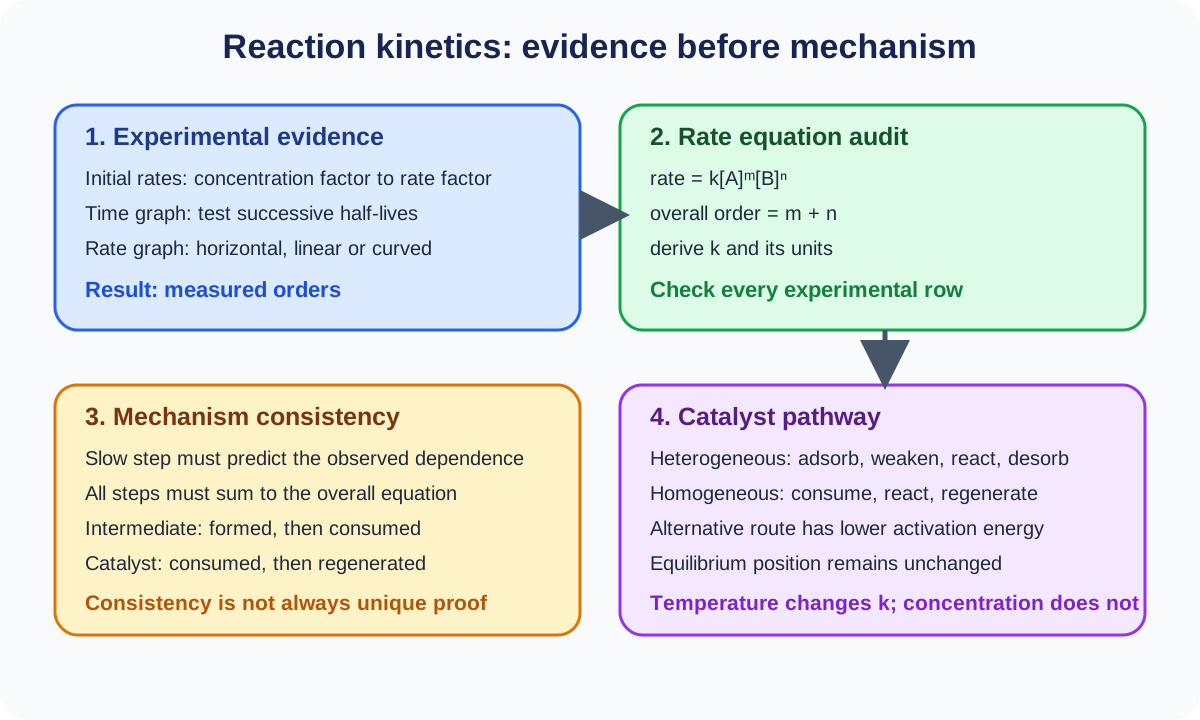
Reaction kinetics is Cambridge International Chemistry 9701 Topic 26. The A Level boundary covers simple rate equations, orders, first-order half-life, rate constants, evidence-based mechanisms, temperature effects and homogeneous or heterogeneous catalysis.
1. Rate equation
A rate equation expresses how reaction rate depends on reactant concentrations at a stated temperature. Its general Cambridge form is rate equals k multiplied by concentration of A to power m and concentration of B to power n.
The exponents m and n are experimentally determined orders. For this syllabus they may be zero, one or two. They are not normally copied from the balanced overall equation.
The rate equation describes an observed relationship. It can constrain a mechanism, but it does not by itself give every elementary step.
2. Individual and overall order
The order with respect to one reactant is its exponent in the rate equation. Overall order is the sum of all concentration exponents.
If rate equals k times A squared times B, the reaction is second order in A, first order in B and third order overall.
Order is not a chemical amount and has no concentration unit. State which reactant an individual order refers to.
3. Meaning of zero, first and second order
At fixed values of all other variables, doubling a zero-order reactant concentration leaves rate unchanged. Doubling a first-order concentration doubles rate. Doubling a second-order concentration multiplies rate by four.
For a concentration factor f, the corresponding rate factor is f raised to that reactant's order.
Use ratios between experiments rather than assuming every change is a doubling.
4. Initial-rates method
Initial rates compare experiments before concentrations have changed appreciably and products have accumulated. Select two experiments where only one reactant concentration changes.
Divide the two rate equations. Constants and unchanged concentrations cancel, leaving a concentration ratio raised to the unknown order.
After finding one order, use another suitable pair for the next. When several concentrations change together, substitute orders already established rather than guessing from the raw rate ratio.
5. Calculating an initial rate
An initial rate may be obtained from the gradient of a tangent at time zero on a concentration-time graph. Rate of disappearance has the opposite sign to the concentration gradient, so rate is usually quoted as a positive magnitude.
If a product concentration is plotted, its initial gradient is positive. Stoichiometric coefficients may be required when converting between rates of disappearance and formation.
Check this topic from memory
Attempt the matching topic bank before reopening the notes. Use each missed idea to decide what to review next.
Keep both concentration and time units when reporting the gradient.
6. Concentration-time evidence
A concentration-time curve becomes less steep as reaction slows. Equal successive half-lives indicate first-order loss of that reactant.
For a zero-order reactant, concentration falls linearly with time until the kinetic regime ends. A simple curved trace alone is not enough to distinguish every order.
Read graph scales precisely and compare defined intervals instead of judging shape by eye alone.
7. Rate-concentration graphs
For one reactant while other conditions stay fixed, zero order gives a horizontal rate-concentration line, first order gives a straight line through the origin and second order gives an upward-curving relationship.
A straight line that does not pass through the origin may indicate background effects or that the supplied interpretation needs more care. Do not force it into the first-order model.
Graphs are experimental evidence for one variable at a time.
8. Constructing the rate equation
Once individual orders are known, write each reactant concentration with its measured exponent and place k as the proportionality constant.
A zero-order concentration may be omitted because any non-zero value to power zero equals one. It is still important to state the zero order explicitly in words.
Check the proposed equation against every experimental row, not only the pairs used to derive it.
9. Rate constant
The rate constant k converts the concentration product into the observed rate. At a fixed temperature and for a fixed reaction, k does not depend on the reactant concentrations.
Calculate k by rearranging the rate equation and substituting one complete experiment. Agreement across other rows is a useful audit.
The magnitude of k cannot be compared meaningfully across different overall orders without considering its units.
10. Units of the rate constant
Rate normally has concentration per time units. Divide those units by concentration raised to the overall order.
For overall order one, k has inverse-time units. For overall order two, it has inverse-concentration inverse-time units. For overall order zero, it has concentration per time units.
Derive units from the actual rate equation instead of memorising one unit for all reactions.
11. Half-life
Half-life is the time taken for a reactant concentration to fall to half its current value under the defined conditions.
For first-order kinetics, successive halvings take equal times. The half-life is independent of starting concentration and k equals 0.693 divided by the half-life.
After one, two and three half-lives, the fractions remaining are one half, one quarter and one eighth respectively.
12. First-order half-life calculations
Use consistent time units. If half-life is supplied in seconds, k is obtained in inverse seconds.
To find elapsed time for an exact power-of-two decrease, count halvings and multiply by half-life. For other fractions, the question may provide enough logarithmic information or expect graphical reasoning.
Do not apply k equals 0.693 divided by half-life unless first-order behaviour is established.
13. Rate-determining step
The rate-determining step is the slow step whose reactant dependence controls the observed rate equation within the proposed mechanism.
Species present as reactants in that slow elementary step often appear in its rate expression. If the slow step contains an intermediate, an earlier fast equilibrium may be needed to express that intermediate in terms of overall reactants.
Cambridge problems normally give enough structure to connect the proposed steps and observed order without inventing unsupported chemistry.
14. Mechanism consistency
A valid proposed mechanism must sum to the overall equation after cancelling species produced and consumed internally. It must also predict the experimental rate equation.
Matching the overall equation is necessary but not sufficient. Several mechanisms can share the same net stoichiometry while only one matches the kinetic evidence.
Never choose a slow step solely because it has the largest number of particles.
15. Intermediates
An intermediate is formed in one step and consumed in a later step. It does not appear in the overall equation.
Cancel intermediates when adding mechanism steps, but retain them while discussing how individual steps proceed.
A species consumed first and regenerated later is instead acting as a catalyst, even though it also cancels from the overall equation.
16. Predicting order from a mechanism
If a given elementary slow step contains one A particle and two B particles, its direct rate equation is first order in A and second order in B.
This translation applies to the specified elementary rate-determining step, not automatically to the balanced overall equation.
If an intermediate appears, use the relationship supplied by preceding steps before presenting a rate equation containing only measurable starting reactants.
17. Deducing a rate-determining step
Compare the observed rate equation with the reactant composition implied by each candidate slow step. Then verify that all steps sum correctly and identify intermediates or catalysts.
A reactant that is zero order need not be absent from the full mechanism. It may participate after the slow step or be present in effectively constant saturation conditions.
Rate evidence narrows mechanism possibilities; it rarely proves a unique microscopic path without other evidence.
18. Temperature and k
Increasing temperature raises the fraction of collisions with energy at least equal to activation energy. The rate constant therefore increases and the reaction rate rises at unchanged concentrations.
This is more precise than saying particles merely collide more often. Collision frequency changes modestly, while the successful-collision fraction can change substantially.
The rate equation form and orders may remain the same across a suitable temperature range even though k changes.
19. Catalyst classification
A homogeneous catalyst is in the same phase as the reacting system. A heterogeneous catalyst is in a different phase, commonly a solid acting on gaseous or liquid reactants.
Classification depends on phases in the actual reaction, not on whether the catalyst is a metal.
Both types provide an alternative route with lower activation energy and are regenerated overall.
20. Heterogeneous catalyst sequence
Reactants first adsorb onto active sites on the solid surface. Surface interactions weaken relevant bonds and bring species into a favourable arrangement. Reaction occurs, then products desorb and free the sites.
Adsorption is attachment to a surface, not absorption into the bulk. Strong enough adsorption aids activation, but products must still desorb.
Greater exposed surface area can provide more available active sites, provided other conditions are comparable.
21. Iron in the Haber process
In ammonia manufacture, nitrogen and hydrogen adsorb on iron. Their bonds are weakened on the surface, new nitrogen-hydrogen bonds form through surface steps and ammonia desorbs.
Iron changes the rate at which equilibrium is reached but does not change the equilibrium constant or equilibrium composition at a fixed temperature.
The catalyst accelerates forward and reverse reactions through the lower-energy pathway.
22. Catalytic removal of nitrogen oxides
Palladium, platinum and rhodium surfaces help convert pollutants in car exhausts. Nitrogen oxides and suitable reducing species adsorb, bonds weaken, atoms rearrange and less harmful products desorb.
An explanation should name adsorption, surface bond weakening and desorption rather than merely saying the metal speeds reaction.
The exact surface mechanism is not replaced by the balanced overall pollutant-conversion equation.
23. Homogeneous catalyst cycle
A homogeneous catalyst is consumed in one elementary step and reformed in a later step. Adding the steps cancels the catalyst from the net equation.
An intermediate is produced then consumed; a catalyst is consumed then produced. This order distinguishes their roles in a written cycle.
The catalysed steps form an alternative mechanism whose slowest barrier is lower than that of the uncatalysed route.
24. Atmospheric nitrogen oxides
Atmospheric nitrogen oxides can catalyse oxidation of sulfur dioxide. One nitrogen oxide reacts in one step and is regenerated through reaction of another nitrogen oxide species with oxygen.
When the steps are added, the nitrogen oxide catalyst cancels while sulfur dioxide and oxygen give sulfur trioxide overall.
Show regeneration explicitly to earn catalyst-cycle reasoning credit.
25. Iron ions in iodide and peroxodisulfate reaction
The direct reaction between two negative ions is kinetically hindered by electrostatic repulsion. An iron(III) ion can oxidise iodide and become iron(II); peroxodisulfate then oxidises iron(II) back to iron(III).
Alternatively, the same cycle may be described from iron(II) as the starting catalyst form. Both oxidation states are participants in one regenerated redox shuttle.
Add the half-reaction-style steps to confirm the original overall reactants and products remain.
Worked application: deriving a rate equation and testing a mechanism
An experiment doubles A while B is fixed and rate doubles, so the order in A is one. A second comparison doubles B while A is fixed and rate rises by a factor of four, so the order in B is two. The rate equation is therefore rate equals k times A times B squared, with overall order three. A proposed slow elementary step containing one A and two B particles matches this dependence. The remaining fast steps must still sum with it to the overall equation. If the measured rate is 0.024 concentration units per second at A concentration 0.20 and B concentration 0.10, k is 12 in the units required for an overall third-order reaction.
Common misconceptions and corrections
Copying balanced coefficients into the rate equation. Orders come from kinetic evidence.
Calling overall order the largest exponent. Add all exponents.
Saying zero order means concentration is zero. Rate is independent of that concentration.
Treating every rate comparison as a doubling. Use the actual factor.
Comparing rows where several unknown concentrations change. Isolate one variable where possible.
Reading average rate as initial rate. Use the time-zero tangent.
Dropping the gradient sign without explanation. Quote disappearance rate as a positive magnitude.
Judging graph order from vague curvature. Test half-lives or rate-concentration form.
Calling any straight rate graph first order. It should pass through the origin in the ideal model.
Omitting a zero-order result entirely. State it even if its factor disappears.
Using one data row to validate the rate equation. Test every row.
Giving k without units. Derive them from overall order.
Using the same k units for all reactions. Units depend on rate equation.
Saying k changes when concentration changes. At fixed temperature it does not.
Calling every half-life constant. Concentration independence is a first-order property.
Using the first-order half-life formula for other orders. Establish order first.
Reading half-life only from the initial concentration. Test successive halvings.
Equating the slow step with the overall equation. Mechanisms contain elementary steps.
Accepting a mechanism that only sums correctly. It must also match the rate equation.
Leaving an intermediate in the overall equation. It should cancel.
Calling a regenerated species an intermediate. It is a catalyst.
Assuming a zero-order reactant is absent from the mechanism. It may act after the slow step.
Claiming kinetics proves a unique mechanism. It establishes consistency, not always uniqueness.
Explaining temperature only through more collisions. Emphasise the larger successful fraction and higher k.
Saying a catalyst changes equilibrium composition. It changes rate, not fixed-temperature equilibrium.
Classifying every metal catalyst as heterogeneous. Compare phases.
Confusing adsorption with absorption. Heterogeneous catalysis begins at the surface.
Stopping at adsorption. Include bond weakening, reaction and desorption.
Calling a homogeneous catalyst unchanged in every step. It is consumed then regenerated.
Omitting catalyst regeneration from a cycle. Show the later reforming step.
Treating iron(II) and iron(III) as unrelated catalysts. They are two states of one redox shuttle.
Assessment guidance
For data questions, compare controlled experiment pairs, state each order and verify the completed rate equation against all rows. Derive k units from overall order and use the first-order half-life relation only after establishing first-order behaviour. Mechanism answers must satisfy both net stoichiometry and the observed rate equation, while clearly distinguishing intermediates from regenerated catalysts. Temperature explanations should link a larger successful-collision fraction to a higher rate constant. Heterogeneous catalyst accounts need adsorption, bond weakening, surface reaction and desorption; homogeneous accounts need consumption in one step and regeneration in another.
Retrieval practice
Derive orders and k from an initial-rates table, identify orders from concentration-time and rate-concentration graphs and solve successive first-order half-lives. Test proposed mechanisms against both the overall equation and rate law, then label the slow step, intermediates and catalysts. Explain temperature through k, classify catalyst phases and reconstruct the iron Haber surface sequence, exhaust nitrogen-oxide removal and both homogeneous catalyst cycles named by Cambridge.