

Cambridge International AS and A Level Chemistry 27: Group 2
Cambridge International Chemistry 9701 notes on Group 2 thermal stability, polarisation, hydroxide and sulfate solubility, hydration and lattice energy.
Group 2 is Cambridge International Chemistry 9701 Topic 27. The A Level boundary compares magnesium to barium through nitrate and carbonate thermal stability, then explains hydroxide and sulfate solubility and enthalpy of solution through the competing magnitudes of hydration enthalpy and lattice energy.
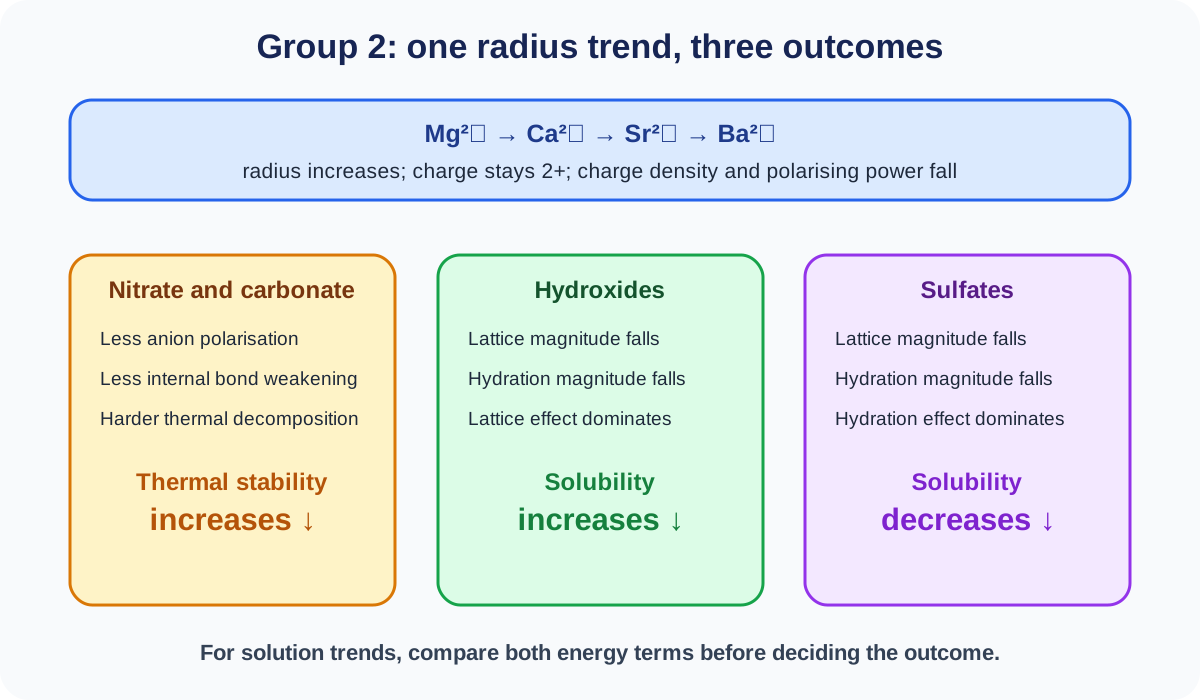
1. The comparison set
Cambridge asks for the Group 2 sequence magnesium, calcium, strontium and barium. Each forms a two-plus ion, so ionic charge remains constant while ionic radius increases down the group.
That controlled change in radius drives the required explanations. A larger ion has lower charge density and attracts nearby electron density less strongly.
Beryllium is not part of this stated comparison, so do not use its atypical chemistry to define the requested trend.
2. Thermal decomposition of carbonates
Group 2 carbonates decompose on heating to the metal oxide and carbon dioxide. The general pattern is metal carbonate giving metal oxide plus carbon dioxide.
Thermal stability increases from magnesium carbonate to barium carbonate. Therefore, progressively stronger heating is needed down the group.
Stability concerns resistance to thermal decomposition, not whether the carbonate is soluble in water.
3. Thermal decomposition of nitrates
Group 2 nitrates decompose on heating to the metal oxide, nitrogen dioxide and oxygen. A balanced general equation uses two nitrate formula units to form two oxide units, four nitrogen dioxide molecules and one oxygen molecule.
The nitrates also become more thermally stable down the group. Magnesium nitrate decomposes more readily than barium nitrate under comparable conditions.
Do not import the different nitrate products used for some Group 1 compounds.
4. Polarisation of the large anion
A small two-plus cation has high charge density and a strong electric field. It attracts electron density in a nearby carbonate or nitrate ion and distorts, or polarises, that large anion.
Polarisation weakens covalent bonding within the anion and makes decomposition easier. The magnesium ion therefore destabilises carbonate or nitrate more than the larger barium ion does.
Down Group 2, cation radius increases, polarising power decreases and anion distortion decreases. Thermal stability consequently increases.
5. Building the thermal-stability explanation
A complete trend explanation has four linked statements: ionic radius increases; charge density decreases because charge stays two-plus; polarising power falls; the large anion is less distorted and decomposes less easily.
Naming only stronger or weaker bonds is insufficient unless the cation-to-anion polarisation link is given.
Check this topic from memory
Attempt the matching topic bank before reopening the notes. Use each missed idea to decide what to review next.
Start the topic quiz