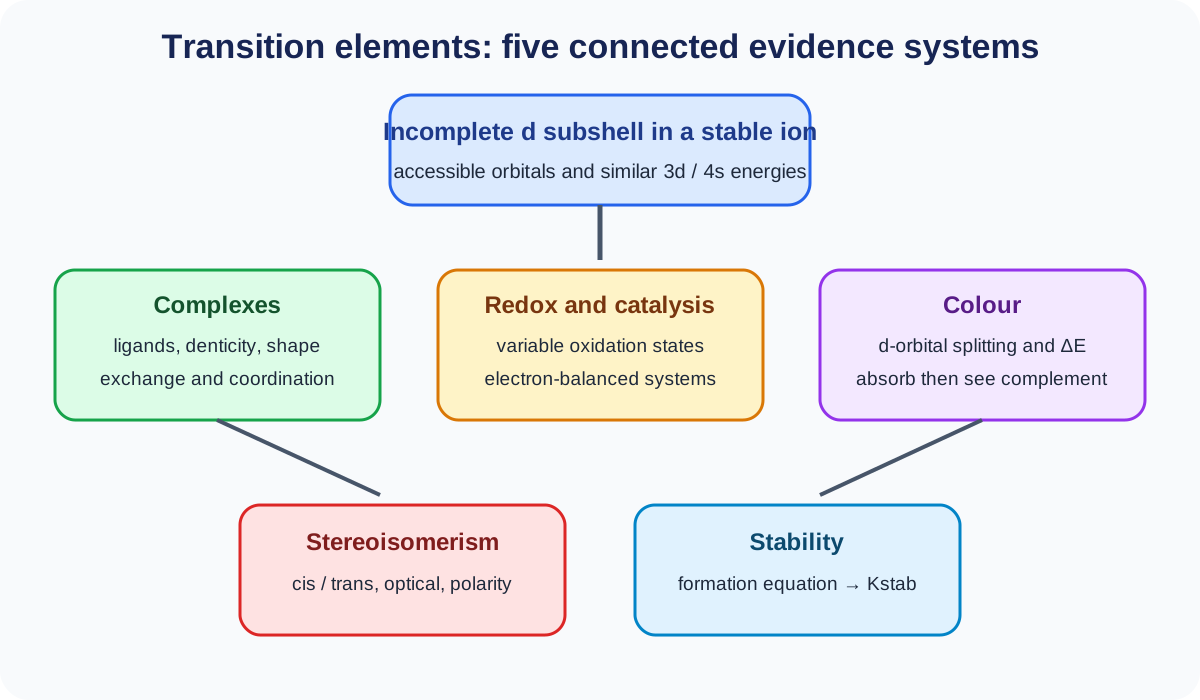
Chemistry of transition elements is Cambridge International Chemistry 9701 Topic 28. The A Level boundary spans first-row transition-element properties, complex formation and exchange, redox systems, colour, stereoisomerism, polarity and stability constants.
1. Transition-element definition
A transition element is a d-block element that forms at least one stable ion with an incomplete d subshell. Position in the d block alone is insufficient.
Scandium commonly forms a d-zero ion and zinc forms a d-ten ion, so neither meets the definition under its usual stable ions. The Cambridge property set concerns titanium to copper.
Always apply the definition to an ion, not merely the neutral atom configuration.
2. The required d orbitals
The 3dxy orbital has four lobes lying between the x and y axes in the xy plane. The 3dz squared orbital has two lobes along the z axis plus a torus around the nucleus in the xy plane.
Label axes and keep opposite lobes as parts of one orbital. These are probability-region shapes, not electron paths.
All five d orbitals have equal energy in an isolated gaseous ion, so they are degenerate before ligand interactions split them.
3. Characteristic properties
Transition elements show variable oxidation states because 3d and 4s energies are similar, so differing numbers of electrons can participate in bonding or ion formation.
They act as catalysts through accessible oxidation states or vacant d orbitals that accept ligand lone pairs. They form complex ions because energetically accessible vacant orbitals accept dative bonds.
They often form coloured compounds because ligand fields split d-orbital energies and suitable light can promote d electrons.
4. Ligands and denticity
A ligand contains a lone pair that forms a dative covalent bond to a central metal atom or ion. Both bonding electrons originate from the ligand.
Monodentate ligands donate through one atom, including water, ammonia, chloride and cyanide. Bidentate ligands bind through two atoms, including 1,2-diaminoethane and ethanedioate. EDTA is polydentate.
Denticity counts donor atoms used by one ligand, not the total number of ligands.
5. Complexes and coordination number
A complex is a molecule or ion in which a central metal atom or ion is surrounded by one or more ligands. Coordination number is the number of dative bonds to the metal.
Six monodentate ligands give coordination number six; three bidentate ligands also give six. Determine overall charge by adding metal oxidation state and all ligand charges.
Check this topic from memory
Attempt the matching topic bank before reopening the notes. Use each missed idea to decide what to review next.
Neutral water and ammonia do not change charge, whereas chloride, cyanide and hydroxide each contribute negative charge.
6. Shapes and angles
Coordination number two is commonly linear with a 180-degree angle. Coordination number four may be tetrahedral with about 109.5 degrees or square planar with 90-degree angles. Coordination number six is octahedral with 90-degree adjacent angles.
Coordination number alone does not distinguish tetrahedral from square planar. Use the complex or evidence given.
Sketch ligands in their correct spatial positions and place the metal centrally.
7. Copper(II) ligand reactions
The aqueous copper(II) ion is represented as a hexaaqua complex. Limited aqueous ammonia or hydroxide removes protons from coordinated water and forms a pale-blue copper(II) hydroxide precipitate.
Excess ammonia dissolves the precipitate through ligand exchange, producing the characteristic deep-blue ammine complex while water ligands remain where required by the accepted formula.
Concentrated chloride can replace water to form a yellow-green tetrachlorocuprate(II) complex in an equilibrium mixture.
8. Cobalt(II) ligand reactions
The aqueous hexaaquacobalt(II) complex is pink. Hydroxide or limited ammonia produces a cobalt(II) hydroxide precipitate through deprotonation chemistry.
Excess ammonia can form an ammine complex. Concentrated chloride shifts ligand exchange toward blue tetrachlorocobaltate(II), which is tetrahedral rather than octahedral.
State whether the observation arises from precipitation, dissolution or ligand exchange rather than listing colour alone.
9. Ligand exchange
Ligand exchange replaces one ligand by another while retaining a metal centre. It can change coordination number, geometry and colour.
Write balanced complex equations with correct ligand counts and charges. Water is a ligand in the initial aqua complex, not an invisible solvent label.
Hydroxide reactions can instead be acid-base deprotonation of coordinated water, so not every observed change is simple substitution.
10. Redox feasibility and calculations
Use standard electrode potentials by pairing a reduction at the cathode with the reverse of another half-equation at the anode. A positive standard cell potential supports thermodynamic feasibility under standard conditions.
For acidic manganate(VII) with ethanedioate or iron(II), balance electrons before combining half-equations. For copper(II) with iodide, account for both iodine formation and copper(I) iodide precipitation.
Convert moles through the electron or equation ratio, not through equal solution volumes.
11. Degenerate and split d orbitals
Degenerate orbitals have equal energy; non-degenerate sets have different energies. Ligand approach causes electrostatic interactions that split the five d orbitals.
In an octahedral complex, two orbitals form the higher set and three form the lower set. In a tetrahedral complex, three are higher and two are lower.
The energy gap is represented by delta E. Do not reverse the number pattern between the two geometries.
12. Origin of colour
A d electron can absorb a photon whose energy matches delta E and move from a lower to a higher split d orbital. The unabsorbed or transmitted light gives the complementary colour observed.
Different ligands produce different splitting magnitudes, changing the absorbed frequency and hence the observed complementary colour.
A colour statement needs the full chain: ligand field, split d orbitals, matching absorption, electron promotion and complementary observed light.
13. Ligand effects on colour
Changing water to ammonia, hydroxide or chloride changes metal-ligand interactions and delta E. Frequency and photon energy therefore change, so the absorbed and observed colours change.
Colour can also change with geometry and oxidation state. Use the supplied complex identities rather than attributing every change solely to concentration.
Copper(II) and cobalt(II) ligand reactions provide the required Cambridge examples connecting exchange to colour.
14. Geometrical isomerism
Square-planar complexes with two pairs of ligands can show cis and trans forms. In cisplatin-type geometry, identical ligands are adjacent in cis and opposite in trans.
Octahedral complexes with two matching ligands can likewise place them adjacent or opposite. Bidentate ligands occupy adjacent positions because both donor atoms belong to one chelate.
Geometrical isomers have the same formula and bonding connections but different spatial arrangements.
15. Optical isomerism
Some octahedral complexes with bidentate ligands form non-superimposable mirror images. Tris(1,2-diaminoethane)nickel(II) is a standard example.
Optical isomerism requires chirality of the whole complex, not merely the presence of a bidentate ligand. Check for symmetry that might make a mirror image superimposable.
Draw three-dimensional ligand paths consistently when identifying an enantiomeric pair.
16. Overall polarity
Bond dipoles combine as vectors. A symmetrical trans or highly regular complex may have cancellation, while a cis arrangement can retain a net dipole.
Polarity depends on geometry and ligand identity, not simply the overall ionic charge. A charged complex can still have a particular internal dipole arrangement.
Use symmetry to decide whether equivalent bond dipoles cancel.
17. Stability constant
Kstab is the equilibrium constant for formation of a complex ion in a solvent from its constituent ions or molecules. Write the formation equation first.
The expression places complex concentration in the numerator and constituent concentrations in the denominator, each raised to its stoichiometric coefficient. Water solvent is omitted.
A large Kstab indicates equilibrium strongly favours the formed complex under the stated conditions.
18. Kstab calculations
Use equilibrium concentrations rather than initial values. Construct a change table when appreciable amounts of free metal or ligand remain.
For a formation using one metal ion and n ligands, the ligand concentration appears to power n. Units, if requested, follow from the concentration powers.
Do not take a large Kstab to mean free ions are mathematically zero unless an approximation has been justified.
19. Stability and ligand exchange
Compare formation equilibria under a consistent solvent and convention. Exchange toward a complex with a substantially larger relevant stability constant is favoured, subject to concentrations and coupled reactions.
The chelate effect often makes multidentate complexes stable, but Cambridge calculations should be based on supplied Kstab data rather than a memorised universal ranking.
Kinetic inertness and thermodynamic stability are different: a favoured complex may still form slowly.
Worked application: formula, colour and stability audit
A metal(II) ion binds three neutral bidentate ligands. Each ligand supplies two donor atoms, so coordination number is six and octahedral geometry is expected; because the ligands are neutral, the complex charge remains two-plus. If two such ligand sets create non-superimposable mirror arrangements, the pair is optically active. Its colour is explained by octahedral splitting into three lower and two higher d orbitals, absorption matching delta E and observation of complementary light. To compare formation with a competing aqua complex, write both formation equations and Kstab expressions, omitting solvent water. The larger appropriate Kstab favours the more stable equilibrium complex, but does not alone state how fast exchange occurs.
Common misconceptions and corrections
Defining every d-block element as transitional. A stable ion must have an incomplete d subshell.
Applying the definition only to neutral atoms. Examine stable ions.
Drawing dxy lobes on the axes. They lie between x and y axes.
Omitting the torus from dz squared. It is part of the required shape.
Explaining variable oxidation states through d electrons alone. Cite similar 3d and 4s energies.
Calling a ligand an electron-pair acceptor. It donates a lone pair.
Counting ligands as coordination number. Count metal-donor bonds.
Treating EDTA as monodentate. It is polydentate.
Ignoring ligand charges in complex charge. Sum every contribution.
Assuming coordination number four fixes shape. It may be tetrahedral or square planar.
Calling every hydroxide precipitate ligand exchange. Coordinated water may be deprotonated.
Saying excess ammonia always leaves a precipitate. Copper(II) precipitate dissolves into a deep-blue complex.
Keeping octahedral geometry after tetrachloro complex formation. The named complexes are tetrahedral.
Predicting redox feasibility by adding two listed reduction potentials. Reverse one role and calculate the cell difference.
Using equal-mole ratios in redox titrations. Balance electrons.
Forgetting copper(I) iodide precipitation. It couples to iodine formation.
Calling split orbitals degenerate. The two sets are non-degenerate.
Reversing octahedral splitting counts. Two are higher and three lower.
Reversing tetrahedral splitting counts. Three are higher and two lower.
Saying compounds show the absorbed colour. The observed colour is complementary.
Explaining colour without electron promotion. Link photon energy to delta E.
Assuming every transition ion is coloured. Electron configuration and transitions matter.
Calling cis and trans different connectivities. They differ spatially.
Assuming every chelate complex is optically active. Whole-complex symmetry decides.
Equating ionic charge with molecular polarity. Use vector cancellation.
Including solvent water in Kstab. Omit it from the expression.
Using initial concentrations in Kstab. Use equilibrium values.
Calling large Kstab fast formation. Stability is thermodynamic, not kinetic.
Comparing unrelated constants without a common formation convention. Align the equilibria first.
Assessment guidance
Begin complex questions with metal oxidation state, ligand charge, denticity, coordination number and geometry. Distinguish ligand exchange from deprotonation or precipitation and balance every complex charge. Redox calculations require balanced half-equations and electron ratios; feasibility requires a correctly signed cell potential. Colour explanations must move from ligand-dependent d-orbital splitting to matching photon absorption, electron promotion and complementary observed colour. For stereoisomers, use spatial geometry and symmetry to decide cis or trans, optical activity and polarity. Write the Kstab formation equation before its equilibrium expression, omit solvent water and use equilibrium concentrations.
Retrieval practice
Apply the transition-element definition to first-row examples, sketch dxy and dz squared, and build formulas and charges from ligand denticity. Reconstruct copper(II) and cobalt(II) reactions with water, ammonia, hydroxide and chloride. Balance the three named redox systems, draw octahedral and tetrahedral splitting, predict complementary colour changes, classify cis, trans and optical isomers, audit polarity by symmetry and solve a Kstab exchange problem from equilibrium concentrations.