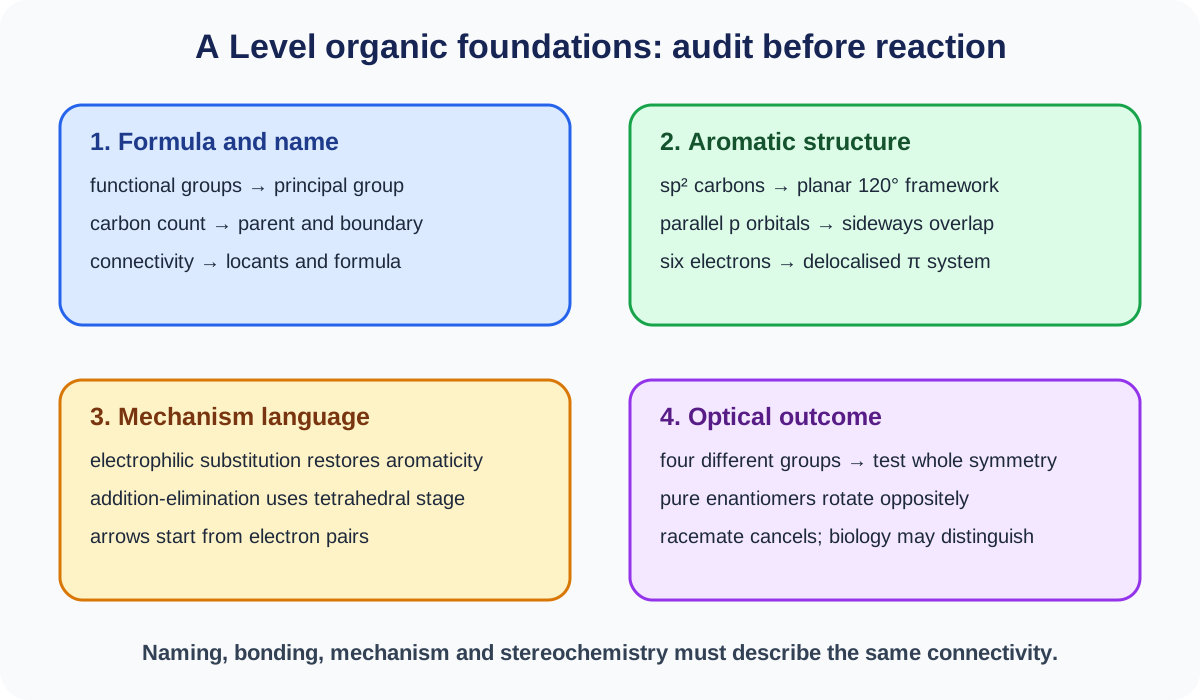
An Introduction to A Level Organic Chemistry is Cambridge International Chemistry 9701 Topic 29. It extends the AS framework to arenes, halogenoarenes, phenols, acyl chlorides, secondary and tertiary amines, amides and amino acids, then adds aromatic nomenclature, electrophilic substitution, addition-elimination and the practical meaning of chirality.
1. Functional groups control behaviour
A functional group is the reactive structural feature that largely determines a homologous series' characteristic physical and chemical properties. The carbon skeleton still affects boiling point, solubility and steric access, but the functional group predicts the central reaction family.
At A Level, identify every functional group before naming or planning reactions. A molecule may contain more than one, and later synthesis questions often depend on selective reaction at one site.
Do not classify by the compound name alone; locate the defining atoms and bonds.
2. Arenes and halogenoarenes
An arene contains an aromatic ring such as benzene. A halogenoarene has a halogen bonded directly to an aromatic carbon.
This direct attachment matters: chlorobenzene is a halogenoarene, while phenylmethyl chloride has chlorine on a side-chain carbon and behaves as a halogenoalkane.
Represent the benzene ring consistently in structural or skeletal formulae and preserve all substituent positions.
3. Phenols
A phenol contains a hydroxyl group directly bonded to an aromatic ring. Phenol is therefore different from an alcohol whose hydroxyl-bearing carbon is aliphatic.
Ring delocalisation affects acidity and substitution chemistry. The functional-group label must follow connectivity, not simply the presence of oxygen and hydrogen.
Number substituted phenols from the carbon bearing hydroxyl as carbon 1 and choose the lowest locants.
4. Acyl chlorides and amides
An acyl chloride contains the carbonyl-chlorine unit, while an amide contains a carbonyl carbon bonded to nitrogen. Primary, secondary and tertiary amides differ by substitution on nitrogen.
The syllabus requires naming simple amides but does not require systematic naming of secondary and tertiary amines. It still expects recognition of those amine classes.
Keep acyl chlorides distinct from halogenoalkanes because chlorine is attached to the carbonyl carbon.
5. Amines and amino acids
Secondary and tertiary amines contain nitrogen bonded to two or three carbon groups respectively. Their lone pair remains central to basicity and nucleophilic behaviour.
An amino acid in this boundary contains both amine and carboxyl groups. Number from the carboxyl carbon when constructing a systematic name, then locate the amino substituent.
Check this topic from memory
Attempt the matching topic bank before reopening the notes. Use each missed idea to decide what to review next.
Do not call an amide an amine: the carbonyl directly attached to nitrogen changes the functional group.
6. Formula representations
General formulae describe a homologous series. Structural formulae show connectivity in condensed form, displayed formulae show every atom and bond, and skeletal formulae show the carbon framework with carbon-bound hydrogens omitted.
Translate without changing connectivity, carbon count, multiple bonds or functional-group placement. A benzene ring need not be expanded into a fully displayed alternating-bond drawing in the stated table context.
At every endpoint and vertex of a skeletal line, account for the implied carbon and enough hydrogen to complete valency.
7. Aliphatic naming boundary
Cambridge requires simple aliphatic molecules up to six carbon atoms, including cyclic compounds with one ring of up to six carbons. Esters and amides may contain six plus six carbons across their fragments.
Esters and nitriles are restricted to straight chains in this naming outcome. Choose the parent containing the highest-priority functional group, number for the lowest relevant locant and alphabetise substituent prefixes.
Respect explicit naming exclusions rather than inventing more advanced conventions.
8. Aromatic nomenclature
For a simple molecule with one benzene ring, identify the principal group and make its ring carbon position 1 where appropriate. Assign substituents the lowest possible locant set.
Names such as 3-nitrobenzoic acid and 2,4,6-tribromophenol encode exact relative positions. Ortho, meta and para language may aid reasoning, but systematic locants provide unambiguous answers.
Retain repeated-substituent prefixes such as di and tri without using them to determine alphabetic order.
9. Electrophilic substitution
Electrophilic substitution replaces an atom, usually ring hydrogen, by an electrophile while preserving aromaticity overall. The aromatic pi system first donates electron density to the electrophile.
An intermediate temporarily loses full delocalisation, then proton loss restores the aromatic system. This is substitution rather than addition because the ring regains its delocalised structure.
Curly arrows must start at an electron pair or bond and finish at the atom or bond receiving those electrons.
10. Addition-elimination
Addition-elimination involves nucleophilic addition to an acyl carbon followed by elimination that reforms the carbonyl. Acyl chloride reactions provide a central example.
The carbonyl carbon is electrophilic because the carbon-oxygen bond is polar. After nucleophile attack, a tetrahedral intermediate forms, then the leaving group departs.
Do not compress the mechanism into direct substitution if the question asks for the addition and elimination stages.
11. Benzene geometry
Each carbon in benzene is sp2 hybridised and trigonal planar. The ring is planar with bond angles about 120 degrees.
Each carbon uses three sp2 orbitals for sigma bonding and retains one unhybridised p orbital perpendicular to the ring plane. Side groups directly attached at an sp2 carbon begin in the same local plane unless steric or structural evidence alters the wider molecule.
Planarity allows neighbouring p orbitals to overlap continuously.
12. Sigma and delocalised pi systems
Sigma bonds form the carbon-carbon and carbon-hydrogen framework through head-on orbital overlap. The six parallel p orbitals overlap sideways above and below the ring.
Their electrons form a delocalised pi system spread across all six carbons. Consequently, benzene's carbon-carbon bonds are equivalent and intermediate between simple single and double bonds.
Avoid describing three isolated double bonds that stay fixed in place.
13. Enantiomers
Enantiomers are non-superimposable mirror images. A tetrahedral carbon bonded to four different groups is a common chiral centre, but the whole molecule must still be checked for symmetry.
The two enantiomers have identical physical and chemical properties in achiral environments apart from rotating plane-polarised light in opposite directions. They may behave differently with chiral biological targets.
The direction of rotation cannot be predicted from a simple wedge-and-dash drawing without experimental or assigned information.
14. Optically active substances
An optically active sample rotates the plane of plane-polarised light. Pure enantiomers rotate by equal magnitudes in opposite directions under identical conditions.
Observed rotation depends on concentration, path length, temperature and wavelength as well as identity. Opposite rotation does not mean different ordinary boiling points or solubilities in achiral media.
A sample with net enantiomeric imbalance can be optically active even if it is not a pure enantiomer.
15. Racemic mixtures
A racemic mixture contains equal amounts of two enantiomers. Their equal and opposite rotations cancel, so the mixture is optically inactive by external compensation.
The individual molecules remain chiral; the sample is not inactive because every molecule has become achiral.
Ordinary achiral separation methods struggle because the enantiomers have matching bulk physical properties.
16. Chirality in medicines
Biological receptors, enzymes and transport proteins are chiral. Two drug enantiomers may therefore bind differently and show different therapeutic effects, potency, metabolism or adverse effects.
It is unsafe to assume the second enantiomer is merely inactive; its activity must be evaluated. Drug preparation and quality control may need a defined enantiomeric composition.
This application links molecular three-dimensional arrangement to biological selectivity.
17. Resolving a racemate
Resolution separates a racemic mixture into its enantiomers, often by temporarily interacting with a single chiral substance to create species with different properties.
After separation, the auxiliary interaction is reversed and enantiomeric purity is checked. The syllabus requires the need for separation, not detailed industrial resolution protocols.
Yield is an important issue because a racemate initially contains only half of each desired enantiomer.
18. Chiral catalysts
A chiral catalyst creates an asymmetric environment in which two mirror-related pathways no longer have equal activation energies. One enantiomer can therefore form preferentially.
This asymmetric synthesis can avoid producing a full racemate and reduce later separation demand. The catalyst is regenerated and does not become a stoichiometric part of the product.
Producing one preferred enantiomer is a selectivity claim, not automatic proof of absolute purity.
Worked application: auditing an aromatic chiral target
A target contains one benzene ring bearing a carboxyl group at carbon 1, a nitro group at carbon 3 and a side chain with a tetrahedral carbon attached to hydrogen, methyl, hydroxyl and the aromatic group. The aromatic parent is numbered from the carboxyl carbon, so the nitro locant is retained in a name such as 3-nitrobenzoic-acid derivative. The side-chain carbon is chiral because its four groups differ. Its two enantiomers share ordinary properties in achiral conditions but rotate plane-polarised light oppositely and may interact differently with a receptor. A racemic synthesis gives no net rotation; resolution or an enantioselective chiral catalyst is needed when one biological enantiomer is required.
Common misconceptions and corrections
Classifying by atoms present rather than connectivity. Locate the defining bonds.
Calling side-chain chloride a halogenoarene. Halogen must bond directly to the ring.
Calling phenol an ordinary alcohol. Hydroxyl is bonded directly to aromatic carbon.
Calling an amide an amine. Carbonyl attachment changes the group.
Treating acyl chloride as a halogenoalkane. Chlorine is attached to carbonyl carbon.
Requiring names for secondary and tertiary amines. Their systematic naming is excluded here.
Losing carbons in skeletal conversion. Count endpoints and vertices.
Drawing carbon-bound hydrogens on every skeletal carbon. They are implied.
Ignoring the six-carbon naming boundary. Apply the stated scope.
Using branched ester or nitrile naming beyond the outcome. Those classes are straight-chain here.
Numbering an aromatic ring from an arbitrary substituent. Start from the principal group.
Dropping repeated aromatic locants. Preserve every position.
Calling benzene attack electrophilic addition overall. Aromaticity is restored by substitution.
Starting a curly arrow at positive charge. It starts from electrons.
Skipping the tetrahedral stage in addition-elimination. Addition precedes leaving-group loss.
Calling every carbon in benzene sp3. Ring carbons are sp2.
Drawing benzene as non-planar. Continuous p overlap requires planarity.
Treating pi electrons as three fixed pairs. They are delocalised.
Saying benzene has alternating bond lengths. Its ring bonds are equivalent.
Calling any carbon with four bonds chiral. Four groups must differ.
Assuming a chiral centre guarantees a chiral molecule. Check whole-molecule symmetry.
Saying enantiomers have different boiling points in achiral media. Their ordinary properties match.
Predicting rotation direction from a basic drawing. It needs assigned or experimental evidence.
Calling each molecule in a racemate achiral. Molecular chirality remains.
Saying a racemate contains one inactive isomer. Rotations cancel collectively.
Assuming the unwanted drug enantiomer is harmless. Biological effects can differ.
Using distillation to resolve ordinary enantiomers. Their achiral physical properties match.
Calling a chiral catalyst part of the product. It is regenerated.
Equating preference with complete enantiopurity. Selectivity may be less than total.
Assessment guidance
Begin with an exact functional-group and carbon-count audit, then apply the stated naming boundaries and locants. Mechanism answers need correct terminology and electron-flow arrows: aromatic attack must restore delocalisation, while acyl substitution must show addition then elimination. Benzene explanations should connect sp2 planarity, sigma framework, parallel p orbitals and a delocalised pi system. Optical-isomer answers must distinguish molecular chirality, pure-enantiomer rotation and racemic cancellation. Drug contexts require different potential biological activity plus a justified route through resolution or asymmetric synthesis with a chiral catalyst.
Retrieval practice
Translate each new A Level functional group among structural, displayed and skeletal formulae, then name bounded aliphatic, cyclic and substituted aromatic examples. Draw electron flow for electrophilic substitution and addition-elimination, reconstruct benzene bonding from hybridisation and diagnose chiral centres without assuming every candidate is active. Compare pure enantiomers with a racemate, explain biological selectivity and decide whether resolution or a chiral catalyst better addresses a stated drug-manufacturing problem.
Cambridge International, Chemistry 9701 syllabus for examinations in 2025, 2026 and 2027, the Topic 29 functional-group table and sections 29.1 to 29.4 for formulas and naming, characteristic reactions, aromatic shape and bonding, and optical isomerism.