Cambridge International AS and A Level Chemistry 32: Hydroxy compounds
Cambridge International AS and A Level Chemistry 32: Hydroxy compounds
Study guide/
Cambridge International Chemistry 9701 notes on alcohol acylation, phenol preparation and reactions, phenol acidity, ring activation and directing effects.
Hydroxy Compounds is Cambridge International Chemistry 9701 Topic 32. The A Level boundary adds alcohol acylation and develops phenol through diazonium-salt preparation, acid-base reactions, azo coupling, nitration, bromination, acidity, ring activation and application to other phenolic compounds.
1. Alcohols with acyl chlorides
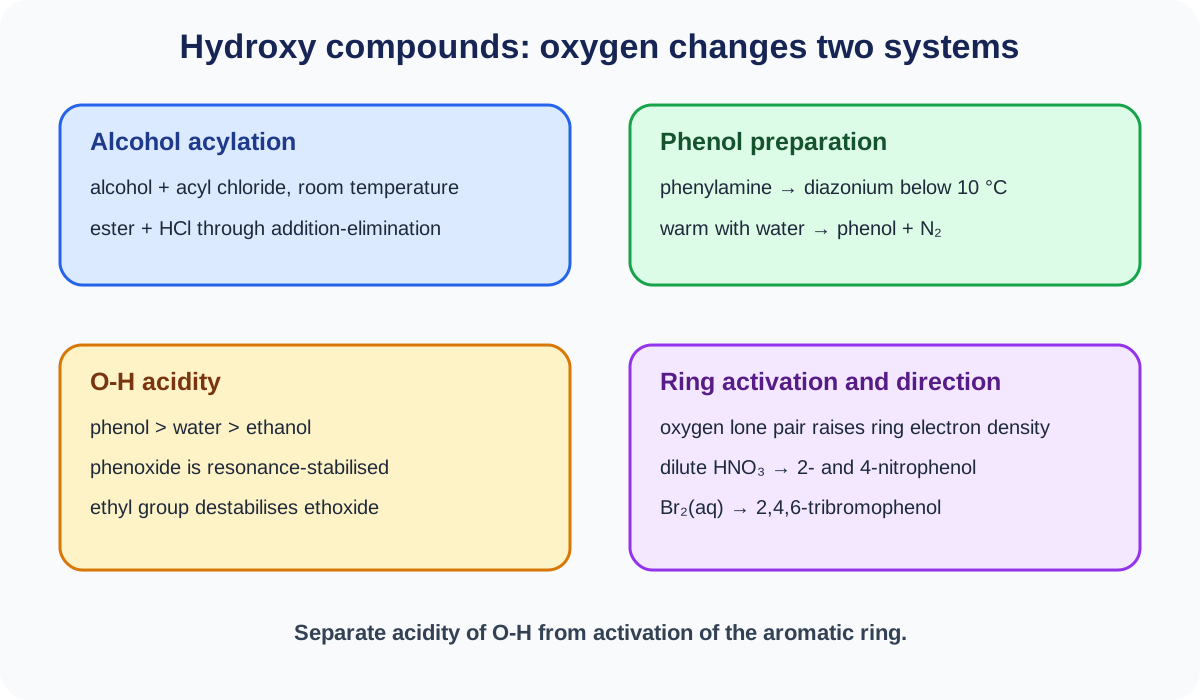
An alcohol reacts with an acyl chloride at room temperature to form an ester and hydrogen chloride. Ethanol plus ethanoyl chloride gives ethyl ethanoate.
The alcohol oxygen attacks the electrophilic carbonyl carbon. Addition is followed by elimination of chloride and proton transfer, so the carbonyl is restored.
This route is rapid and does not require the concentrated sulfuric acid and reflux associated with reversible carboxylic-acid esterification.
2. Recognising phenol
Phenol has hydroxyl bonded directly to an aromatic carbon. An aromatic molecule with hydroxyl on a side-chain carbon is an alcohol instead.
Direct ring attachment allows an oxygen lone pair to interact with the delocalised pi system. That interaction affects both O-H acidity and ring reactivity.
Connectivity therefore explains why phenol cannot be treated as merely an aromatic-looking ethanol.
3. Phenylamine to diazonium salt
Phenylamine reacts with nitrous acid below 10 degrees Celsius to form a benzenediazonium salt. Nitrous acid is commonly generated in situ from sodium nitrite and dilute acid.
The low temperature keeps the diazonium salt sufficiently stable for use. Warming too early causes decomposition before the intended intermediate is established.
State both the nitrite-acid reagents and the below-10-degree condition.
4. Diazonium salt to phenol
Further warming the aqueous diazonium salt replaces the diazonium group with hydroxyl, producing phenol and nitrogen gas.
This is a two-stage preparation: cold diazotisation first, then warming with water. Combining the stages without their different temperatures loses the control logic.
Effervescence of nitrogen is evidence for decomposition of the diazonium intermediate.
5. Phenol with aqueous alkali
Phenol reacts with aqueous sodium hydroxide to form sodium phenoxide and water. This shows phenol is acidic enough to be deprotonated by hydroxide.
Ethanol does not react appreciably with aqueous sodium hydroxide under the same conditions because ethoxide is less stabilised relative to ethanol.
The product charge is delocalised through resonance involving the aromatic ring.
6. Phenol with sodium
Phenol reacts with sodium metal to form sodium phenoxide and hydrogen gas. Two phenol molecules produce one hydrogen molecule.
Check this topic from memory
Attempt the matching topic bank before reopening the notes. Use each missed idea to decide what to review next.
Alcohols and water also react with sodium, so this observation alone does not uniquely identify phenol. It demonstrates the presence of a removable O-H proton.
Balance hydrogen stoichiometry and do not write hydrogen atoms as the gaseous product.
7. Azo coupling
In aqueous sodium hydroxide, phenol forms phenoxide, whose ring is strongly activated. It couples with a diazonium salt to form an azo compound containing the nitrogen-nitrogen linkage.
Coupling occurs predominantly at an activated ring position, commonly position 4 when available. The extended conjugated system often gives an intensely coloured product.
Keep azo coupling distinct from the hydrolysis route that converts a diazonium salt into phenol.
8. Nitration of phenol
Phenol reacts with dilute aqueous nitric acid at room temperature to give a mixture of 2-nitrophenol and 4-nitrophenol.
These conditions are much milder than benzene nitration, which needs concentrated nitric and sulfuric acids. The hydroxyl group activates the ring and directs substitution toward positions 2 and 4.
Do not predict 3-nitrophenol as the principal product from an unsubstituted phenol.
9. Bromination of phenol
Phenol reacts readily with aqueous bromine at room temperature to form 2,4,6-tribromophenol. Bromine water is decolourised and a white precipitate forms.
No aluminium bromide catalyst is needed because the hydroxyl group strongly activates the ring. All three available 2,4,6 positions are substituted under these conditions.
This contrasts with benzene, which needs a Lewis-acid catalyst and usually gives monosubstitution.
10. Why phenol is acidic
Loss of a proton gives phenoxide. An oxygen lone pair and negative charge can interact with the aromatic pi system, distributing electron density across several resonance contributors.
The conjugate base is therefore stabilised relative to a localised alkoxide ion. Greater conjugate-base stability shifts proton loss further toward products.
Do not say the negative charge disappears; it is delocalised over the ion.
11. Ethanol, water and phenol acidity
Phenol is more acidic than water, and water is more acidic than ethanol in the required comparison.
Phenoxide is resonance-stabilised, making phenol distinctly more acidic. The ethyl group donates electron density toward oxygen, destabilising the negative charge on ethoxide, so ethanol is less acidic than water.
The comparison must focus on conjugate-base stability rather than O-H bond polarity alone.
12. Ring activation by hydroxyl
An oxygen lone pair donates electron density into the benzene ring. This raises electron density, especially at positions 2, 4 and 6, and stabilises substitution intermediates formed by attack there.
Electrophiles can therefore attack phenol under milder conditions than benzene. The same donation that stabilises phenoxide through resonance also changes the neutral phenol ring's reactivity, though the species and direction of reasoning must not be conflated.
Number the carbon bearing hydroxyl as carbon 1. The adjacent positions are 2 and 6, while the opposite position is 4.
Hydroxyl directs electrophilic substitution to all three of these positions. Nitration under mild conditions gives mainly mono-substituted 2 and 4 products, while bromine water gives the 2,4,6 trisubstituted product.
Product multiplicity depends on reagent and conditions, not directing preference alone.
14. Applying phenol chemistry to naphthol
Naphthol is a phenolic compound because hydroxyl is attached directly to a fused aromatic system. Its oxygen can show analogous acidity and ring activation.
Use electron donation and stabilisation principles to predict reactions, then account for the fused-ring positions given in the problem. Do not assume every numerical position maps directly from benzene numbering.
Transfer the chemistry by functional group and electronic effect, not by copying one product formula.
15. Tests and observations as evidence
Phenol dissolving in sodium hydroxide supports acidic deprotonation. Bromine-water decolourisation with a white precipitate supports rapid multiple aromatic substitution.
These observations must be tied to equations or structures. Bromine decolourisation alone can also occur with alkenes, so the precipitated 2,4,6-tribromophenol and substrate context matter.
Use multiple independent observations when identifying an unknown hydroxy compound.
Worked application: distinguishing ethanol and phenol, then planning a derivative
Two colourless samples both react with sodium metal, so that test does not distinguish them. Only phenol reacts with aqueous sodium hydroxide to form a soluble phenoxide salt because its conjugate base is resonance-stabilised; ethanol remains largely unchanged because ethoxide is destabilised by the electron-donating ethyl group. Bromine water then gives phenol a white precipitate of 2,4,6-tribromophenol without aluminium bromide. To make an azo dye, first generate a diazonium salt from phenylamine with sodium nitrite and dilute acid below 10 degrees Celsius, then couple it with phenol in sodium hydroxide. Warming that diazonium salt with water instead would produce phenol and nitrogen, not the azo product.
Common misconceptions and corrections
Using carboxylic-acid esterification conditions for an acyl chloride. Alcohol acylation is rapid at room temperature.
Calling phenol an alcohol. Hydroxyl is directly attached to aromatic carbon.
Diazotising above 10 degrees Celsius. Keep the first stage cold.
Naming nitric acid as a stored reagent without its generation route. Sodium nitrite and dilute acid form it in situ.
Warming before the diazonium salt forms. Separate the cold and warm stages.
Omitting nitrogen gas from diazonium hydrolysis. It is a key product.
Saying phenol cannot react with sodium hydroxide. It forms phenoxide.
Using sodium metal as a unique phenol test. Alcohols and water also release hydrogen.
Balancing one phenol to one hydrogen molecule. Two O-H groups give one hydrogen molecule.
Confusing azo coupling with diazonium hydrolysis. Conditions and products differ.
Nitrating phenol with the benzene acid mixture. Use dilute nitric acid at room temperature.
Predicting mainly 3-nitrophenol. Hydroxyl directs to 2 and 4.
Requiring aluminium bromide for phenol. Bromine water reacts without it.
Predicting only bromophenol. The named product is 2,4,6-tribromophenol.
Calling bromination an addition. It is aromatic substitution.
Saying resonance removes negative charge. It distributes it.
Explaining acidity from O-H polarity alone. Compare conjugate-base stability.
Calling ethanol more acidic than water. Its ethyl group destabilises ethoxide.
Saying phenol and water have equal acidity. Phenoxide resonance makes phenol stronger.
Using activation and directing as synonyms. One concerns rate, the other position.
Assuming 2,4,6 direction always gives three substituents. Conditions control extent.
Copying benzene numbering directly onto naphthol. Apply principles to the supplied fused structure.
Using bromine decolourisation alone to prove phenol. Alkenes can also decolourise bromine.
Assessment guidance
For alcohol acylation, state acyl chloride, room temperature, ester and hydrogen chloride. Phenol preparation must separate cold diazotisation below 10 degrees Celsius from warming the diazonium salt with water. Reaction answers need exact observations and products for sodium hydroxide, sodium, azo coupling, dilute nitric acid and bromine water. Acidity explanations should compare phenoxide resonance stabilisation with water and electron-donating destabilisation of ethoxide. Explain milder aromatic-substitution conditions through hydroxyl lone-pair donation, increased ring electron density and 2,4,6 direction, while allowing reagent conditions to determine mono- or trisubstitution.
Retrieval practice
Write the ethyl-ethanoate acyl-chloride route and the two-stage phenylamine-to-phenol sequence. Build balanced or structural equations for every named phenol reaction and attach observations. Rank ethanol, water and phenol acidity from conjugate-base evidence, then explain why phenol nitrates and brominates more readily than benzene. Predict products for substituted phenols and a supplied naphthol by combining directing effects with occupied positions and reaction conditions.