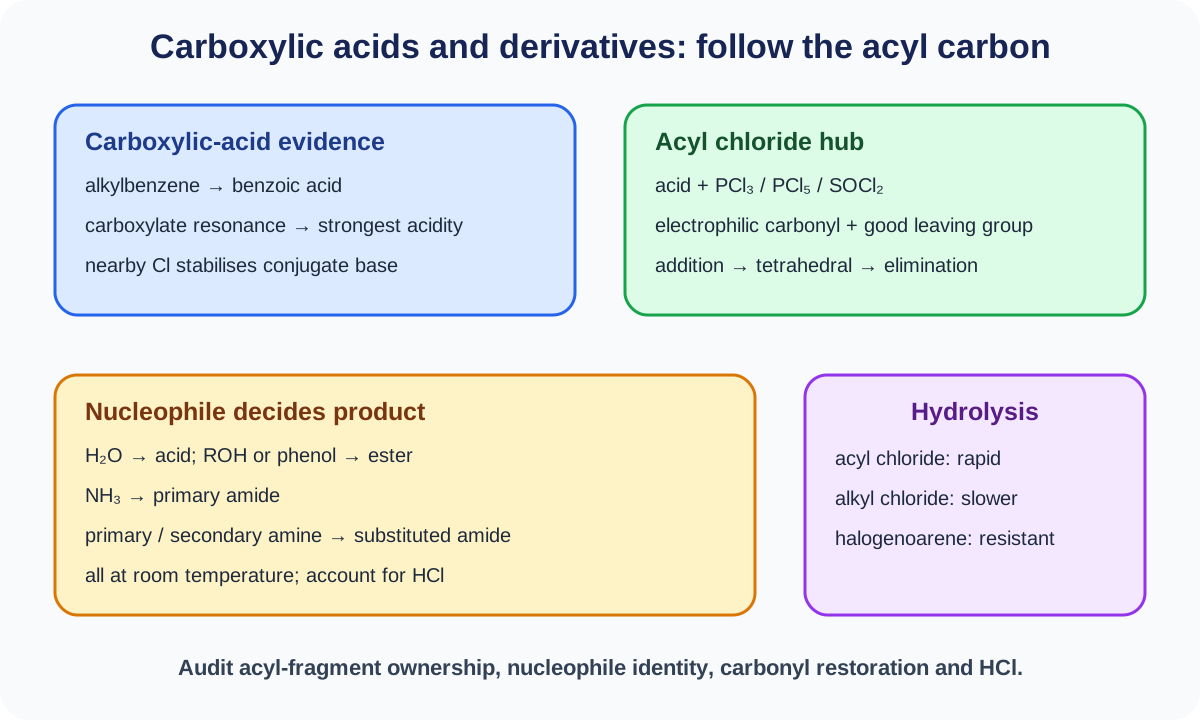
Carboxylic Acids and Derivatives is Cambridge International Chemistry 9701 Topic 33. The A Level boundary covers benzoic-acid formation, oxidisable acids, acidity trends, ester formation and the preparation, reactions, mechanisms and comparative hydrolysis of acyl chlorides.
1. Alkylbenzene to benzoic acid
Heat an alkylbenzene such as methylbenzene with alkaline potassium manganate(VII), then add dilute acid. The side chain is oxidised to benzoate in alkaline solution and acidification gives benzoic acid.
The aromatic ring remains intact. The carbon attached to the ring becomes the carboxyl carbon, so the rest of an oxidisable side chain is removed during complete oxidation.
Always include the acid work-up rather than reporting only the carboxylate salt.
2. Making acyl chlorides from acids
Carboxylic acids form acyl chlorides with phosphorus trichloride and heat, phosphorus pentachloride, or thionyl chloride.
The hydroxyl part of the carboxyl group is replaced by chlorine while the carbonyl remains. Product formulas must preserve the original acyl carbon skeleton.
Thionyl chloride is convenient because its sulfur dioxide and hydrogen chloride by-products are gases, aiding product separation.
3. Oxidation of methanoic acid
Methanoic acid is unusual because its carboxyl carbon still bears hydrogen and can be oxidised further to carbon dioxide and water.
It reduces Fehling reagent or Tollens reagent and is also oxidised by acidified potassium manganate(VII) or acidified potassium dichromate(VI).
Positive aldehyde-type reagent results here do not mean methanoic acid contains an aldehyde functional group; they show its reducing ability.
4. Oxidation of ethanedioic acid
Warm acidified potassium manganate(VII) oxidises ethanedioic acid to carbon dioxide. Both carbons are already highly oxidised but can reach carbon dioxide.
The purple manganate(VII) colour is discharged as reduction occurs under suitable acidic conditions.
Distinguish the two-carbon diacid from ethanoic acid, which does not show the same specified oxidation.
5. Carboxylic-acid acidity
Carboxylic acids lose a proton to form carboxylate ions. The negative charge is delocalised over two equivalent oxygen atoms.
This strong resonance stabilisation makes carboxylate more stable than phenoxide, whose charge is shared less effectively into carbon atoms, and much more stable than localised alkoxide.
Thus carboxylic acids are more acidic than phenols, which are more acidic than alcohols.
6. Chlorine substituents and acidity
Check this topic from memory
Attempt the matching topic bank before reopening the notes. Use each missed idea to decide what to review next.
Chlorine withdraws electron density inductively through sigma bonds. It stabilises the negative charge of a carboxylate conjugate base and increases acidity.
More chlorine substituents generally strengthen the effect. A chlorine closer to the carboxyl group has a greater influence because induction weakens with bond distance.
Compare structures before comparing pKa, and do not treat chlorine as electron-donating in this context.
7. Esters from alcohols and acyl chlorides
An alcohol reacts with an acyl chloride at room temperature to produce an ester and hydrogen chloride. Ethanol with ethanoyl chloride gives ethyl ethanoate.
The alcohol supplies the alkoxy part of the ester; the acyl chloride supplies the carbonyl-containing acyl part.
This rapid, effectively one-way route differs from reversible acid-catalysed esterification.
8. Phenyl benzoate formation
Phenol reacts with benzoyl chloride at room temperature to form phenyl benzoate and hydrogen chloride.
Benzoyl chloride supplies the benzoate acyl fragment, while phenol supplies the phenoxy fragment. Naming and structures should preserve that ownership.
Phenol is less nucleophilic than a typical aliphatic alcohol, but reactive acyl chlorides still undergo the reaction readily.
9. Acyl chloride hydrolysis
Water attacks an acyl chloride at room temperature, giving the corresponding carboxylic acid and hydrogen chloride. The reaction is rapid and may produce acidic fumes.
The carbonyl carbon is strongly electrophilic because both oxygen and chlorine withdraw electron density. Chloride is also an effective leaving group.
Moisture therefore destroys acyl chlorides, so dry handling is important before intentional reaction.
10. Acyl chlorides with ammonia
Ammonia reacts at room temperature to form a primary amide. Hydrogen chloride is also produced and reacts with excess ammonia to form ammonium chloride.
Using excess ammonia both supplies the nucleophile and neutralises acid. When writing a full equation, account for the additional ammonia needed for the salt.
The carbonyl group remains in the amide product.
11. Acyl chlorides with primary amines
A primary amine attacks an acyl chloride to form an N-substituted amide. A second amine molecule can neutralise hydrogen chloride to give an ammonium salt.
The carbon group originally attached to nitrogen remains attached in the product. Do not name the product as a primary unsubstituted amide.
This is condensation in the syllabus sense because two organic fragments join while a small molecule is eliminated.
12. Acyl chlorides with secondary amines
A secondary amine forms an N,N-disubstituted amide at room temperature. Its nitrogen has no N-H bond remaining in the neutral amide product.
Tertiary amines cannot form the same neutral amide through simple replacement because they lack an N-H proton and already have three carbon substituents.
Track every nitrogen substituent during structure construction.
13. Addition-elimination mechanism
The nucleophile lone pair attacks the electrophilic carbonyl carbon and the carbon-oxygen pi electrons move to oxygen. A tetrahedral intermediate forms.
The oxygen lone pair reforms the carbonyl, eliminating chloride. Proton transfer then gives the neutral acid derivative and hydrogen chloride or its salt.
Curly arrows start from electron pairs. Show both addition and elimination rather than a one-step direct displacement.
14. Applying one mechanism to five nucleophiles
Water gives a carboxylic acid, alcohol or phenol gives an ester, ammonia gives a primary amide, and primary or secondary amine gives a substituted amide.
The shared mechanism is nucleophilic addition-elimination at the acyl carbon. The nucleophile identity determines the group retained after chloride leaves.
This unifies the reaction family more reliably than memorising five disconnected equations.
15. Relative hydrolysis: acyl chloride and alkyl chloride
Acyl chlorides hydrolyse much more readily than alkyl chlorides. Their carbonyl carbon is strongly electron-deficient and attack leads to a tetrahedral intermediate that can eliminate stable chloride while restoring the carbonyl.
Alkyl chlorides react by SN1 or SN2 routes at saturated carbon and lack carbonyl activation. Their rates depend on structure and conditions.
Do not explain acyl reactivity only by a weak carbon-chlorine bond; electrophilicity and addition-elimination are central.
16. Relative hydrolysis: halogenoarene
Halogenoarenes such as chlorobenzene are least reactive under ordinary hydrolysis conditions. Chlorine lone-pair overlap with the aromatic system gives partial double-bond character and strengthens the carbon-chlorine bond.
Ordinary SN1 would require an unstable phenyl cation, while ordinary SN2 backside attack at the sp2 ring carbon is unfavourable.
The qualitative order is acyl chloride most readily hydrolysed, then suitable alkyl chloride, with halogenoarene much less reactive.
17. Evidence-led product audit
For any acyl chloride question, identify the acyl fragment, classify the nucleophile and predict the retained nucleophilic atom or group. Then balance hydrogen chloride or its ammonium salt.
Use product class as a cross-check: oxygen nucleophiles yield acid or ester, while nitrogen nucleophiles yield amide.
Finally confirm the carbonyl and total carbon skeleton have been preserved.
Worked application: selecting and validating an acyl route
A synthesis needs phenyl benzoate and an N-ethyl amide from benzoic acid. First convert benzoic acid to benzoyl chloride using thionyl chloride. Reaction with phenol at room temperature gives phenyl benzoate and hydrogen chloride; the benzoyl fragment owns the carbonyl side and phenol supplies phenoxy. In a separate portion, ethylamine attacks benzoyl chloride and gives N-ethylbenzamide, with excess ethylamine neutralising hydrogen chloride. Both use addition-elimination: nucleophile attack forms a tetrahedral intermediate, carbonyl re-formation eliminates chloride and proton transfer completes the product. Water contamination instead hydrolyses benzoyl chloride rapidly back to benzoic acid because its electrophilic acyl carbon is far more reactive than the saturated carbon of chloroethane or the sp2 carbon of chlorobenzene.
Common misconceptions and corrections
Stopping alkaline side-chain oxidation at benzoate. Acidify to obtain benzoic acid.
Oxidising the aromatic ring rather than the side chain. The ring remains.
Removing the carbonyl when forming an acyl chloride. Only hydroxyl is replaced.
Calling methanoic acid an aldehyde. It is a carboxylic acid with reducing behaviour.
Predicting ethanoic acid gives the ethanedioic-acid reaction. The specified substrates differ.
Ranking phenol above carboxylic acid in acidity. Carboxylate is more strongly stabilised.
Saying carboxylate charge sits on one oxygen. It is shared over two equivalent oxygens.
Calling chlorine electron-donating. Its inductive effect withdraws electron density.
Ignoring chlorine distance from COOH. Induction weakens with distance.
Reversing ester fragment ownership. Acyl chloride supplies the carbonyl fragment.
Using reflux and sulfuric acid for acyl-chloride ester formation. Room temperature is sufficient.
Naming phenyl benzoate as benzyl benzoate. Phenyl and benzyl connect differently.
Omitting hydrogen chloride from acyl reactions. It is produced or neutralised.
Using one ammonia molecule in the complete salt equation. Excess ammonia captures HCl.
Losing the primary-amine carbon group. It remains on amide nitrogen.
Making an unsubstituted amide from a secondary amine. It gives N,N-disubstitution.
Treating tertiary amines like primary amines. They lack the required N-H outcome.
Drawing direct one-step substitution at acyl carbon. Show addition then elimination.
Starting curly arrows at positive charge. Start from electron pairs.
Failing to reform the carbonyl. It returns during chloride elimination.
Calling chloride the attacking nucleophile in hydrolysis. Water attacks the acyl carbon.
Explaining acyl hydrolysis only by bond weakness. Carbonyl activation is central.
Calling alkyl and acyl chloride mechanisms identical. They use different pathways.
Saying chlorobenzene has a non-polar bond. Partial double character, not non-polarity, impedes reaction.
Claiming halogenoarenes can never hydrolyse. They are much less reactive under ordinary conditions.
Comparing hydrolysis without common conditions. State the qualitative controlled comparison.
Assessment guidance
Preparation answers should include alkaline manganate then acid work-up for benzoic acid and an accepted phosphorus or sulfur chlorinating reagent for acyl chloride. Acidity comparisons need conjugate-base structures, resonance and chlorine's distance-dependent inductive effect. For acyl reactions, identify nucleophile, product class, room-temperature condition and hydrogen chloride handling. Mechanisms require nucleophilic attack, a tetrahedral intermediate, carbonyl re-formation, chloride elimination and proton transfer. Comparative hydrolysis answers should connect acyl electrophilicity to addition-elimination, alkyl chloride to ordinary substitution and halogenoarene resistance to sp2 bonding and lone-pair delocalisation.
Retrieval practice
Construct the methylbenzene-to-benzoic-acid and acid-to-acyl-chloride routes, then explain the unusual oxidations of methanoic and ethanedioic acids. Rank acids using resonance and inductive evidence. For each of water, alcohol, phenol, ammonia, primary amine and secondary amine, draw the acyl product and mechanism. Finish by comparing hydrolysis across acyl chloride, chloroalkane and chlorobenzene using both bond structure and mechanism accessibility.