Cambridge International AS and A Level Chemistry 34: Nitrogen compounds
Cambridge International AS and A Level Chemistry 34: Nitrogen compounds
Study guide/
Cambridge International Chemistry 9701 notes on amine preparation and basicity, phenylamine, azo dyes, amides, amino-acid zwitterions, peptides and electrophoresis.
Nitrogen Compounds is Cambridge International Chemistry 9701 Topic 34. The A Level boundary covers primary and secondary amines, phenylamine and azo chemistry, amide formation, hydrolysis and reduction, and amino-acid zwitterions, isoelectric points, peptide bonds and electrophoresis.
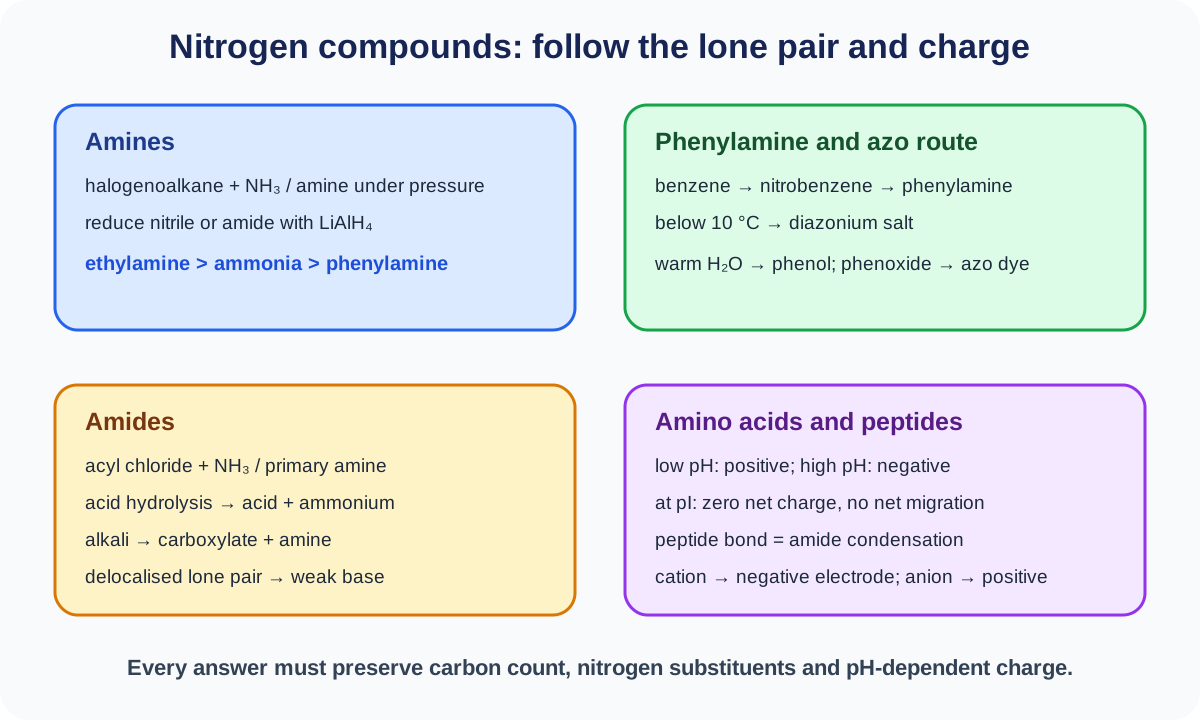
1. Primary amines from halogenoalkanes
Heat a halogenoalkane with excess ammonia in ethanol under pressure. Ammonia attacks the carbon bonded to halogen, and further proton transfer gives a primary amine.
Excess ammonia favours primary amine because the product amine is itself nucleophilic and can otherwise undergo further alkylation.
The sealed or pressurised condition prevents volatile ammonia from escaping during heating.
2. Secondary amines by alkylation
A halogenoalkane reacts with a primary amine in ethanol in a sealed tube or under pressure to form a secondary amine after proton transfer.
The primary amine nitrogen attacks through its lone pair. Track both carbon groups so the secondary product retains the original amine substituent and gains the halogenoalkane group.
Further alkylation remains possible, so product selectivity depends on reagent ratios and conditions.
3. Amines by reducing nitriles
Lithium aluminium hydride reduces a nitrile to a primary amine. Hydrogen with nickel can also perform the reduction.
The nitrile carbon becomes the carbon attached to the amino group, so cyanide substitution followed by reduction extends a carbon chain by one carbon relative to the original halogenoalkane.
Preserve carbon count when designing a synthesis route.
4. Amines by reducing amides
Lithium aluminium hydride reduces the carbonyl group of an amide to a methylene group and forms an amine.
Nitrogen substituents on the amide remain attached to nitrogen. A primary amide gives a primary amine, while an N-substituted amide gives the corresponding substituted amine.
Do not remove the carbonyl carbon; it remains in the product skeleton.
5. Amine basicity in water
An amine is a Bronsted-Lowry base because its nitrogen lone pair accepts a proton from water. An alkylammonium ion and hydroxide form.
The equilibrium position depends on lone-pair availability and stability of the protonated product. A base is not defined by containing hydroxide in its formula.
Write the reversible proton-transfer equation when explaining alkaline pH.
6. Amides from acyl chlorides
Ammonia or an amine reacts with an acyl chloride at room temperature through addition-elimination. Ammonia gives a primary amide; a primary amine gives an N-substituted amide.
Check this topic from memory
Attempt the matching topic bank before reopening the notes. Use each missed idea to decide what to review next.
Hydrogen chloride forms and is neutralised by excess ammonia or amine. The reaction joins nitrogen and acyl fragments and is described as condensation.
The carbonyl remains in the amide.
7. Preparing phenylamine
First nitrate benzene to nitrobenzene using concentrated nitric and sulfuric acids. Reduce nitrobenzene with hot tin and concentrated hydrochloric acid.
Acidic reduction initially gives a phenylammonium salt. Add aqueous sodium hydroxide to liberate phenylamine.
The alkaline work-up is required; stopping after tin and acid does not give the free amine as the final isolated form.
8. Phenylamine with bromine water
Phenylamine reacts rapidly with aqueous bromine at room temperature to form 2,4,6-tribromophenylamine. Bromine water decolourises and a pale precipitate forms.
The amino lone pair donates electron density into the ring, strongly activating it and directing substitution to positions 2, 4 and 6.
No aluminium bromide catalyst is needed.
9. Diazotising phenylamine
Phenylamine reacts with nitrous acid, generated from sodium nitrite and dilute acid, below 10 degrees Celsius to form a benzenediazonium salt.
Low temperature limits diazonium decomposition. Further warming with water replaces the diazonium group by hydroxyl, producing phenol and nitrogen gas.
Separate the cold formation stage from the warm hydrolysis stage.
10. Ammonia, ethylamine and phenylamine basicity
Ethylamine is more basic than ammonia because the ethyl group donates electron density inductively, making the nitrogen lone pair more available for proton acceptance.
Phenylamine is less basic than ammonia because its lone pair is delocalised into the benzene ring and is less available to bond to a proton.
The required aqueous order is ethylamine, then ammonia, then phenylamine from strongest to weakest base.
11. Azo coupling
Benzenediazonium chloride couples with phenol in aqueous sodium hydroxide to form an azo compound. Alkali produces phenoxide and activates the aromatic ring toward coupling.
The azo group is the nitrogen-nitrogen double-bond linkage between carbon-containing groups. Extended conjugation allows absorption in the visible region, so azo compounds are often dyes.
Changing the diazonium or coupling component creates other azo dyes by the same route.
12. Amide preparation
Ammonia with an acyl chloride at room temperature produces a primary amide. A primary amine produces an N-substituted amide.
In each case, nitrogen attacks the carbonyl carbon, the tetrahedral intermediate eliminates chloride and proton transfer completes the product.
Account for an additional base molecule where the full equation includes ammonium salt formation.
13. Acid hydrolysis of amides
Heating an amide with aqueous acid breaks the carbon-nitrogen bond and forms a carboxylic acid plus an ammonium ion or substituted ammonium ion.
Acid protonates the nitrogen-containing product, so do not write the free amine as the final species in strongly acidic solution.
Hydrolysis reverses amide formation at the connectivity level but uses water and forcing conditions.
14. Alkaline hydrolysis of amides
Heating with aqueous alkali gives a carboxylate salt and ammonia or an amine, depending on nitrogen substitution.
The carboxylic acid is deprotonated under alkaline conditions. Acidification is needed if the free carboxylic acid is required.
Product protonation state must follow the reaction medium.
15. Reducing amides
Lithium aluminium hydride replaces the amide carbonyl oxygen effectively with hydrogen, producing an amine while retaining the carbonyl carbon as methylene.
This route differs from hydrolysis because the carbon-nitrogen bond remains. It is a useful way to make amines with defined carbon and nitrogen substitution.
Audit every carbon before and after the reduction.
16. Why amides are weak bases
The nitrogen lone pair in an amide is delocalised toward the adjacent carbonyl group. Resonance gives partial double-bond character to the carbon-nitrogen bond and makes the lone pair less available for proton acceptance.
Amides are therefore much weaker bases than amines, whose lone pair is not tied to a carbonyl in the same way.
Do not explain the difference only by electronegativity; conjugation is central.
17. Amino acids as acids and bases
An amino acid contains an acidic carboxyl group and a basic amino group. It is amphoteric and can react with both acids and bases.
Internal proton transfer produces a zwitterion containing positively charged ammonium and negatively charged carboxylate groups but zero overall charge for a neutral side chain.
The dominant form depends on pH and side-chain ionisation.
18. pH and amino-acid charge
At low pH, protonation predominates and a simple amino acid has net positive charge. At high pH, deprotonation predominates and it has net negative charge.
Between these limits, the zwitterion may dominate. Apply acid-base equilibria to every ionisable group rather than memorising one formula for all pH values.
Side chains can add further positive or negative sites when the structure is supplied.
19. Isoelectric point
The isoelectric point is the pH at which the amino acid or peptide has zero net charge on average. At this pH it shows no net migration in an electric field.
Zero net charge does not mean no formal charges; a zwitterion can contain both positive and negative centres.
The isoelectric point is specific to structure and is not automatically pH 7.
20. Peptide-bond formation
The carboxyl group of one amino acid condenses with the amino group of another, eliminating water and forming an amide, or peptide, bond.
Two amino acids form a dipeptide with one peptide bond. Three residues form a tripeptide with two peptide bonds when connected linearly.
Sequence matters: reversing residue order gives a different peptide connectivity.
21. Drawing dipeptides and tripeptides
Retain one N-terminus and one C-terminus. Join the carbonyl carbon of one residue to the nitrogen of the next and remove hydroxyl plus hydrogen as water.
Preserve each side chain on its original alpha carbon. Count atoms to verify the stated number of water molecules lost.
Do not create a carbon-nitrogen bond between side chains unless the question explicitly provides such chemistry.
22. Electrophoresis principle
Charged amino acids and peptides migrate in an electric field. Cations move toward the negative electrode, while anions move toward the positive electrode.
At the isoelectric point, a species has no net migration. Distance can also depend on charge magnitude, size and experimental conditions, so charge establishes direction more reliably than exact distance.
The apparatus assembly is excluded, but interpretation is required.
23. Predicting electrophoresis at varying pH
Compare solution pH with the species' isoelectric point. Below its isoelectric point it is more protonated and tends to be positive; above it, more deprotonated and tends to be negative.
For mixtures, assess each amino acid or dipeptide separately. Two species can migrate in opposite directions or one can remain near the baseline.
Electrode signs must be stated explicitly rather than inferred from left or right on an arbitrary diagram.
Worked application: route, basicity and electrophoresis audit
A synthesis converts bromoethane to propan-1-amine by aqueous cyanide substitution followed by nitrile reduction with lithium aluminium hydride; the nitrile carbon supplies the extra carbon. For a basicity comparison, ethylamine is stronger than ammonia because its ethyl group donates electron density, while phenylamine is weaker because its lone pair is delocalised into the ring. In an electrophoresis mixture at pH below one amino acid's isoelectric point but above another's, the first is net positive and migrates to the negative electrode, while the second is net negative and migrates to the positive electrode. A species exactly at its isoelectric point remains near the application point even though its zwitterion still contains formal charges.
Common misconceptions and corrections
Heating ammonia in an open vessel. Use pressure or a sealed system.
Using limited ammonia for a primary amine. Excess suppresses further alkylation.
Losing the original amine substituent during secondary-amine formation. It remains on nitrogen.
Forgetting nitrile chain extension. The nitrile carbon enters the product.
Removing the carbonyl carbon during amide reduction. It becomes methylene.
Defining an amine base by hydroxide content. Its lone pair accepts a proton.
Using cold tin and acid for nitrobenzene reduction. The stated route is hot.
Omitting sodium-hydroxide work-up. Acid reduction gives a phenylammonium salt first.
Requiring aluminium bromide for phenylamine. Bromine water reacts directly.
Predicting monobromination only. The named product is 2,4,6-tribrominated.
Diazotising above 10 degrees Celsius. Keep the diazonium-forming stage cold.
Warming diazonium salt and expecting an azo dye automatically. Water gives phenol; coupling needs activated phenol.
Ranking ammonia above ethylamine. The ethyl group increases lone-pair availability.
Ranking phenylamine above ammonia. Ring delocalisation decreases availability.
Calling any nitrogen-nitrogen bond azo. The group is the double-bond linkage.
Explaining azo colour without conjugation. Extended delocalisation enables visible absorption.
Losing the carbonyl in amide formation. It remains.
Writing a free amine after strongly acidic amide hydrolysis. It is protonated.
Writing a free carboxylic acid after alkaline hydrolysis. It is a carboxylate until acidified.
Calling amide reduction hydrolysis. The carbon-nitrogen bond is retained.
Saying amides have no nitrogen lone pair. It is delocalised and less available.
Calling a zwitterion uncharged at every atom. It contains opposite formal charges.
Assuming every amino acid has zero net charge at pH 7. Charge depends on structure and pH.
Defining isoelectric point as neutral pH. It is structure-specific.
Saying a dipeptide has two peptide bonds. It has one.
Ignoring peptide sequence. Reversed order changes connectivity.
Losing side chains when drawing a peptide. Retain each on its alpha carbon.
Sending cations to the positive electrode. They move to the negative electrode.
Saying a species at its isoelectric point has no formal charges. It may be zwitterionic.
Using migration distance as charge alone. Size and conditions also matter.
Assessment guidance
Route questions should track carbon count, nitrogen substituents, reagents and pressure or reduction conditions. Basicity explanations require lone-pair availability: alkyl donation strengthens ethylamine, aromatic delocalisation weakens phenylamine and carbonyl delocalisation makes amides much weaker. Keep cold diazotisation, warm hydrolysis and alkaline azo coupling distinct. Amide hydrolysis products must match acidic or alkaline protonation states. For amino acids, draw charge forms at the stated pH, define isoelectric point by zero net charge, construct peptide bonds with correct sequence and use net charge to predict migration toward the oppositely charged electrode.
Retrieval practice
Build primary and secondary amines from all four official route types and compare their carbon counts. Reconstruct phenylamine preparation, bromination, diazotisation, hydrolysis and azo coupling, then rank aqueous basicity. Draw acid and alkaline amide hydrolysis plus lithium-aluminium-hydride reduction. Finally, generate amino-acid charge forms across pH, assemble dipeptides and tripeptides in both sequences and interpret an electrophoresis mixture relative to each species' isoelectric point.